
Alongside some things in my personal and academic life, these past few months have involved for me a lot of adjusting to Pope Leo’s teaching style. I’ve been trying to figure out the best way to approach blogging here, with a contemplative focus, as he instructs, leads, and suggests. There are certainly a lot of things that I’ve missed—some less relevant to the topic of contemplation on the roads and in the mud, others more relevant—but in the past two days, a few remarks have been made that brought me back into my old spirit.
Meeting in Rome with the cardinal brothers to whom he keeps appealing for help in discerning and building, Pope Leo outlined four interrelated themes. He started the list thus:
First of all, we are invited to contemplate the world in which the Church is called to proclaim the Gospel. Before asking ourselves what to do, we must pause to consider reality, looking at it through the eyes of faith and allowing ourselves to be challenged by listening to our brothers and sisters. (Leo XIV, Opening Address of the Ordinary Consistory, 26 June 2026)
Although the other points—power and love in society, synodality and responsibility in light of his recent encyclical Magnifica Humanitas, and a summative consideration of synodality—are important, the pan-American pope starts with something that has to be done “first of all.” And that’s an act of contemplation, emanating from an attitude of contemplation.
The contemplation in question, however, isn’t straightforwardly the contemplation of the Creator, the Trinitarian Persons, or the historical Humanity of Jesus in Palestine. Rather, it’s contemplation of “the world in which the Church is called to proclaim the Gospel.” This is attained by looking straight at “reality” and being “challenged by listening to our brothers and sisters.” This is good. But it won’t be contemplation without another dimension added to it. These things have to happen in faith. We have to look at all this “through the eyes of faith”—and hear our human siblings with ears of faith and probably also have contact with them through the hands of Christ.
Contemplation has to happen in the places that we might call muddy and pedestrian. It has to happen on the streets. In fact, this isn’t just my spin on things. Pope Leo’s address to the cardinals goes on to quote his own words from his apostolic voyage to Spain:
Jesus travels the streets, crosses the squares and visits our neighborhoods, dwelling in the settings of our daily lives. He is a God who is close to us, who walks with his people, the Lord of history. (Leo XIV, Homily in Plaza de Cibeles, Madrid, 7 June 2026)
This is where faith comes in. It’s Christ in, through, behind, and among the people and places that allows this contemplation to be in faith. There’s a lot to unpack here. But I’d note at least two things. First, Leo is drawing on the notion of Christ as Lord of history. In his first apostolic exhortation, he’d said:
Love for the Lord, then, is one with love for the poor. The same Jesus who tells us, “The poor you will always have with you” (Mt 26:11), also promises the disciples: “I am with you always” (Mt 28:20). We likewise think of his saying: “Just as you did it to one of the least of these brothers and sisters of mine, you did it to me” (Mt 25:40). This is not a matter of mere human kindness but a revelation: contact with those who are lowly and powerless is a fundamental way of encountering the Lord of history. In the poor, he continues to speak to us. (Leo XIV, Apostolic Exhortation Dilexi Te [4 October 2025], 5)
I’ve written on this before, so I’ll just leave the connections to ruminate.
Second, Leo is alluding here to some comments of Pope Francis that I’ve found very aptly put. The Argentinian pontiff, in words delivered to a group in Seville, remarked how “it is the beauty of Christ that summons us, calls us to be brothers and sisters and urges us to take Christ out into the streets, to bring him to the people, so that everyone can contemplate his beauty” (Francis, Message to the International Congress of Fraternity and Popular Piety, Seville, 5 December 2024). I’ve likewise written on this before.
On that occasion, Pope Francis drew attention to how the love that touches the other person is “the same love, the same hidden charity that we find in the tabernacle.” Well, when Pope Leo was in Spain, he spoke these words immediately after telling us that Jesus travels the streets:
The Christ who processes through the streets in the monstrance is the same one who identifies with the poor, the downtrodden, those who are alone and forsaken. (Leo XIV, Homily in Plaza de Cibeles, Madrid, 7 June 2026)
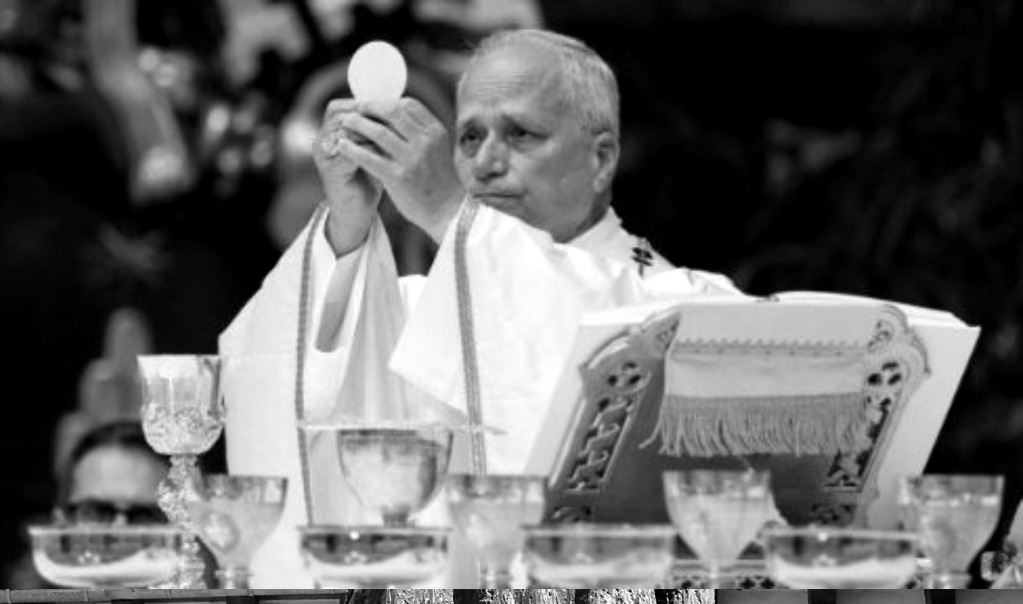
Tabernacle, monstrance—the notes are the same. What is essential in the thoughts of both popes here is that the Eucharistic Jesus is not cordoned off from Jesus present in those who are pushed to the sidelines. Indeed, in Madrid, Pope Leo had also said:
Let us drink anew from this Eucharistic spring, which does not enclose us in private devotion, but sends us out to refresh our brothers and sisters, our families, the poor, the suffering, and those who have lost hope. Eucharistic grace transforms us and makes us protagonists of the transformation of history, a sign of hope for those we meet. (Leo XIV, Homily in Plaza de Cibeles, Madrid, 7 June 2026)
Christ is there. But he’s also—again—the Lord of history, which enables this path, walked well and together, to transform history.
Of course, we have at this point hit virtually all the major notes of this blog: contemplation in its various forms, contemplation in faith of the other person, the particularity and unsurpassable directionality of this contemplation when the other lies at the margins, intimacy and interconnection with the Eucharist, action and contemplation. But there is perhaps another that one might add. It’s dear enough to me, too. That’s the connection between us humans and our common home. To round things out, I’d indicate that Pope Leo has not forgotten this whole world of meaning. The day prior to the opening of the Consistory, he gave a different address:
Sport is also an opportunity for spiritual growth. Swimming, in this regard, has something special about it. Indeed, we practise it while being immersed in an element – water – that surrounds us. This symbolically recalls an aspect that has been part of us since our mother’s womb: to live means learning to move in harmony with others and with the environment around us. For us Christians, moreover, water is a symbol of Baptism and of new life in Christ. (Leo XIV, To Members of the Italian Swimming Federation, 25 June 2026)
This is a fascinating use of imagery. It links together several things: humanity in its historical reality (the process of gestation and birth), the created world in all its parts and relations (harmonious living), and the use of creation in sacramental rejuvenation (baptismal symbolism). Here, too, everything is connected.
So, here we’ve run—or swum—pretty much the whole race. To the various forms of contemplation and the priority of it taking place on the streets, with Eucharistic devotion, and in transformative action, we’ve added the profound and inescapable intertwining of creation and redemption, with all that that means for our common home and for a humanity that grows ever closer together and ever more fragmented at the same time.
All of this may not be the whole thing. But it does come, as the Holy Father says, first of all.


