
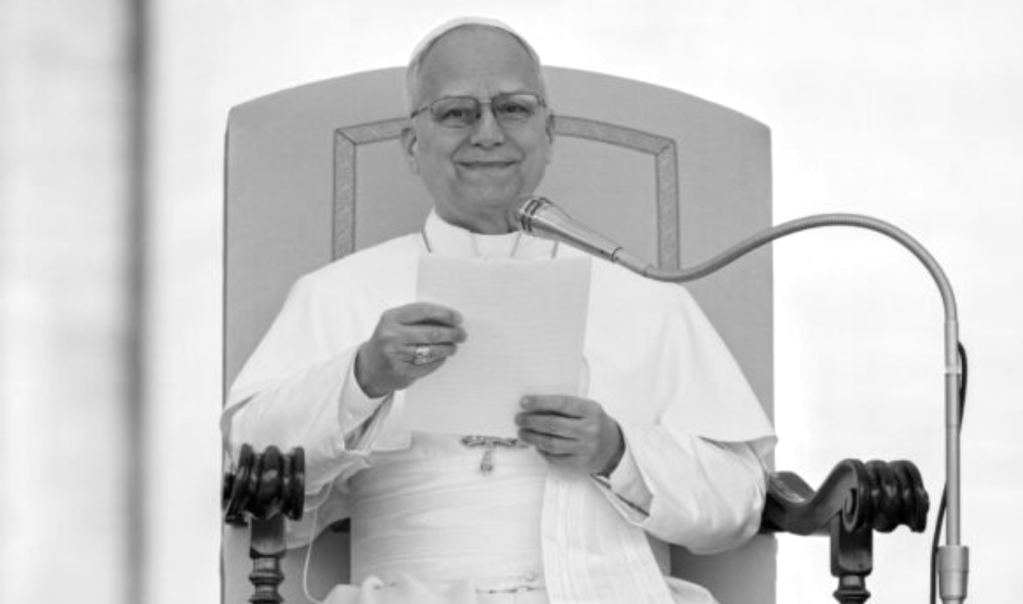
At his General Audience yesterday, Pope Leo said some things that are, I think, quite hard for a contemplative soul to ignore. Moving through the documents of the Second Vatican Council, the Holy Father has come to some gritty questions about who or what the Church is. Much of the discussion stays pretty faithful to the text of Lumen Gentium, if not to its most common and popular interpretations.
Towards the end of his address, however, Leo identifies the holiness of the Church in a very particular way. The words are interesting. I want to quote them at length:
This is what constitutes the holiness of the Church: the fact that Christ dwells in her and continues to give himself through the smallness and fragility of her members. Contemplating this perennial miracle that takes place in her, we understand ‘God’s method’: He makes himself visible through the weakness of creatures, continuing to manifest himself and to act. For this reason, Pope Francis, in Evangelii gaudium, exhorts us all to learn “to remove our sandals before the sacred ground of the other (cf. Ex 3:5)” (no. 169). This enables us still today to build up the Church: not only by organizing its visible forms, but by building that spiritual edifice which is the body of Christ, through communion and charity among ourselves.
Indeed, charity constantly generates the presence of the Risen One. “If only we could all just let our thoughts dwell on the one thing, charity! It’s the only thing, you see, which both surpasses all things, and without which all things worth nothing, and which draws all things to itself, wherever it may be” ([Augustine’s] Sermon 354, 6, 6).
There are a few things that stand out to me here.
First, note that Pope Leo says that sites of littleness and fragility are integral to the sacred constitution of the Church. Without them, the Church just isn’t the Church. And I guess it just isn’t holy. Ecclesial holiness exists precisely because of the indwelling of Christ in human smallness. The sacrality of the Church is manifest in the co-presence of the risen Jesus and our fragility.
Both of these statements are worth reflecting on, but it is the latter statement which, I think, is especially interesting. It is reminiscent of something that Pope Francis said about a year ago. When he reorganized the Diocese of Rome in the apostolic letter La Vera Bellezza, he centred everything around contemplation and the mysterious beauty of Christ. He spoke there not only of beauty in general. Rather, he told us that vulnerability is another expression of beauty. In vulnerability, said Francis, the Church offers something to contemplate. In fragility, echoes Leo, we have an ecclesial dimension to contemplate. Fragility, vulnerability—indeed, it is the same Italian word being used (la fragilità).
Second, it is worth remarking that Pope Leo exhorts us to “[c]ontemplat[e] this perennial miracle that takes place in [the Church]” so that we can thereby “understand ‘God’s method’.” Like the diocese-reorganizing apostolic letter written by the Argentinian pontiff before him, this address of the U.S. American pontiff emphases contemplation. This isn’t just about action; it’s about how we see things. There are not just running about and acts of making charity tangible; there are important moments of sitting and wondering at the charity that God has put before our eyes.
Third, Pope Leo tells us that the Church is helped along “not only by organizing its visible forms” (but that there’s something else too). This confirms the background with which he is working. The “organization” language is clearly a callback to La Vera Bellezza, i.e., the recent reorganization of the Diocese of Rome. So again, it’s not incorrect to recall the Bergoglian claim that vulnerability is another reality to contemplate and act from within and for the sake of. Of course, we do reorganize. We do work with visible structures. But we don’t do only that. We do much more: we find charity coming out of vulnerability, and we go to meet it ourselves.
As with Francis, we are at the antipodes from a modern-day Pelagianism. It’s not just the case that acts of help offered to the fragile and the vulnerable show us the charity and beauty of God. Charitable works are beautiful. They do show us the hands of Christ. But they only exist because, at a prior level, Christ is present in the fragility, in the vulnerability, in the smallness, in the weakness. God is there “continuing to manifest himself and to act.” We can’t deny the prior activity of God. It’s there. If we want to be faithful to the Lord’s gifts, we have to appreciate the divine presence with a contemplative disposition. We have to, as Leo quotes Francis as saying, take off our footwear and wonder at the mysterious other.
Since God is already there, we also recognize that there is a preferential option for communion—and communion must include, if not favour, all the places of fragility and littleness in which the holiness of the Church shines through. After all, those are places where God is already at work. Before we’ve arrived, God has; God is.
If we take all this seriously, it sounds very much like Pope Francis’ claim to find beauty in vulnerability. The form of charity that Leo envisages is not mere works-activism. We have to contemplate the Crucified and Risen One present in what seems to our all-too-human eyes to be mere nothingness. The Church is holy because of the double-reality of smallness and divinity. It is a sacred reality manifest in historical time because of the binding of fragility and grace. That is the Church we belong to. It’s the creation of the God we, along with the Church, believe in.


