
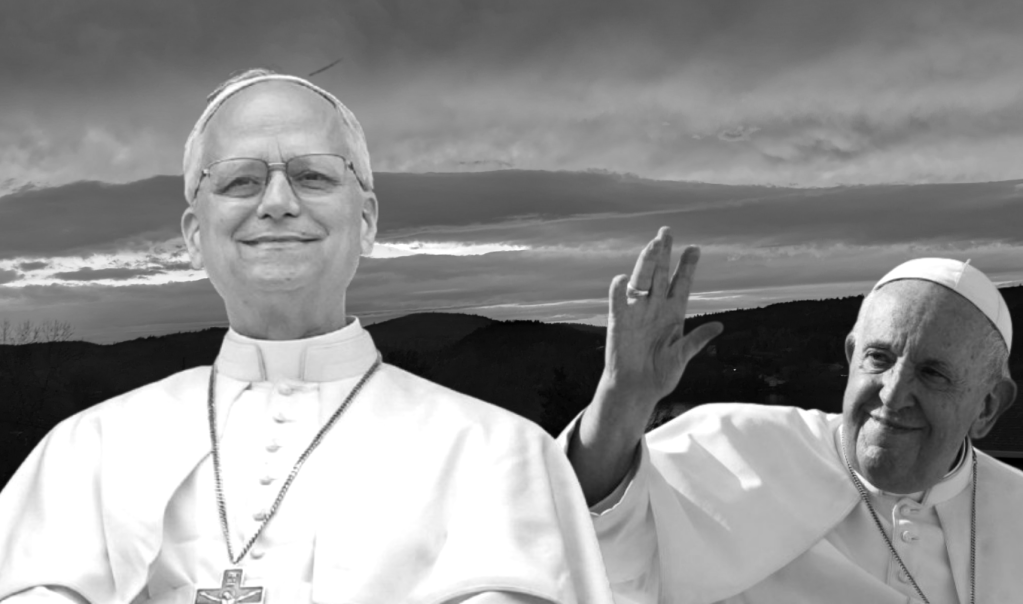
Apparently Pope Leo can turn anything into a meditation on our common home or discourse on Christian contemplation. And sometimes he is open to doing both at once. That’s what happened this week.
Pope Leo’s teaching
Wednesday’s general audience is a remarkable one. Although the Gospel text for his catechesis pertains to the Resurrection of Christ, Pope Leo takes an entirely unanticipated approach. He turns it into—or rather, finds within the pages of Scripture—a reflection on “ecological conversion, which Christians cannot separate from the reversal of course that Jesus asks of them.” Conversion is an issue of the heart. It’s a spiritual matter. Accordingly, says Leo, an incarnate spirituality should lead the way:
Paradise is not lost, but found again. In this way, the death and resurrection of Jesus are the foundation of a spirituality of integral ecology, outside of which the words of faith have no hold on reality and the words of science remain outside the heart. (General Audience, 19 November 2025)
To develop his argument (or apostolic teaching), the Holy Father then quotes his predecessor’s encyclical letter on care for our common home:
Ecological culture cannot be reduced to a series of urgent and partial responses to the immediate problems of pollution, environmental decay and the depletion of natural resources. There needs to be a distinctive way of looking at things, a way of thinking, policies, an educational programme, a lifestyle and a spirituality which together generate resistance. (Laudato Si’, 111)
This lifestyle and spirituality, however, are not matters of action. Leo is convinced that they are matters of contemplation. He remarks:
Pope Francis, with the Encyclical Laudato si’, showed us the extreme need for a contemplative gaze: if he is not the custodian of the garden, the human being becomes its destroyer. Christian hope therefore responds to the challenges to which all humanity is exposed today by dwelling in the garden where the Crucified One was laid as a seed, to rise again and bear much fruit. (General Audience, 19 November 2025)
This is major, huge, groundbreaking—in no small part because Papa Francisco never used the phrase extreme need.
There are a few points worth drawing out. First, there is an important connection between this short address and some previous, extra-Vatican ponderings of the pope. In July, during the first Mass for the Care of Creation at Castel Gandolfo, Leo had already said this:
Only a contemplative gaze can change our relationship with created things and lead us out of the ecological crisis caused by the breakdown of relationships with God, with our neighbors, and with the earth, due to sin (cf. Pope Francis, LS 66).
Well, in light of this week’s papal activities, we can say that it is not just the case that “[o]nly a contemplative gaze” is capable of changing our relationship with creation, but there is urgency to become immersed in this gaze. There is an extreme need—perhaps in more fluid English, a pressing and widespread need—for it. That is part of this week’s message.
Another dimension of Leo’s most recent catechesis is that “if he is not the custodian of the garden, the human being becomes its destroyer.” This speaks to the power of contemplation to change us from within. Contemplation adjusts attitudes. It changes perceptions. Without it, all is lost. I think this can be hard to understand in our contemporary Western culture. But perhaps what we mean by a contemplative custodian can be better understood by turning to Leo’s own teacher, Francis.
Pope Francis’ teaching
Pope Francis insisted on the contemplation of the world created by God. In his own audiences, he said, “The best antidote against this misuse of our common home is contemplation” (General Audience, 16 September 2020). His catechesis also contains the following exhortation:
[I]t is important to recover the contemplative dimension, that is, to look at the earth, creation, as a gift, not as something to exploit for profit. When we contemplate, we discover in others and in nature something much greater than their usefulness. Here is the heart of the issue: contemplating is going beyond the usefulness of something. Contemplating the beautiful does not mean exploiting it: contemplating is free. We discover the intrinsic value of things given to them by God. (General Audience, 16 September 2020)
What should be noted in the present context is that Pope Leo has taken these comments on contemplation being the best antidote and having a high importance, and then he has modified them: first, by shifting the wording such that contemplation is announced as the only means available for a change of course; second, by moving a step ahead and declaring the extreme need for contemplation with which we are faced. These changes are in continuity with the magisterial teaching of the last Bishop of Rome. But they are certainly a development.
At any rate, to understand Leo, we can still look at Francis. For him, contemplation necessarily implies an attitude of care. This is just how reality works when it is viewed through Bergoglian eyes. The same papal catechesis teaches:
Contemplation, which leads us to an attitude of care, is not a question of looking at nature from the outside, as if we were not immersed in it. But we are inside nature, we are part of nature. Rather, it is done from within, recognizing ourselves as part of creation, making us protagonists and not mere spectators of an amorphous reality that is only to be exploited. Those who contemplate in this way experience wonder not only at what they see, but also because they feel they are an integral part of this beauty; and they also feel called to guard it and to protect it. And there is one thing we must not forget: those who cannot contemplate nature and creation cannot contemplate people in their true wealth. And those who live to exploit nature end up exploiting people and treating them like slaves. This is a universal law. If you cannot contemplate nature it will be very difficult for you to contemplate people, the beauty of people, your brother, your sister. (General Audience, 16 September 2020)
At this point, it is worth noting that the Argentinian pontiff is here cribbing from his post-synodal apostolic exhortation on Amazonia. But he’s applying it to the whole Church.
To Pope Francis’ mind, it is quite difficult for us Westerners to learn the contemplation of the natural world. We are shackled with a certain lack of mental and affective development in this area. This does not, however, leave us without a solution. We can put ourselves in a position of vulnerable learning with respect to some whom we have historically—and for the most part contemporaneously—treated as inferior:
From the original peoples [i.e., Indigenous peoples], we can learn to contemplate the [earth] and not simply analyze it, and thus appreciate this precious mystery that transcends us. We can love it, not simply use it, with the result that love can awaken a deep and sincere interest. Even more, we can feel intimately a part of it and not only defend it; then the [earth in our own region] will once more become like a mother to us. (Apostolic Exhortation Querida Amazonia, 55)
The late pope then enjoins us to “awaken our God-given aesthetic and contemplative sense that so often we let languish” (QA 56). Contemplation, as he always taught, is a matter not of the intellect alone or of loving alone, but a matter of beauty, i.e., an envelopment in and appreciation of someone/something as an end in themselves/itself. Contemplation involves knowing the other and loving the other, not as a means to an end, but in themself/itself. This necessarily entails a sense of belonging. A sense of belonging touches not on abstract principles but on the particular, the immediate, the tangible. Such an attitude of particular belonging is very much exemplified in the relationships that Indigeous peoples have with creation.
According to Pope Francis, the earth in its—or, as he allows us to say, her—particularity and local generosity is “a theological locus, a space where God himself reveals himself and summons his sons and daughters” (QA 57). That being the case, what we contemplate behind or with nature is the Creator himself. This is truly a Christian contemplative gaze. It is wholly evangelical (cf. LS 96–100). Grateful contemplation of creation is not a pale imitation of the real deal.
Being centred on the God of the Gospel, contemplation of creation is connected to the ever-present, ever-needed Christian ministry of prophecy (cf. the section title for QA 53–57). When Pope Francis exhorts us to “a prophetic and contemplative lifestyle, one capable of deep enjoyment free of the obsession with consumption” (LS 222), he is using “prophetic and contemplative” in a synonymous or mutually reinforcing sense. Prophecy generates a shift in assessment. It looks at things as they really are, underneath the appearances that are foisted on them by the empires of this world. Contemplation is prophetic, and prophecy when it is fully itself is contemplative.
Of course, it is for all these reasons that Pope Francis proposed grateful contemplation of creation as a spiritual work of mercy; it addresses the most general object of mercy, which is human life itself and all its relationships (Message for the 2016 World Day of Prayer for the Care of Creation). I’ve discussed this at length before. But it’s worth mentioning in passing—and for a conclusion. Contemplation is mercy. It is the way out.
In fact, given the teaching of Pope Leo already this year, I can say that again with a different emphasis.
Contemplation is mercy. It is, accordingly, the way out. It is a spiritual disposition and commitment for which we have an extreme need. May God grant the rain and the harvest.


 Contemplative in the Mud