
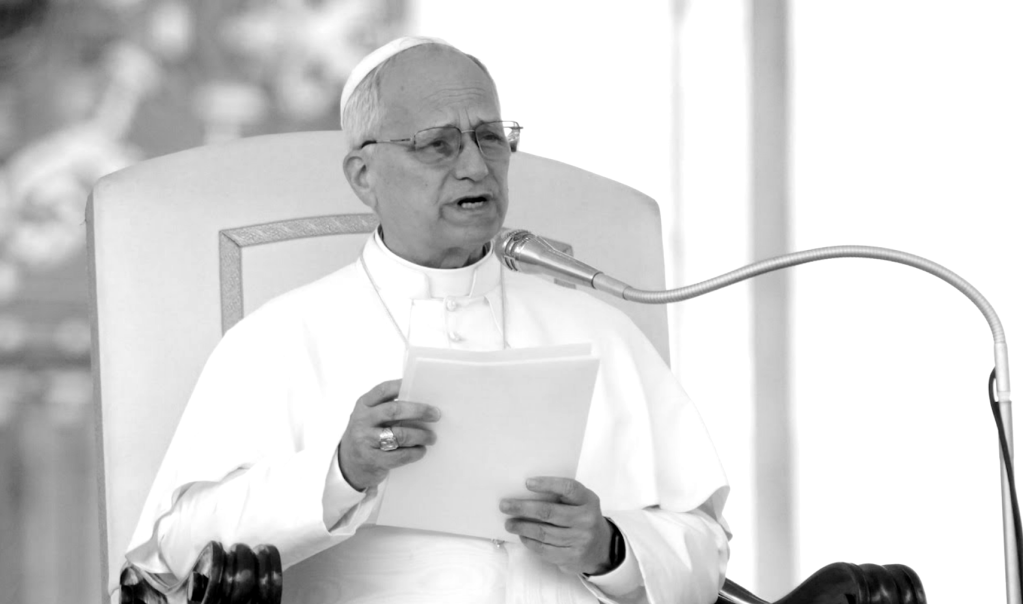
On Saturday, Pope Leo gave an address to Italian hermits who were in Rome participating in the Jubilee of Consecrated Life, and I think that the words he offered are particularly appropriate to draw out of their context and into the ambience of contemplative life in the world more generally.
Speaking of the proposal in the Sermon on the Mount that we go into our room, shut the door, and pray to our Father in secret, the Holy Father remarks:
First of all, the Lord calls us to enter this hidden place of the heart, patiently delving into it; he invites us to make an inner immersion that demands a journey of emptying and divesting ourselves. Once we have entered, he asks us to close the door to bad thoughts in order to safeguard a pure, humble and meek heart, through vigilance and spiritual combat. Only then can we abandon ourselves with confidence to intimate dialogue with the Father, who dwells and sees in secret, and in secret fills us with his gifts.
He then continues:
You, as hermits, are called to live this vocation to worship and inner prayer, proper to every believer, in an exemplary way, in order to be witnesses in the Church to the beauty of the contemplative life. It is not an escape from the world, but a regeneration of the heart, so that it may be capable of listening, a source of the creative and fruitful action of the charity that God inspires in us. This call to interiority and silence, to live in contact with oneself, with one’s neighbour, with creation and with God, is needed today more than ever, in a world increasingly alienated by the media and technology. From intimate friendship with the Lord, in fact, the joy of living, the wonder of faith and the taste for ecclesial communion are reborn.
According, then, to Pope Leo, the contemplative life does not exist as an escape hatch. It exists as a space of new growth and rejuvenation. Its purposes are numerous; among them is the fact that Christian contemplation increases our ability to listen to and accompany others, as well as to act in love for and with them.
Pope Leo also remarks that “distance from the world does not separate you from others, but unites you in a deeper solidarity.” This, of course, he aims at the diocesan hermits who are in the room with him. But it’s a good remark in general. It makes me think of all the controversy surrounding people who wanted to be more Catholic than the pope and more contemplative than a Carmelite. It doesn’t take much familiarity with contemplative literature to realize that contemplation is supposed to enhance relationships and activity within them, not subtract from these.
Accordingly, Pope Leo reminds us that one must “live in contact with oneself, with one’s neighbour, with creation and with God.” He uses a quadripartite description of Christian relationship that is reminiscent of Pope Francis. We might describe these as four loci of meditation and restful contemplative gaze. At any rate, they are four different relationships that must be lived in a good way and which silence, listening, and a regard for beauty will improve.
Indeed, Leo says that one of the most notable paths for this inner life is “safeguarding the Word, through the lectio divina and the service of prayer and intercession with the prayer of the Psalms.” This gives so much foundation to the four relationships. It also supplies dynamism—and no less than when one is “called to dialogue with all seekers of meaning and truth, educating you in sharing and guiding their spiritual quest, often confused.” Even hermits have an important social role that is, I dare say, rather active.
I would recommend reading this address in its entirety. Much of it is, of course, particular to the eremitical life. But the Holy Father closes with an exhortation that strikes me as an incredibly powerful reminder that all Christians—all of us called to be with our loving Father clauso ostio and also to meet this world where it is—are some kind of standing delegates to prayer and living, if partially broken, bridges between worlds:
Called to stand in the breach, with your hands raised and your hearts alert, walk always in the presence of God, in solidarity with the trials of humanity. Keeping your gaze fixed on Jesus and opening the sails of your hearts to his Spirit of life, sail with the whole Church, our mother, on the stormy sea of history, towards the Kingdom of love and peace that the Father prepares for all.

 Contemplative in the Mud