
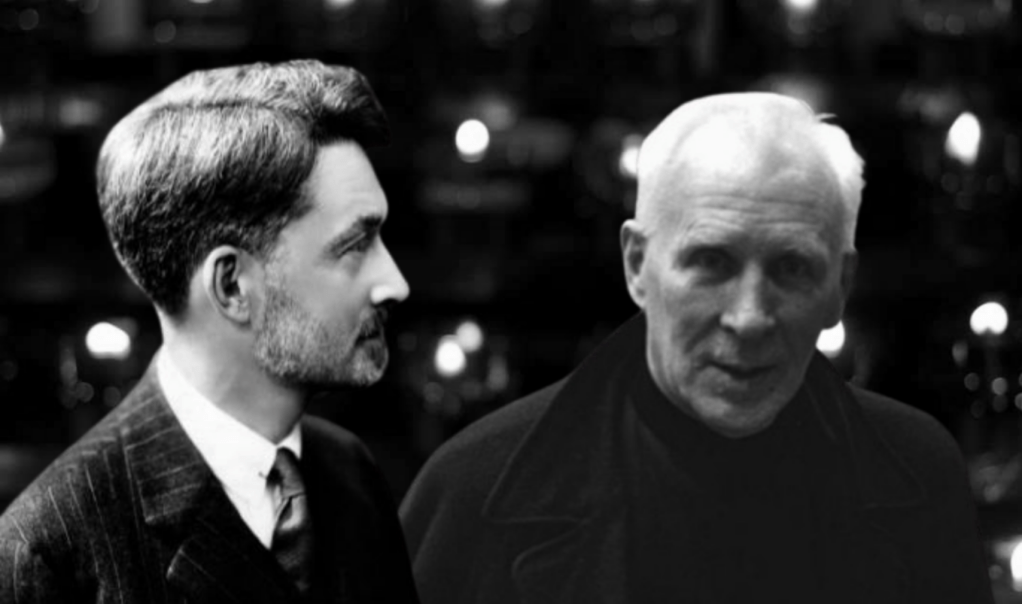
… run the other way. I know, this seems like an innocuous point of trivial theologizing. But there is a significant history and context to this debate. A similar debate happened last in the 1930s–’50s. The positions that the different sides took directly paralleled their stances on those decades’ extreme right-wing politics, i.e., fascism.[1]
But first—where we are today.
A story of a Catholic Media Personality
In the past week, a Catholic Media Personality of vast reach has decided to podcast about how God loves some people more than others. The first prong of his argument is that God loves us more than he loves a rock, because the nature of a rock is less exalted than the nature of a human being. There is less to love, there is more to love; God loves less, God loves more. This claim might seem innocent enough. But in his podcast the bigshot Catholic Media Personality immediately adds a comment about how we shouldn’t get big-headed about this. After all, he claims, God loves the angels more than he loves human beings. The Catholic Media Personality is confident about this claim; he repeats it later in the podcast. His logic is that angels are of a higher nature than we are, so there is more of them to love, God has willed them to be more, God loves them more.
In other words, the famous Catholic Media Personality asserts that God’s love for a created being can be inferred from the goodness in/of the being. Goodness in/of creatures implies how much God wills their good. It implies how much God loves them as creator and initiator of all that is good. That’s Claim #1.
To this, the Catholic Media Personality adds a Claim #2: The goodness in/of a being can somehow be inferred from the goodness of its nature or position. Without the second claim, it doesn’t make much sense to assert that God loves the angels more than he loves us. The point is that they are higher than us, therefore God loves them more. This is evidently some claim about their superior nature or hierarchical status. It certainly isn’t a claim about the free will of angelic beings, because it’s perfectly feasible that a particular angelic will responded less freely and fully to God’s friendship and beauty than you or me—or the Blessed Virgin. And it even more certainly isn’t a claim about angels instantiating Gospel littleness. The point is about natural hierarchy.
What the Magisterium teaches
The first problem with the teaching of the Catholic Media Personality is that, even if Claim #1 can be considered legitimate theological reflection, it’s not what the Catholic Church goes out of its way to teach. What the Magisterium teaches is that “God loves every man and woman with an infinite love” (Fratelli Tutti 85). The Church insists on stressing the infinite love of God directed at each and every human person.
In fact, we can do even better. The Magisterium challenges us to dislodge any undue anthropocentrism. Pope Francis teaches that “God our Father… created each being in the universe with infinite love” (Querida Amazonia 57). God loves every created being with an infinite love. Not just men and women. Not just created persons, i.e., humans and angels. No. The Trinity loves animals, plants, stars, and even those lowly rocks with the infinite love that is God’s very self.
This is a great mystery, and the Catholic Media Personality ignores it. Such a presentation is clearly unbalanced. It misrepresents what the Church teaches. Even if there is some fancy, hairsplitting philosophical parlance in which we can say that some things are better than others and therefore we infer that they are loved by God more than others, the Magisterium stresses that God’s love is an infinite love which is directed towards every person—indeed every created being. Sure, this could be a two-sides-of-the-same-coin issue. But even if both sides of the coin are valid currency, the Church today emphasizes the opposite truth from the Catholic Media Personality. That’s important. It’s not without reason. There is, I am going to show, a sound historical basis for the Magisterium’s choice.
The last proxy war
We have had a debate like this before, and its purpose at this kairos should become clearer to everyone. In the 1930s–’50s, an angelology debate similar to Claim #2 was in many regards a proxy war about politics and ethics.
On one side, you had those who submitted that the free will in angels was essentially, well, free. Freedom is a property of spirit. God offers. The spirit is always free in how well it will respond. The nature of the spiritual being doesn’t determine, constrain, and dictate the relationship it assumes and accepts with God. Any spirit can respond yes or no. Even as it responds to God with a yes, the yes can always be more or less resounding. That’s a property of freedom. A person’s love is not dictated and predetermined by the person’s nature. There is a key dimension of freedom, and with freedom only God is essentially impeccable. This thesis was championed by Jacques Maritain and Henri de Lubac. Both tied their position directly into their shared/convergent position on the vexed question of “the supernatural” in Thomism.
On the other side, you had those who directly tied the decision to love, to respond to God’s offers, with the angel’s individual nature. At the time, they phrased things in terms of some hypothetical world without grace. But the important point for my purposes, is that they contended that the loves of an angel were in some determinative way a product of their nature; their relationship with God would always be essentially predetermined by their (pre- or non-lapsarian) position in the heavenly hierarchy. It’s the static picture that they defended, the natures of things. Not gratuitousness, freedom, and love—these took a back seat. The proponents of this thesis were legion. It should be no surprise that their position was typically tied to a theological and political integralism. The vast majority of them opposed de Lubac’s now-influential book Surnaturel—practically the essence of nouvelle théologie—and Maritain’s conceptually related democratic project. The divide in angelology wasn’t just about angelology.
Unfortunately, here we are again
Functionally, the argument of the integralists blurs the line between the natures of things and the order of freedom and love. It does this all while relegating the Gospel preference for littleness to the margins and asserting a prudential preference for levels of so-called natural greatness. It’s truly the worst of all worlds.
The mentality of the Catholic Media Personality isn’t nearly as sophisticated as his 1930s–’50s predecessors, but it contains a lot of the same confusions. It supposes that if someone is good with God, the good relationship they are involved in flows from their nature, state, or position. Now, this isn’t explicitly stated. But what other reason is there for arguing that God loves the angels more than he loves us? Everything else that might be relevant has vanished into thin air. Gone is the freedom in the will, not just to say yes, but even how fully and resoundingly. At the same time, there remains no Gospel preference for littleness and the marginalized. We have a thick fog of unevangelical ideas instead.
The contention is that the angels themselves love or are good not, of course, according to their God-given exercise of freedom, their response, their particular and unknown relationship to God—but according to their nature and assignment, which we know are universally higher than ours (Claim #2); therefore, we know that God loves them more, too (Claim #1).
Where this starts to have horrific consequences is when the thesis moves from heaven to earth. If God’s love is so very much reflective of the natural hierarchy, then it follows that God’s love, his choices, his offers, his potential friendship, are greater not just for angels but probably also—why not?—for rulers and bigshots. Indeed, if God loves the angels more than he loves us humans, that is the only logical conclusion. Moreover, if we are to be like God, we too need a preference for station, position, nature—hierarchy. Of course, we wouldn’t say this part out loud. Oh no. That’s why deceit wages a proxy war.
It should come as no surprise, then, that Maritain and de Lubac were staunchly and openly anti-fascist, while so many of their opponents—including many of the most prominent—to varying degrees slid into bed with the tyrannies of the ’30s and ’40s. Back then, angelology was a proxy war. It still is today.
In practical terms, the point to this argument is twofold. The integralists will draw us into passivity in the face of fascism. They do so by the only means possible, which is to push back on de Lubac’s historical-theological position in Surnaturel and the position Maritain arrived at independently in his own philosophical register. In our day, this is akin to pushing back the theological, evangelical, social, and ecclesial gains of the Second Vatican Council. That is what this proxy war is ultimately about: challenging the democratic and synodal energy characteristic of the Council. All of this is tied up together. It was last time. It is this time.
This isn’t “hysteria”—it’s historical memory
Now, the big-time Catholic Media Personality has accused me, personally, of “hysteria.” At the time, I had said nothing as strong as I have in this post. But, well, I was called hysterical anyway. No doubt he and his supporters would think I am even more feverish today.
But what’s really the case is that I have a long historical memory. One month ago, the Catholic Media Personality, following a political cue from on high, published an article in favour of a “concentric circles” approach to Christian social love. At that time, I remembered that Marcel Văn had systematically dealt with this version of ordo amoris and shown us the way out; I wrote on that. Now, one month later, the same Catholic Media Personality is podcasting about God loving some people more than others and angels more than human persons. I don’t have a short historical memory, so I remember that we’ve been here before with Maritain and de Lubac, not coincidentally interwar Catholic France’s most prominent philosophical and theological opponents of fascism.
The whole point of all this is to justify loving some people more than others. The same Catholic Personalities keep trying to find an argument that will stick. The first attempt came one month ago. The proposal was an “order of operations” in love and duty, ordo amoris: we can love the people close to us, the most like us, more than others. The Pope directly rebuffed the idea. With a high-level magisterial intervention, the war can’t be waged too openly. It becomes a proxy war. And as if by magic, we’re back at the exact same battleground as the last theological proxy war: angelology. We say aloud that, even in the world of persons, the weight of God’s love follows (at least some) natural hierarchies—and we insinuate in a whisper that we should be like God, right?
The darkness is transparent. Still, maybe you object that this isn’t all tied in with a slide towards fascism, a turning back of the synodal and democratic élan of the Council, a thorough theological and political integralism. There’s no definitive proof, you say. Well, that’s as may be. But there is never definitive proof in prudential matters. The signs of the times must be judged in the deepest conscience of each person, based on some combination of experience, love, and the Spirit at work. And the wider picture has much to tell us. It’s not as if the frank adulation of power and far-right connections is absent. For example, the selfsame Catholic Media Personality recently effused of a political hobnobbing function: “Everyone who’s anyone was there.” And he mentioned (of course only) extreme right-wing influencers and political functionaries. Details like these are the signs of the times.
It’s been only a month since the last attempt—shot down by the Pope—to preach about loving some people more than others. This time, we’ve hit on, not an argument dealt with by Văn, but one similar to the arguments confronted by Maritain and de Lubac. The Christians with the answers to these arguments—and their prayers from heaven to offer us—are known for their heroic struggles against unjust political power in general and totalitarianism in particular. This is not a coincidence, just as the political and influencer connections that we see paraded today are not coincidental. Everything is what it looks like. We’ve been here before. Much closer, even in the theological proxy wars, than most people are aware.
[1] Although it goes little into the parallel political dimensions, the best study that I am familiar with is René Mougel, « La position de Jacques Maritain à l’égard de Surnaturel : le péché de l’ange, ou Esprit et liberté », in Cardinal Henri de Lubac – Jacques Maritain, Correspondance et rencontres (Paris: Cerf, 2012), 85–115. For the sake of getting this post out in as timely a manner as possible, I will forgo specific references to Maritain’s and de Lubac’s works and their (rather sparse) correspondence.

 Contemplative in the Mud