
Recent events have drawn to my attention just how much of a road we still have to travel with a certain point of catechesis and Christian practice. It implicates Querida Amazonia directly and primarily. Since that apostolic exhortation might be considered the cornerstone of the relaunched Contemplative in the Mud, I take this very much to heart.
The interpretations that I’m going to present are ones which I’ve worked out independently, for myself. No doubt they could do with a lot more fleshing out. But I think the main points hit are unavoidable conclusions of some high-level papal teachings.
Querida Amazonia and Laudato Si’
According to one of Pope Francis’ encyclical letters, referenced again in an apostolic exhortation, Indigenous people are not just one minority among many. They are “the principal dialogue partners, those from whom we have the most to learn, to whom we need to listen out of a duty of justice, and from whom we must ask permission before presenting our proposals” (QA 26). The context for the specification here is that Indigenous land is implicated. The frequency with which Indigenous people, and especially their land as such, are implicated in decision-making makes it a pretty big deal to think through what this all means.
To make matters more complicated, however, the original magisterial context for the phrase “the principal dialogue partners” doesn’t actually necessitate the involvement of Indigenous land (or even the obvious connection of an existing topic of dialogue to Indigenous peoples):
The disappearance of a culture can be just as serious, or even more serious, than the disappearance of a species of plant or animal. The imposition of a dominant lifestyle linked to a single form of production can be just as harmful as the altering of ecosystems.
In this sense, it is essential to show special care for indigenous communities and their cultural traditions. They are not merely one minority among others, but should be [Spanish: deben convertirse, lit. should become] the principal dialogue partners, especially [Spanish: sobre todo, above all] when large projects affecting their land are proposed. (Laudato Si’ 145–146).
There are similarities to and divergences from Querida Amazonia. The first quoted paragraph is basically repeated in Querida Amazonia: “Just as there are potentialities in nature that could be lost forever, something similar could happen with cultures that have a message yet to be heard, but are now more than ever under threat” (QA 28).
Meanwhile, in the second paragraph quoted from Laudato Si’, the use of “especially” clearly doesn’t mean “exclusively.” We are asked to show Indigenous people special dialogical care because their lifestyle, experience, and culture are endangered. Immediate discussion may be focused on particular projects, but Pope Francis has framed this as part of a much larger problem: “A consumerist vision of human beings, encouraged by the mechanisms of today’s globalized economy, has a levelling effect on cultures, diminishing the immense variety which is the heritage of all humanity” (LS 144). It would be artificial to entirely separate the particular from the general here. Neither the exact language used nor the context merits it.
How to disentangle all this?
The easy way out is to just ignore the broad scope of the original Laudato Si’ passage and reduce everything down to situations where Indigenous land is already implicated. But I find this wholly unsatisfactory, not only because it ignores too much from Laudato Si’, but also because it can’t account for some other passages that I have yet to quote. There must be another explanation.
Bits and pieces on dialogue
Everything here hinges on what is meant by dialogue, and it is a process about which the Church has some definite thoughts. Recently, Pope Francis has given us this snapshot: “Approaching, speaking, listening, looking at, coming to know and understand one another, and to find common ground: all these things are summed up in the one word ‘dialogue’” (Fratelli Tutti 198). Certainly, more could be added. There is a large magisterial literature on dialogue. But even from this, there is enough to investigate what “the principal dialogue partners” might mean.
In the Pope’s thinking, it seems that Indigenous communities today are characterized in a particular way that is relevant for dialogue as such. Indigenous peoples of course contribute “the most authoritative voice” (QA 26) on the regions that are their land, as well of course on matters that involve them—as is more generally true for other minorities and marginalized groups on issues that concern them. But there is much more than this, striking at the very heart of what it means to dialogue.
The target and aim of dialogue directly pertain to Indigenous peoples. “If we wish to dialogue,” writes Pope Francis, “we should do this in the first place with those in last place [Spanish: los últimos; the official English translation uses the far less poetic and far less accurate phrase ‘the poor’]. They are not just another party to be won over, or merely another individual seated at a table of equals” (QA 26). In other words, dialogue with everyone is best achieved when we acknowledge different levels of success in hearing each other and in integrating insights, then prioritize those in last place. This is unsurprising reasoning for Pope Francis. He similarly says of Charles de Foucauld that “only in identifying with the least did he become the brother of all” (FT 287). Only when we are willing to run all the way to the end can we get the necessary moments when everyone else fits in the train with us and is heading in the same direction. And it is hard to deny that so many of the brothers and sisters whom the rest of the world knows the least well and whose cultures have been integrated notably badly into common discourse are Indigenous.
Added to this is an idea that Pope Francis in an address to the Dicastery for Promoting Integral Human Development has expressed thus: “These vulnerable communities have a lot to teach us.” Or, said another way, we have a special lack in integrating their knowledge and experience, and who they are and what they possess are vulnerable in a special manner. The vulnerability is felt in response to social and economic forces. It also results from changes to local climate and land, with which Indigenous cultures are much more tightly interwoven than others.
Towards a synthesis
In the Church’s mind, it appears that there are at least two interacting reasons why Indigenous people are to be treated as not just one minority, but “the principal dialogue partners”: (1) due to historical development and decisions taken up until now, we stand to learn the most from these groups (i.e., deficits in knowledge, understanding, and appropriate response are notably high); (2) what they do know and experience is at great risk, and in a unique way at risk, of being lost. Further factors might be added in the future. At the moment, the two factors combine as “cultures that have a message yet to be heard, but are now more than ever under threat” (QA 28). This expresses a dual condition that does not repeat, or at least does not usually exist with the same intensity, in other communities, which have for better or worse lived side by side, migrated from another country that remains a reference point, etc. The magisterium therefore points this special characteristic out.
Thus, I suppose Indigenous people might be called “the principal dialogue partners” in two distinct, complementary senses—one situational, the other general. First, Indigenous peoples are truly (to be) the principal dialogue partners in situations where their persons, cultures, and/or land are implicated. But second, the terminology is (arguably) fitting from the general perspective of anyone committed to dialogue at all, for Indigenous knowledge and culture are the last to be heard and simultaneously, under prevailing socio-economic and planetary climate conditions, specially in danger of loss.
If we’re not willing to go all the way to the end, to the last-heard, or if we’re willing to give up before an endangered corner vanishes, then we’re not fully committed to dialogue. Indigenous peoples provide this dual limit case that tests our resolve. Thus they represent and call forth dialogue in a special way. To capture this situation, the magisterium has started to talk about “the principal dialogue partners.” There might be a better name to capture this second, general meaning, but for now the magisterium seems to associate the phrase with the urgent, universal, and non-contingent need for dialogue with the vulnerable last-heard.
None of this is to say that other minorities are unimportant dialogue partners. Quite the contrary. By the same logic, they are important—in general more important than a majority or powerful group whose views and experience have been much more successfully incorporated into common discourse (and I’d add, this logic applies with special importance when factors like chattel slavery or forced deportation and loss of connection to a specific homeland permanently change the name of the game in their own way). Minorities often have “the most authoritative voice” in a particular domain of concern. But however important all minorities and marginalized groups are, the magisterium has taken to highlighting that there remain additional, non-transferable factors embedded in Indigenous peoples which are salient for the very meaning of dialogue today.
In the same way, we can remark that every human being is conferred an infinite dignity (Evangelii Gaudium 178; LS 65; FT 85). There is no variation in that. But when it comes to dialogue, not every (infinite) side of the social world has been fitted into the whole with the same degree of success. This deficit affects, e.g., migrants, minorities, and marginalized groups as such. But on top of that, there remain salient, non-transferable factors embedded in Indigenous peoples.
We could repeat the same clarifications with other terms in the Church’s social teaching, e.g., solidarity, social fraternity, the common destination of created goods, the common good, justice. The teaching and universality of them all stand. But if we think about dialogue, we find that it contains special exigencies in regards Indigenous peoples.
In other words, everyone matters with their infinite dignity, and minorities and marginalized groups matter especially in dialogue, but unless we intend to change what dialogue itself means and aims at, if Indigenous peoples have anything to say, they should become what Pope Francis calls “the principal dialogue partners” (by virtue of what dialogue by definition is and seeks).
Consequences in teaching and example
These aren’t just empty words. There are repercussions throughout other papal teachings and actions.
In Fratelli Tutti, the encyclical on fraternity and social friendship, Indigenous groups, unlike virtually every other ethnic group, get a special discussion. Prejudice against their cultures is even singled out as a special kind of violence: “Intolerance and lack of respect for indigenous popular cultures is a form of violence grounded in a cold and judgmental way of viewing them” (FT 220). One can read the whole document, and it will appear in which highlighted and specially defended company one finds Indigenous peoples.
In a similar vein, Pope Francis has claimed that, in the interest of dialogue and indeed the future of Indigenous peoples themselves in the current multipolar world, “interest and concern for the cultural values of the indigenous groups should be shared by everyone, for their richness is also our own” (QA 37). The “should” in this passage is not conditioned by personal circumstance, familiarity, or interaction. Insofar as we participate in the same “Western urban cultures” or quote-unquote “civilization,” the Holy Father is addressing us in this section (cf. QA 36). A requisite interest in and concern for last-heard, endangered views comes part-and-parcel with Pope Francis’ idea of a polyhedral world, of which dialogue is a part (cf. EG 236; QA 29–32; FT 145, 190, 215).
The demand in Querida Amazonia 37 is explicit. But elsewhere we find numerous instances where the requisite interest in and concern for Indigenous cultural values is taken for granted, and becomes a foundation for other social teachings, even further afield doctrinal teachings, such as about Christian contemplation. This happens in Laudato Si’ (179), Querida Amazonia (22, 36, 55–56, 71–72, 83), Fratelli Tutti (220), and Laudate Deum (27). It’s remarkable how many magisterial teachings—or at least particular exemplar causes of, illustrations of, and arguments for magisterial teachings—would have the floor pulled right out from under them if interest in and concern for Indigenous values were optional or conditioned by personal circumstance. As I keep indicating, even the core charter for my relaunched blog on Christian prayer is among them.
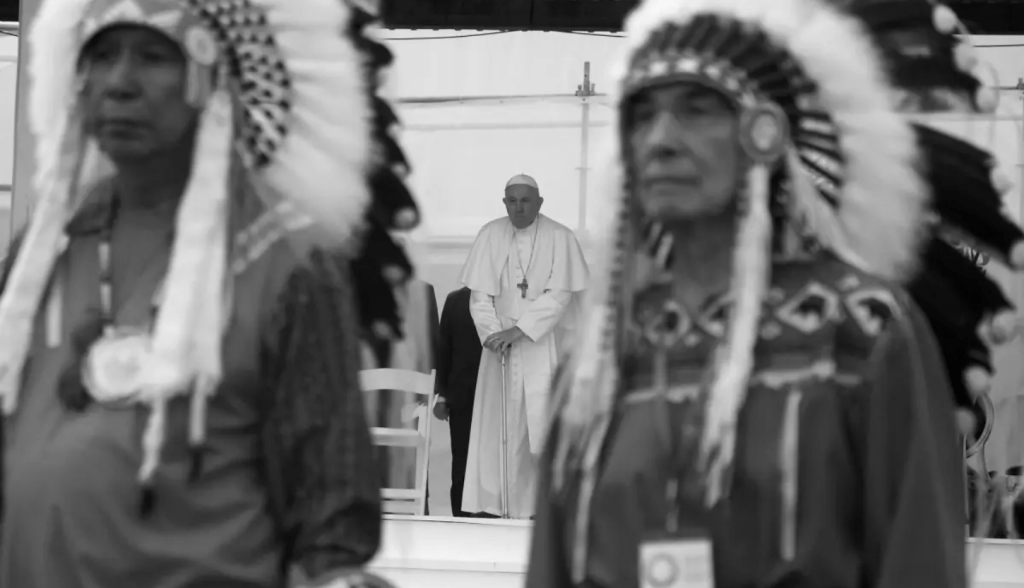
We can further see this “preferential option” (QA 27) for Indigenous groups in the example set by Pope Francis’ penitential pilgrimage to Canada (July 24–30, 2022). As far as I can tell, the Holy Father refused at every turn to move from a discussion of what happened to Indigenous people in residential schools, to preferred reflection on the broader dynamics of corruption and abuse in the Church. There are partial parallels. At some time in the future, dialogue may require a fuller scope and some shared discussion of generalities and universals (when the suggestion comes, I suspect, from the principal dialogue partners). But for now, no. That is not how to lead off. When Indigenous concerns are implicated, that is not how Rome is going to proceed. Full stop.
Consequences for our hearts
It is essential to present this truth—in part just because the Church teaches it, but especially because it flies in the face of the philosophical liberalism that is in currency among both political liberals and political conservatives, which tends to patch up its original identical-interchangeable-atomism of individuals with an identical-interchangeable-atomism of minority and marginalized groups. Dialogue challenges this paradigm at its core. It is a hard truth for most of us North Americans. (Probably not coincidentally—colonial ideologies were hardly intended to enfranchise Indigenous people!) What we require is metanoia.
There is a lot of personal reframing involved here. If, for example, the response that we have to in-the-news violence against Indigenous people and culture is that it is another example of violence against a minority or marginalized group, then however laudable our reaction, we could still have some distance to travel before we are thinking with the Church. If attacks on Indigenous culture by clerics push us immediately into general rubrics of clericalism, clerical abuse, or a listening Church for everybody, ours is not an entirely misguided response, but there seems to be distance yet to cover. If disrespect for Indigenous Christian religious symbols evokes nothing more from us than general concerns about inculturation and iconography, we might be farther from what the Church desires than we think.
I won’t try to measure the distance exactly; I myself am still trying to put into words a complete synthesis of the Church’s teaching on Indigenous dialogue partners. But regardless of where we finally pinpoint the destination, I’m certain we would benefit from going back to the drawing board and praying again with some of the recent magisterial documents. It’s both a marvellous invitation and a terrible challenge.
July 24, 2024—second anniversary of the start of Pope Francis’ penitential pilgrimage to Canada

 Contemplative in the Mud