
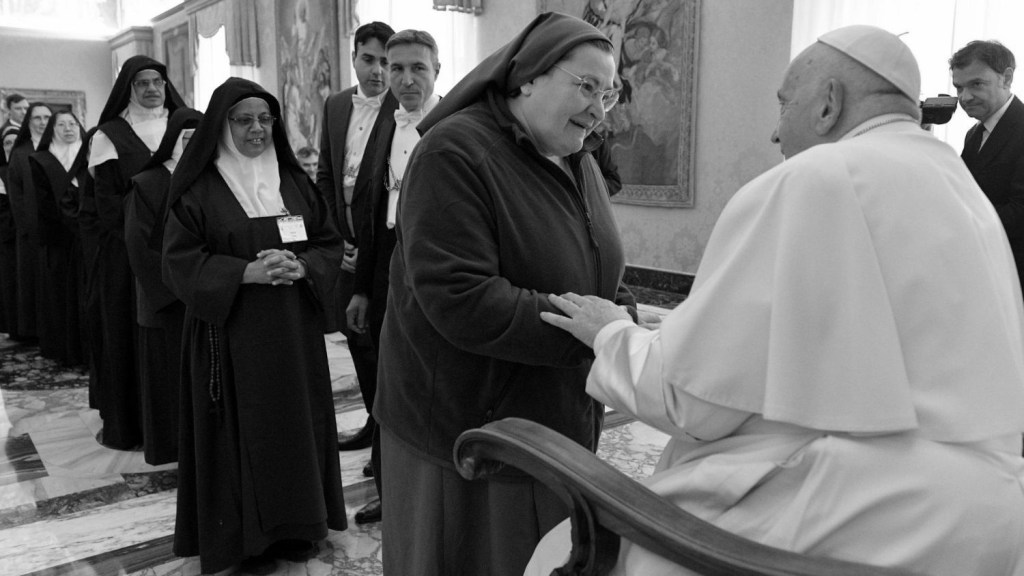
Yesterday, Pope Francis met with members of the Discalced Carmelite nuns and superiors who were gathered together with the purpose of revising their Constitutions. The remarks that he made are worth highlighting, at least in part.
The Holy Father opens with a concern to “give greater impetus to the contemplative life” lived in the cloister of Carmel, and the reason for that is not purely individual. Always, with Francis, the question is one of growth and community, whether that be apparent on the surface of one’s actions and life choices, or merely lived out in less visible ways. Contemplative life is no exception. Indeed, it is perhaps the most clear instantiation of this truth. After all, the pope says: “When a Carmel works well, it attracts, it attracts, doesn’t it? It is like light with flies, it attracts, it attracts.”
Pope Francis had already remarked on the place of attraction in the writing of Thérèse of Lisieux. The final pages of her autobiographical manuscripts, he noted in C’est la Confiance 10–11, tell us of the saint’s “appreciation of the fact that evangelization takes place by attraction, not by pressure or proselytism.”
In his remarks yesterday, the Holy Father continued on this theme. Contemplation does not withdraw us into ourselves. It doesn’t limit our horizons. It doesn’t make us concerned with a narrower and more concentrated group of people (or even just our own self). Rather,
the contemplative vocation is not about tending embers, but rather about fanning into flame a fire that can continue to burn and provide warmth to the Church and the world.
Indeed:
Far from seeking refuge in interior spiritual consolations or a prayer divorced from reality, yours is a journey in which you allow yourselves to be touched by the love of Christ and union with him, so that his love can pervade your entire existence and find expression in all that you say and do. The path of contemplation is inherently a path of love. It serves as a ladder that raises us up to God, not to separate us from the world but to ground us more deeply in it, as witnesses of the love we have received.
These are words of great light. They’re also very Carmelite words. The whole purpose of that Order, in both its original form and in the reform of Teresa of Avila and John of the Cross, is to provide love for the heart of the Church, first in the contemplative’s own life and then in the life that moves through the Communion of Saints to other members of the Church. We could produce a litany of quotes from the two great saints of the Discalced tradition, as well as their daughter Thérèse, on the subject. Pope Francis is very traditional in commenting on contemplative life in this way.
The Holy Father doesn’t let up. He adds more thoughts on the same topic:
In this way, the contemplative life will not risk degenerating into a spiritual inertia that withdraws from the tasks of daily life – a priest who did not know this type of mysticism called them “the drowsy nuns”, who live in sleep – and it will continue to provide the interior light needed for discernment.
Contemplation, if it is truly Christian, should make us more active, more discerning, more capable of living the daily drum with evangelical love. It shouldn’t produce fear or laziness, but growth, community, and evangelical courage to choose and do what is necessary. This, of course, assumes that the contemplation is Christian, rooted in the Gospel and full of hope:
And what is the light that you need to revise your Constitutions and address the many concrete problems of monasteries and of community life? That light is none other than the hope of the Gospel, yet always rooted in your founding fathers and your Mother foundress [Teresa of Jesus] and in Saint John [of the Cross].
This kind of hope does not leave us victims of a time that has disappeared, absolutizing the past; rather,
evangelical hope grants us joy in contemplating our history up to the present, but also empowers us to look ahead to the future with those roots that we have received… Look to the future with evangelical hope, with unshod feet, that is, with the freedom born of abandonment to God.
If you have taken off your shoes (i.e., become “discalced”), it is for evangelical freedom, which is nothing but the abandonment of a child into the arms of the Father: “The complete confidence that becomes an abandonment in Love sets us free from obsessive calculations, constant worry about the future and fears that take away our peace” (CLC 24). It’s an outpost of the virtue of hope.
Check out the full transcript of the papal address in the Consistory Hall on the Vatican website (link above).

 Contemplative in the Mud