

[ Marcel Văn and Clerical Abuse | Introduction | Part 1 | Part 2 | Part 3 | Part 4 | Part 5 | Part 6 | Part 7 | Part 8 | Part 9 | Part 10 ]
Although I have for a long time been aware of Marcel Văn as a clerical abuse survivor, it was upon reading a book chapter[1] by Redemptorist priest Jean-Philippe Auger that my understanding really started to be transformed. Father Auger is not a particularly well-known author, as far as I know—not even in the literature on Marcel Văn.[2] He is, incidentally, attached to the same province of the Congregation of the Most Holy Redeemer that Marcel was (Saint-Anne-de-Beaupré), and he is also, incidentally, my fellow countryman. The links are interest-piquing and heartwarming, but it is the content of course that drew my attention.
The thrust of the argument of the book chapter of Jean-Philippe Auger
Father Auger’s book chapter actually has an incredibly innocuous title for the spiritual time bomb that it is. It’s called “La mission de Van : « changer la souffrance en bonheur »”—which means, quite simply, “The Mission of Văn: ‘changing suffering into happiness’.” The title makes it sound like a simple explanation or exploration of this theme in the writings of the little Vietnamese brother. Reading the first page alone might even be a bit off-putting. The author frames what he’s going to say in terms of “life coaching” (the French terminology even uses the English word “coaching” on loan).[3] This is a matter that basically does not interest me, at least as far as I usually understand the notion of “life coaching,” so I completely understand if anyone else would have difficulty getting past the first page. But the rewards in doing so are phenomenal.
Although Father Auger works in the area of spiritual coaching, what he actually goes on to say is that a proper understanding of Marcel Văn must be rooted in the experience of Marcel Văn. We’re not talking about a dogmatic theologian. If Marcel is a theologian, he is an experiential theologian. Like Thérèse, he has a “lived theology.”[4] Of course, it could be worth exploring the idea of “changing suffering into happiness” in the abstract. Father Auger suggests here a paragraph of Pope Saint John Paul II (Salvifici Doloris 7).[5] But that isn’t Văn. Văn works from experience. In fact, the precise background experience of the revelation of a mission of “changing suffering into happiness” is the abuse at the presbytery of Hữu Bằng.
I’ve covered the abuse that happened in extensive, but of course not exhaustive, detail in Part 1 of this series on clerical abuse and Marcel Văn. There I did not pay much attention to chronology, but at this point the chronology starts to matter quite a bit. According to Marcel, his life (up to the time of writing the Auotbiography) can be divided into three periods. The inauguration of the mission of “changing sadness into joy” is precisely the start of the third period, and it is contextualized by Marcel by what happens in the preceding period, which is the one that started with him moving to Hữu Bằng. These are the words of Marcel himself:
During this sorrowful winter, external circumstances had deprived my soul of any joy. I was like a plant which, when frost is around, can grow neither leaves nor flowers. Nevertheless, the time will come when the plant will produce flowers of an incomparable beauty. The second stage of my life was a very severe winter, and to bring this cold season to an end God has allowed that I live the saddest days being badly treated in the bosom of my family [in the midst of the larger Hữu Bằng period]. But it is also there that the source of divine consolations made itself known to me. The season of great joys will begin with the third stage of my life, precisely, at Christmas night [1940]. (A 436)[6]
Like his spiritual big sister Saint Thérèse, his life is divided into three periods (Ms A 4r, 13r, 45v),[7] and like her, he receives a life-altering Christmas grace (A 437; Ms A 45r–46r). The grace of Văn, though, and that of Thérèse are not identical. Văn’s will be to change suffering into happiness:
That year, as Christmas drew near, I no longer thought of the presents I received at the time of my childhood. I understood that, this time, my Christmas present had been prepared by the tears and sufferings of the months I had just lived through. But the mysterious meaning of suffering escaped me completely and, therefore, the reason for which God sent it to me. Consequently, instead of taking delight in suffering, I was naturally distressed by it. God will make me understand, therefore, that suffering is his holy and mysterious will, it is the present of Love. My heart is still overwhelmed by fear of suffering: I suffer, but instinctively I run away from suffering, although now I am not so cowardly. (A 437–438)
Văn’s grace is received when he receives the Eucharist itself:
The much longed-for time arrives…. and, lo and behold! I clasp Jesus present in my heart. A great joy has taken possession of my entire soul; I am outside myself as if I had found the most precious treasure I have ever met in my life… What happiness! And what sweetness! Why do my sufferings appear so beautiful at this moment? It is impossible to say. It is impossible to describe this beauty in comparison with an earthly beauty. All I can say is that God had given me a treasure, the most precious present of Love.
My soul has been totally transformed in one moment. I feared suffering no longer; on the contrary, I was delighted and took pleasure in finding opportunities to suffer. From now onwards my flag of victory will fly on the hill of Love. God has given me a mission, that of changing suffering into happiness. I am not abolishing suffering, but I am changing it into happiness. My life from now on, in drawing its strength from Love, will be only a source of happiness. I have, above all, been able to conquer myself. It is my too-sensitive nature which, many times, has made me suffer, much more than regrettable external events. I now felt I had a lighter heart and I could stand up to all suffering. (A 438–439)
I would stress in reading this not to take things too simplistically or too absolutely. What we have here is a description of the immediate grace of liberation. We all know how on top of the world we can feel at the beginning. A new discovery is like the headiness of adolescence itself. Văn’s description of his discovery should not be taken in any way as a bludgeon to be used against survivors, nor a tool to suggest that anybody should want suffering. The wording is more careful than that. Attention to the whole of Marcel’s oeuvre also shows more variety—indeed a surprising array, or itinerary, of interpretations of the same grace (more on which to come later in this article).
I quote Marcel at length here, because I don’t think we should be fleeing from his words into some abstract conception of the transformation of sadness into joy. Surely, yes, there is something universalizable in what Văn experienced. But it is also more than that. It is rooted, as Father Auger insists, in Văn’s life, his personal experience. In other words, “changing sadness into joy” can be treated as—and is—an arm of Văn’s profound experiential theology of abuse.
Further reading bears this out. When Marcel runs into a new experience of clerical abuse at the Saigon Redemptorist community, he draws up his understanding of the Christmas grace again. He writes to a friend: “During the two years I spent at Saigon I have been truly spoilt like a king by God, obtaining all I wished for with furthermore some things I did not wish for” (To Brother Bernard, 17 Aug 1952).[8] But what Marcel refers to here as being “spoilt by God” was actually the misunderstandings of his confreres, alongside the abuse of power and conscience of the confessor and the superior. Reading his correspondence with his spiritual director from this time shows somebody in spiritual death throes, someone who is spinning out psychologically. If he “wished for” this, it is only in a loose sense of knowing the value of his mission for himself and for others, not in enjoying evil in itself. It is only because he accepts being close to God the way events present the possibility. Suffering is inevitable in life. He accepts that sometimes it happens. But it won’t own him. The grace here is to understand that where he is if he is suffering isn’t what he is; he is made for joy, so he jumps into the arms of the loving God whenever suffering comes. Marcel is implementing the grace given to him. He’s accepting it. It makes sense of his life, and it draws him to the God he loves so dearly—and who loves him yet more.
Spiritual resilience
Now, how do the book chapter I’ve highlighted, the writings of Marcel, and the theme of clerical abuse connect and explain each other here? Admittedly, Jean-Philippe Auger doesn’t talk about “clerical abuse.” His terms are more general—and that’s reasonable, because of course a first exploration can only have the character of a first exploration.[9] It would be absurd to expect more. I want to do more, but I don’t expect my source material to always have more. Going beyond the general argument made by Father Auger, though, starts to reveal how everything fits together.
The general concepts and “psycho-spiritual concepts” that are used in the book chapter are the following: religious experience, resilience, trauma, beating, neglect, violence, abuse of power, abuse of confidence. Văn is explicitly classed as “an abused child.”[10] With these concepts in place, the various sufferings of Văn are then indicated very summarily.[11] Within this experiential nexus, Father Auger talks about spiritual resilience.
In the psychological literature from which Jean-Philippe Auger is drawing, the notion of resilience has a quasi-physical character. It comes from physics. It means that some metal can regain its original integrity after suffering a shock or a pressure.[12] Here, I think, at least two aspects are highly significant.
First, there is the notion of regaining or changing; there is an activity, a movement. This is key to Văn’s formula of “changing sadness into joy.” We don’t have a world of nouns so much as verbs. We don’t have to explain and classify so much as enter into a propulsion or attraction. Part of the marvel of this formulation is no doubt the genius of language itself; Tai, Austroasiatic, and Sino-Tibetan languages are infamous for pivoting around verbs, rather than nouns, at least compared to Indo-European languages. But part of the genius is of course just Văn—and God working through Văn.
Second, note the term or goal of the movement. What is regained in psychological resilience is the original integrity, not the original shape. In human terms, it would be an impossibility to go back to the same shape. We are changed by what happens to us. What matters is not to reset the clock but to regain the integrity of being. This isn’t just my interpretation either. What is said in the book chapter of Father Auger bears it out. Among the most important factors psychologists speak about regarding resilience, attention is drawn to “the capacity to make sense in the wake of a wound and the capacity to create a link of attachment with a significant person.”[13] This, I think, is key. “Changing sadness into joy” as we saw it described in the Autobiography is precisely that. There is a new or renewed sense conveyed to the suffering endured in the past—and to be experienced in the future—and there is a strong attachment to God at the focus of it.
It would be horrifically abusive to use Văn’s discovery to brush away all the pain of survivors. But it remains true that there is a psychological need to find meaning and meaningful attachment. “Changing sadness into joy” is a—if not the—creative, spiritual instantiation of the satisfaction of that human need. It doesn’t tell the victim to suck it up. It doesn’t minimize their suffering. It doesn’t lock them within their own limited horizons and resources. It tells them that, yes, they still have within themselves the integrity of orientation towards joy, towards happiness, towards things and persons that are good for them. Nothing has stripped them of this dignity. Perhaps, perhaps, the way forward, if we give it a try, is what Văn calls “changing sadness into joy.”
I say that this capacity of “changing suffering into joy” is a creative, spiritual instantiation of the satisfaction of a particular human need. The choice of words is deliberate. This kind of resilience doesn’t exclude other deeply felt psychological needs for meaning and meaningful attachment. We have those, too. Văn’s version of resilience is one that offers the possibility of meeting these needs in the realm where the psyche intersects the spirit. It isn’t the whole thing. Psychological needs are complex. They will vary from person to person, both naturally and in the disrupted, injured state. Yet the resilience of “changing suffering into joy” is not just one option among many; it seems to be an absolutely necessary part of healing when it comes to clerical abuse. For without it, how are you going to satisfy the need for meaning and meaningful attachment when what is broken is a relationship with priests of Christ and other clericalized representatives?
In other words, “changing suffering into happiness” is a form of psycho-spiritual resilience.[14] And that suggests a further matter for reflection. Resilience in the psychological sphere is connected to courage in the moral sphere. Courage is a cardinal virtue. As Father Auger astutely remarks, there are 36 occurrences of “courage” and “courageous” in Văn’s Autobiography, with another 15 occurrences of “encouragement” and “discouragement” (and their cognate verbs and adjectives), which are of course related ideas.[15] In comparison, I myself count in Thérèse’s autobiographical manuscripts exactly the same number of words like “encouragement” and “discouragement” as for Văn (15), and the same number again for “courage” and “courageous.” Regarding Thérèse, whose Story Marcel takes as his own “model” (A 8), as a baseline, we can rather confidently suggest that courage is characteristic of Văn. It is not quite original to him but does gain new life in him. In his work, we are told in remarkable detail how resilience was translated into moral action, the only thing that can keep it going at a fully human level. Moreover, if anyone wants to really pursue the logical conclusion, we have here “matter for reflection for those who wish to contribute to the recognition of the heroic status of the virtues of Van.”[16] Survivors, in getting through a day, any day, are courageous, and Văn is an example of this to a heroic degree.
Marcel Văn teaches us, through experiential theology, something about what the most basic of virtues looks like in situations of psychological upheaval, abuse, and trauma—a matter which, let’s be honest, hardly anyone talks about, at least in ways that are accessible to everyday Christians. What’s this? A holy person who teaches evangelical things that are vitally important for our day? Someone who shines light on the universal call to holiness for some of the most abandoned, discarded, and marginalized? Santo subito, dottore subito!
The grace of “changing sadness into joy”
Although Marcel knows that the grace of Christmas 1940 is rooted in his own experience and is given to him in response to what he’s been through, so that, starting from where he is, he will be a survivor, he does not interpret his grace as reserved solely for himself. He doesn’t think it’s one special mode of life for one particular person.
If someone is to experience a lot of suffering, perhaps even the normal amount, Marcel considers it absolutely essential, indispensable to be able to change sadness into joy. Without this grace, the spiritual life dies, we die inside:
You see that in this world, joy without tears is also sadness, that sadness without joy is all the more painful. Consequently, if we do not know how to change sadness into joy, and then offer this joy to God, our life will be so overwhelmed under the yoke of sadness that our soul will lose all interest for the spiritual life. (To Tế, 22 Apr 1950)
We can, then, judge that, in Marcel’s own view, Văn would have died spiritually without the grace of Christmas, the capacity of resilience in the psycho-spiritual world, the ability to “change suffering into happiness.” But we can also determine that he thinks this is true, not just of himself, but others. He is offering the same advice to his younger sister. We can’t escape the way life is. But we aren’t asked to accept it as a thing either. The real task is to enter into a movement, a propulsion, an attraction, and change things as they are in their brute force. We have to have the psycho-spiritual capacity of changing suffering into happiness.
The same message comes through when Marcel describes this grace as integral to holiness:
To be a saint, to strive to perfection, I used to think this meant a life full of charm, like a wonderful springtime, with the greenery, the flowers, the dew, the delicate leaves, the wind in the branches… etc. I thought that holiness was perpetual joy, without the shadow of any sadness.
But the more time passes the more I progress… the more I see that sanctity is a life where it is necessary to change sadness into joy, where it is necessary to wish that joy becomes sadness, for then to change, once again, this sadness into joy, to make of bitterness a dainty dish. (To Brother Alexander, 28 Jan 1951)
In this formulation, the transformation of sadness into joy is necessary. It’s part of spiritual progress. It’s part of Christian perfection (which contains also the contrary movement, whenever it is time, of joy changing into sadness). Marcel doesn’t understand how you can realize the glory for which you’ve been called without this grace. I’m sure he knows he has to live this grace more than most. His abuse history prioritizes this psycho-spiritual resilience and moral courage. But he also understands that some degree of this grace is present in every Christian life.
Marcel of course has a wide variety of ways to express what he’s living. Sometimes the same grace of resilience and courage is spoken in surprisingly tender, childlike terms:
Little Jesus, nothing is as painful as to be your little friend. However, a single one of your kisses, a single glance suffices to chase away the sadness and intoxicate with a perpetual joy. So, therefore, beside great suffering. indescribable joys are also found. (Conv. 222)[17]
Other times, the words are very conceptual and logical: “If one finds comfort in sadness, naturally the sadness changes into joy” (To his father, 6 Oct 1946). Then again, Marcel might highlight the novelty and surprise, along with imagery that on the surface of things makes no more sense that the idea of suffering becoming joy: “All I can say, in using a new way of speaking, is that I am changing suffering into a cross. Yes… sufferings are crosses and crosses are roses” (Conv. 315).
The universalizable aspect, though, isn’t just for the individual who receives the message. It is communal. Replying to a request for prayer and sacrifice, Marcel writes:
As for me, although I am nothing but a very small soul incapable of anything, when I see the suffering of all the souls, I feel, like them, a deep sadness. I offered myself sincerely to the love of God, praying him to take all my future joys, all the pleasures of my existence, with all my life, to give them to the souls who suffer and reserving for myself only the lot that I love: bitterness, distress, the sufferings of these souls. I ask to put up with all in their place so that they receive consolations. Yet, however, it seems that I thirst to do still I more…! (To Father Dreyer Dufer, 19 Jan 1949)
Confident in the infinite God of mercy and love, Marcel gives him the chance to use the grace of “changing sadness into happiness” for the benefit of others. This grace makes merit. Merit can be applied to others. We can do things for others in the spiritual realm. To universalize the mission doesn’t just mean letting others know that they can change suffering into joy. It also means doing this and transferring the overabundant results to others as merit and grace. My sadness is changed into my joy and in God’s merciful hands changes your sadness into your joy. What openness of horizons, if we can live this! What new meaning and meaningful attachments!
Văn and Thérèse
In assessing what Văn contributes to our understanding of Christian spirituality and what exactly it is that he is living, we need, I think, to pay special attention to his dependence on, and deviation from, Thérèse of Lisieux. Suffering is a key theme of the Little Flower. As Dawn Eden Goldstein, writing under the name Dawn Eden, attests, “One could say, in a sense, that she sees her life as the story of a soul who went from suffering without God to suffering with God.”[18] Dawn Eden’s chapter on Thérèse in the context of healing and abuse is called “The Love the Transforms.”[19] We should ask, then, is Văn just cribbing from his spiritual big sister?
Marcel himself says some remarkable things on this subject. Chronologically, the revelation of the grace of Christmas in the Hữu Bằng period (A 436–439) occurs before the discovery of Story of a Soul (A 567) and the beginning of the spiritual conversations with Thérèse at Quảng Uyên (A 587). Yet Marcel is able to speak of his “special talent that gives great pleasure to Jesus [which] consists in receiving all crosses, and once they are in my hands, I throw them in the air where they change into roses” (Conv. 316). This, he says, is a gift from Thérèse (Conv. 318). At the same time, it comes from the merits of Jesus (Conv. 574–575). Yet it is also ascribed to Thérèse. How much is that true?
We can find, if we strain our eyes enough, verbal formulas in Thérèse that bear a resemblance to “changing suffering into joy.” In one letter, she speaks of “supporting suffering with joy” (LT 43B)—but “with” is a preposition of juxtaposition, not penetration and intimacy, and “support” is a relatively static image, lacking the element of dynamic change, alteration, and sometimes alternation so dear to Văn. This isn’t as similar as it appears at first blush. In another letter, she tells one of her sisters, “I can find but one joy, that of suffering for Jesus, yet this unfelt joy is above all joys” (LT 85)—but if we compare this to Marcel, we find immediately that there is nothing of exclusivity and necessary lack of feeling in the latter. He is much more open-ended.
The poems reveal similar difficulties. The nugget of one of Thérèse’s poems is that her “joy is to love suffering” (PN 45.2), while another asserts that “suffering while loving is the purest happiness” (PN 54.6)—but in Văn we will not find a constant taste for or love of suffering, still less a pure identification of the two terms, for Văn speaks of a movement of transformation of one into the other.
In the autobiographical manuscripts, meanwhile, Thérèse speaks of “changing tears into joy” (Ms C, 28v). Here the words are yet more similar to Văn’s—but in fact the meaning is not at all Văn’s. The Little Flower is commenting on how to respond to the situations of others, not of ourselves. As Saint Paul exhorts rejoicing with those who rejoice and shedding tears with those who shed tears (Rom 2:15), Thérèse says she will—but she will always finish, if she can, by changing their tears into joy (cf. Jn 16:20), because the Lord loves the act of giving with joy (2 Cor 9:7). The catena of New Testament passages may be a bit tenuous. But suffice it to say, this is not what Văn means by changing sadness into joy. There is a world of difference between the words applied in charity to external action on others, on the one hand, and in the internal forum, on the other.
Perhaps the closest Thérèse comes to Marcel is the following:
Céline, console yourself; our [divine] spouse is one of tears and not of smiles. Let us give him our tears to console him, and one day these tears will change into smiles of an ineffable sweetness! (LT 120)
This, we might say, is where Văn is. It has a movement of transformation. It has sadness, then joy. But again I think it is not the same. Văn wants the transformation now. It has to start now. If not now, then we risk eliminating psychological resilience. With Thérèse’s letter to her sister, all is deferred indefinitely. If we examine the context, she is talking about “the Fatherland.” What we have is the difference between realized eschatology and an eschatology that, while real, is not necessarily realized right now.
A further parallel between Marcel and Thérèse is remarkable for a completely different reason. Things are backwards. Văn’s formulation of “changing suffering into happiness” is the reverse of Thérèse’s repeated prayer that Jesus “change for me all the consolations of the world into bitterness” (Ms A, 36v, 38r, quoting Imitation 3.26.3). The contrast is even starker in a letter to Céline, who is told that Jesus “wants the purest joys to be changed into suffering” (LT 149). Understood at the level of the words themselves, what we have are flagrant oppositions. One movement is to take suffering into joy. The other movement is to take consolations into bitterness. At first glance, it’s as different as up and down, left and right, east and west.
Indeed, in contrast to the way Thérèse talks, we can find many times that Marcel tells us that he doesn’t want suffering (including the narration of the initial Christmas grace: cf. A 437). He explains that “this grace consists in accepting suffering with joy in the firm hope that suffering will come to an end one day, that the storm will dissipate and that it will be granted to me to see again the sun of love” (Conv. 317–318). He writes to a friend: “Although I naturally fear suffering, I accept it gladly not as I wish for any spiritual advantage but solely for love of Jesus” (To Sáu, 9 Jul 1947). In cases like these, it is plain that there is no request to remove consolation. He is perfectly content not to ask Jesus to bring suffering to him. Often he even says how horrific and actively unwanted it is.
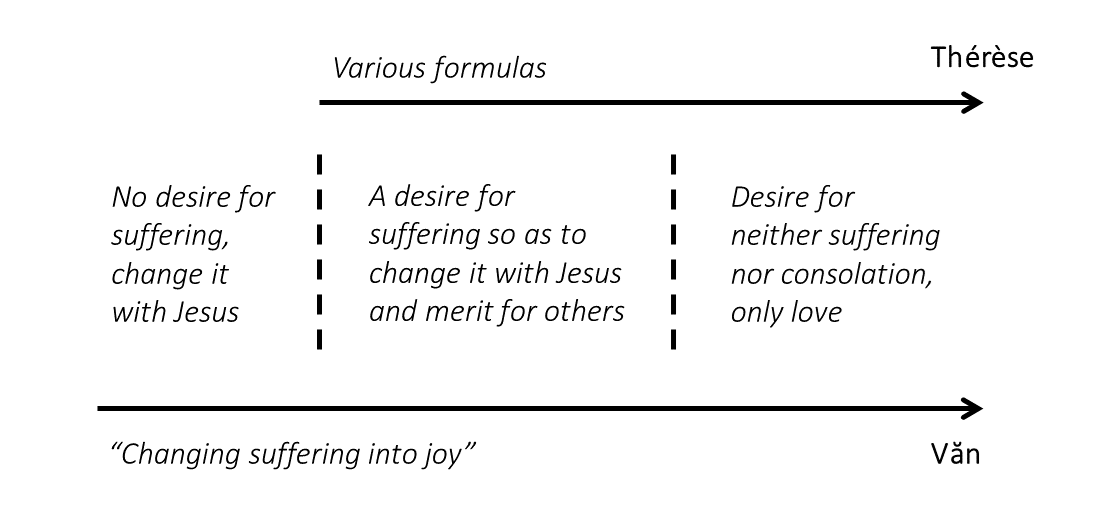
Afterwards, Marcel will understand that suffering is in some mysterious sense gentle for him, even if painful. He will want it in some capacity for Jesus. He will accept, like Thérèse, a desire to suffer (Ms A, 36r; Ms B, 5r; Ms C, 7r, 10v; LT 244, 253). He will accept that “my attraction to suffering grows in the measure that the suffering itself increases” (Ms A, 69v). He will “prefer vinegar to sugar” (Ms C, 26v). All these formulas of Thérèse find their place in a particular, later stage of Văn’s life. The way he says it varies a bit. But the substance is there.
But at the start of this journey, his life is so full of pain that the verbal formula he uses has to first find its place at the antipodes of the verbal formula of his big sister. It is a plain fact that he starts from knowing all too well that priests are not pure crystal (cf. Ms A, 56r), whereas Thérèse’s life, no matter its individual psychological pains and resonances, was never enmeshed in such expansive social and spiritual webs of abuse.[20] Văn needs a kind of initial healing that, despite all her psychological fragility, Thérèse does not. Suffering must be changed into joy—that is the starting point for Văn, and it is the truth that will take on deeper and deeper meaning, even as he learns to love suffering for the sake of Jesus and those taken up in his arms. Nothing in the later movement is excluded by the verbal formula.
Yet the verbal formula accepts, as Thérèse’s does not, another stage or lived reality for people yet more overwhelmed by networks of evils that have debilitated them. It accepts the yearning for the pain to end, the plain fact that I am not made for this, that I am still, despite everything done to me, good enough to want my own good. I am in suffering, and I want joy. Gently, gently may I go there.
Văn’s verbal formula also makes way, as the early formula of Thérèse does not, for the possibility that there may come a stage when one no longer desires suffering, but only love (Ms A, 83r). Marcel too finds this stage. In a notebook, he writes, “I ask for neither suffering nor consolation” (OWN2.33).[21] To his namesake cousin he writes, “as I love Jesus, I do not make a distinction between joy and suffering; I love Jesus solely for himself” (To his cousin Văn, 29 Jun 1947). If there is no distinction, he neither wants to sway Jesus’ will to joy and consolation, nor to suffering and desolation. He wants, as he says, just love. It is enough. It is All. In the midst of such formulations, there remains the hint that the act of transformation is key: “Souls who love God encounter sadness, but without accustoming themselves to sadness” (OWN2.37). It comes, but it doesn’t stay; it’s converted. This isn’t of course by our own gumption. We don’t become superhuman. We simply rely ever more totally on Jesus: “asking Jesus to help me to live, to pass through sadness without losing my smile” (OWN2.40).
For Marcel, this stage is like a reintegration of the earliest stage of overwhelming suffering, where one’s innate goodness is reaffirmed and joy is emphatically sought, and the middle stage of being safe enough to want to suffer a bit to merit for others with Jesus. Now, with these two contrasting experiences adequately assimilated, complete confidence has been achieved; Marcel is aware that when it is bad, Jesus can work the first movement, and when it is well, he can work the second. Afloat on the waves of providence, we are small enough to fit in the boat. Each moment, though, is for us “changing sadness into happiness.”
In other words, for all his surface-level dependence on Thérèse, Văn is actually the one who sees the same journey, the same necessities in our spiritual life, in a broader vision and with a wider-angle lens. He sees farther in both directions, losing nothing of the resolution of the original image. With Thérèse, he sees to the end: neither suffering nor joy, just love. The notion of “changing sadness into joy” is fully compatible with that. There’s no contradiction, not even a verbal one. But in contrast to Thérèse, Marcel also understands a vast mountain range of horror that can lie before this (and reappear, pushing itself up from underground, at any time). In those situations, however long they may last, “changing sadness into joy” has much more mildness and gentleness with oneself than anything Thérèse proposes for herself. Courageous gentleness. Survival. All this because Marcel knows, as his model does not, clerical abuse—or any kind of persistent abuse, for that matter. Thérèse knows trauma, which she calls “the crucible” (Ms A, 3r, 12r, 27r). But she doesn’t know sustained abuse. And part of abuse survival, as Văn understands it, is not to desire suffering, but merely to take what is there and, by the grace of psychological resilience and moral courage, say you don’t want it, it doesn’t own you, and just gently change it into joy with Jesus. In sum:
This, I think, is another reason why Marcel is such an amazing little teaching saint. He thinks he is piggybacking on, indeed copying, Thérèse. But he isn’t. He’s doing something different. His spirituality can subsume hers. But can hers really subsume his? He has this riveting, foundational experience that is expressed spiritually in a riveting, foundational grace of universal scope, but which comes to him only because he is exactly who he is: a survivor of clerical abuse.
Moreover, Marcel accomplishes this by appealing to a broader psychological understanding than that found in his model. His teaching is in many respects a psychological doctrine bathed in the fine waters of the Gospel and refined in a purifying evangelical fire. Văn takes his intimate experience of psychology and treats it with great respect. He himself remarks that “the holy apostles in their time were not familiar with psychology as we know it today,” yet were successful; nonetheless, he argues, even though “the devil is also very good at psychology,” we shouldn’t “pour scorn on the progress of modern life,” but rather “show wisdom” towards its acquisitions (OWN7.10). This, I think, is one of Văn’s own strengths—and I will continue to emphasize psychological dimensions of his evangelical teaching in the next couple of articles.
All of this I could only see clearly from reading Jean-Philippe Auger. “Changing sadness into joy,” he tells us, is a grace of psycho-spiritual resilience. It connects us to a significant person (or significant persons), and it enables us to make sense of experience. Its moral locus is the cardinal virtue of courage. And as such, this grace can be lived to a heroic degree. The person who shows us that with their writing and their life is, I am convinced, Marcel Văn.
Photos in header: The parish church of Ngăm Giáo, where the grace of Christmas 1940 was received, superimposed with Văn at 12 years of age
[1] Jean-Philippe Auger, “La mission de Van : « changer la souffrance en bonheur »,” in Gilles Berceville (ed.), “Tu as du prix à mes yeux”: Comprendre la Rédemption avec Marcel Van (Paris: Éditions de l’Emmanuel / Les Amis de Van, 2010), 157–167. I’ve scanned this article to PDF, but it is still only in French, untranslated. Originally, I had scanned the article to send it to the Sisters of the Little Way, whose apostolate is to those wounded in the Church and whom you may be interested in checking out if you have bothered to read this footnote, but since this blog itself is for educational and spiritual-development purposes for a small audience, publishing one chapter of a book here meets my understanding of Canadian “fair use” laws, too.
[2] His other contribution that I’m aware of is Jean-Philippe Auger, Prier 15 jours avec Marcel Van (Bruyères-le-Châtel: Nouvelle Cité, 2009).
[3] Auger, “La mission de Van,” 157.
[4] This aspect of the Little Flower is given extensive treatment, using exactly this term of reference, in François-Marie Lethel, “La « théologie vécue » du mystère de la Rédemption selon sainte Thérèse de Lisieux, docteur de l’Église,” in Gilles Berceville (ed.), “Tu as du prix à mes yeux”: Comprendre la Rédemption avec Marcel Van (Paris: Éditions de l’Emmanuel / Les Amis de Van, 2010), 89–114.
[5] Auger, “La mission de Van,” 157.
[6] A = Marcel Van, Autobiography, trans. Jack Keogan (Complete Works 1; Versailles: Amis de Van Éditions, 2019).
[7] All references to Saint Thérèse of Lisieux using the system in Œuvres complètes (Paris: Cerf / Desclée de Brouwer, 2023), with translations my own.
[8] To = Marcel Van, Correspondence, trans.Jack Keogan(Complete Works 3; Versailles: Amis de Van Éditions, 2018).
[9] Cf. Auger, “La mission de Van,” 158.
[10] Ibid., 159.
[11] Ibid., 160.
[12] Ibid., 159.
[13] Ibid., 160.
[14] Ibid., 165–166.
[15] Ibid., 166.
[16] Ibid.
[17] Conv. = Marcel Van, Conversations, trans. Jack Keogan (Complete Works 2; Versailles: Amis de Van Éditions, 2017).
[18] Dawn Eden, My Peace I Give You: Healing Sexual Wounds with the Help of the Saints (Notre Dame. IN: Ave Maria Press, 2012), 76.
[19] Ibid., 65–85.
[20] I stress that this doesn’t mean that the experience of the Little Flower is not healing and helpful for abuse survivors. Clearly, Văn is one person who greatly benefited from Thérèse’s witness and life story. I would also again point readers in the direction of Dawn Eden, My Peace I Give You, 65–85.
[21] OW = Marcel Van, Other Writings, trans. Jack Keogan (Complete Works 4; Versailles: Amis de Van Éditions, 2018). Additional system for abbreviations explained on page 14, e.g., OWN = notebooks; OWV = various writings.

 Contemplative in the Mud