
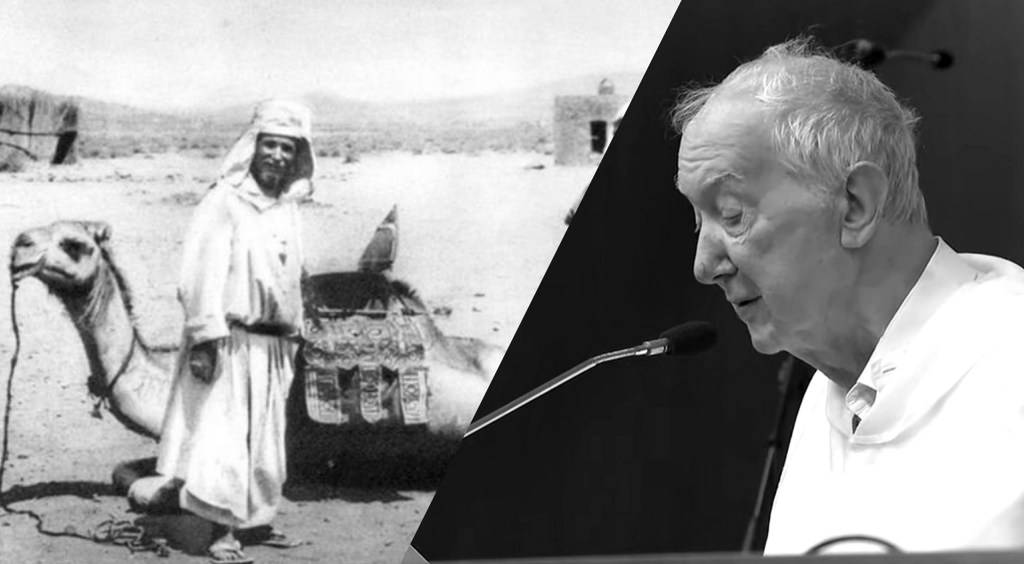
Last week, before the Synod on Synodality began, the participants went on a three-day retreat. Meditations were given by Sister Maria Grazia Angelini OSB and Father Timothy Radcliffe OP. The text of all these meditations is available at the Synod website, much of it in English. I want to draw attention to the second meditation from Timothy Radcliffe. It has a lot of Charles de Foucauld in it.
Now, evidently, the idea of syn-hodos (literally together + road/path/way) has quite a bit to do with the story of Brother Charles. No matter what way you slice it, his journey leads to sharing life with others at the “Nazareth” of Tamanrasset. But in the second meditation of Father Radcliffe, Charles de Foucauld appears not just in some vague terms that we might put into the text, but quite specifically—and so do his followers.
In the first passage that mentions Charles, Father Radcliffe is meditating on, and likewise asking his retreatants to meditate on, the Church as a home. This is just one of many themes in the short talk. But it is a central one. Here is that section in full:
When we think of the Church as home, some of us primarily think of God as coming home to us, and others of us coming to home in God. Both are true. We must enlarge the tent of our sympathy to those who think differently. We treasure the inner circle on the mountain, but we come down and walk to Jerusalem, wanderers and homeless. ‘Listen to him’.
So, first, God makes his home with us. The Word is made flesh in a first century Palestinian Jew, raised in the customs and traditions of his people. The Word becomes flesh in each of our cultures. In Italian paintings of the Annunciation, we see lovely homes of marble, with windows open onto olive trees and gardens of roses and lilies. Dutch and Flemish painters show Mary with a warm oven, well wrapped to keep out the cold. Whatever is your home, God comes to dwell in it. For thirty silent years, God dwelt in Nazareth: an unimportant backwater. Nathaniel exclaimed in disgust, ‘Can anything good come out of Nazareth’ (John 1.46). Philip just replies, ‘Come and see.’
All of our homes are Nazareth, where God dwells. St. Charles de Foucauld said. ‘Let Nazareth be your model, in all its simplicity and breadth…The life of Nazareth can be lived anything where. Live it where is it most useful for your neighbour.’ Wherever we are and whatever we have done, God comes to stay: ‘Behold I stand at the door and knock. If you hear my voice and open the door, I will come into you and eat with you, and you with me’ (Rev. 3.20).
So we treasure the places where we have met Emmanuel. ‘God with us’. We love the liturgies in which we have glimpsed the divine beauty, the churches of our childhood, the popular devotions. I love the great Benedictine Abbey of my school where I first sensed the doors of heaven open. Each of us has our own Mt Tabor, on which we have glimpsed the glory. We need them. So when liturgies are changed or churches demolished, people experience great pain, as if their home in the Church is being destroyed. Like Peter we wish to stay.
Charles de Foucauld, then, makes his appearance at the threshold of the Synod as a response to the question “Can anything good come out of Nazareth?” and with this answer of his own: “Let Nazareth be your model, in all its simplicity and breadth… The life of Nazareth can be lived anything where. Live it where is it most useful for your neighbour.” Charles’ spirituality of Nazareth is, apparently, going to the Synod. Every participant heard something of it. Everyone was asked to reflect on it, be challenged by it, and integrate it into their thoughts on the Church. Let’s say I’m chuffed!
The next appearance of Charles is in the form of a follower. That follower is a Little Brother of the Gospel. And his name is Carlo Carretto. The following passage ends the second of Timothy Radcliffe’s six pre-synodal meditations:
One last very short word. Time and again during the preparation for this Synod, the question was asked: ‘But how can we be at home in the Church with the horrible scandal of sexual abuse?’ For many, this has been the last straw. They have packed their bags and gone. I put this question to a meeting of Catholic head teachers in Australia, where the Church has been horribly disfigured by this scandal. How did they remain? How could they still be at home?
One of them quoted Carlo Carretto (1910 – 1988), a little brother of Charles de Foucauld. What Carretto said sums up the ambiguity of the Church, my home but not yet my home, revealing and concealing God.
‘How much I must criticize you, my church, and yet how much I love you! You have made me suffer more than anyone, and yet I owe more to you than to anyone. I should like to see you destroyed, and yet I need your presence. You have given me much scandal, and yet you alone have made me understand your holiness. … Countless times, I have felt like slamming the door of my soul in your face–and yet, every night, I have prayed that I might die in your sure arms! No, I cannot be free of you, for I am one with you, even if not completely you. Then too – where would I go? To build another church? But I could not build one without the same defects, for they are my defects.’
At the end of Matthew’s gospel Jesus says: ‘Behold I am with you until the end of time.’ If the Lord stays, how could we go? God has made himself at home in us with all our scandalous limitations for ever. God remains in our Church, even with all the corruption and abuse. We must therefore remain. But God is with us to lead us out into the wider open spaces of the Kingdom. We need the Church, our present home for all its weaknesses, but also to breathe the Spirit-filled oxygen of our future home without boundaries.
What is the reason behind putting Charles de Foucauld and his followers into the pre-synodal meditations? Has Timothy Radcliffe always been a fan? Is the inclusion a response to Pope Francis’ attachment to the saint and his spiritual family? Is it simply the fact that, on any plain reading of the past century, there is some possibility that we might not be having a Synod on Synodality without the spiritual event that was Brother Charles? I don’t know. Regardless, Charles is a kind of looming presence for the Synod participants, given the memorable force of hearing the same name twice in one session, sure to set some of them off in pursuit of who this saint is, if they do not yet know.
Bearing this in mind, and in a spirit of reciprocity, I invite you to read the remainder of the meditations for the retreat for the participants of the Synodal Assembly, particularly those given by Father Radcliffe. They are wonderful little gems. They deserve our time. As we pray for the participants this month and foster a spirit of docility within ourselves regarding the workings of the Spirit, we could enter a little bit into the participants’ own experience: the preparation they got on retreat.


