
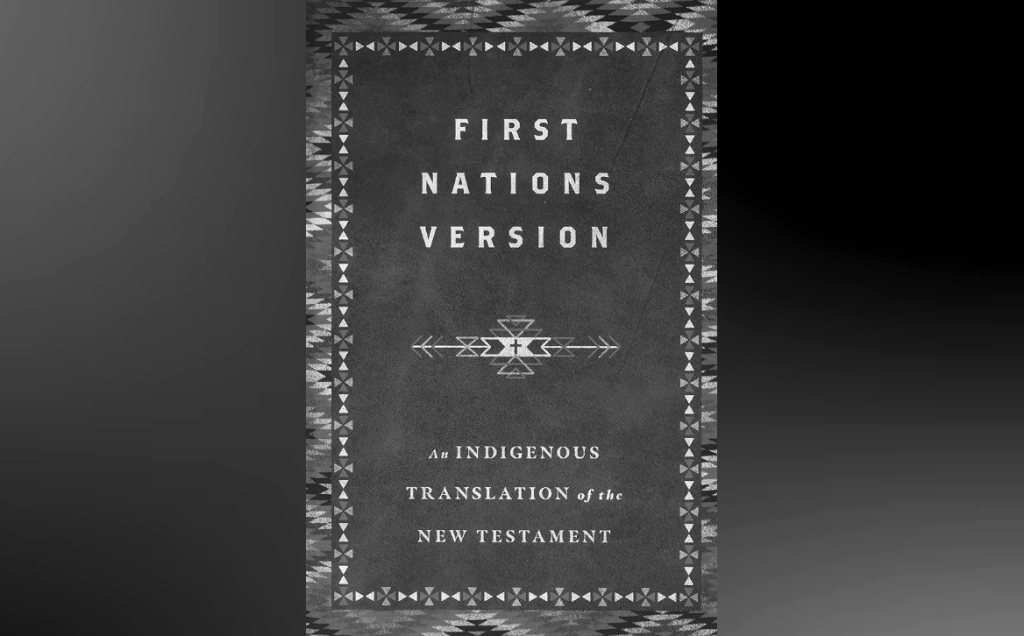
First Nations Version: An Indigenous Translation of the New Testament (Downers Grove, IL: InterVarsity Press, 2021).
In Canada, today is the National Day for Truth and Reconciliation, originally and still colloquially known as Orange Shirt Day. It’s a day to particularly remember indigenous children and youth who suffered through, or sometimes didn’t survive, residential schools. While every day is a good time to hear these cries to heaven and to sit with questions of how to hear the victims and survivors, children of the same Father Creator and sister-mother earth, I want to take the time today to give a review of a book that I would recommend, though with the usual reviewer’s caveats.
Published two years ago by InterVarsity Press and subtitled “an indigenous translation of the New Testament,” the First Nations Version (FNV) of the Bible includes at this time only that—the New Testament. In approach, this is a dynamic translation of “the good story” dedicated to the indigenous peoples of Turtle Island (North America), intended to bring healing and be culturally relevant. Contributors to the oversight committee belong to many different tribes. Accordingly, the translation is into a common language, English, rather than that of a specific tribe or ethnic group.
You won’t find many people who read a Bible translation from cover to cover. In that grand tradition, I haven’t read every book of the New Testament in the FNV, but I have been using it for the entirety of this year, alongside the New Revised Standard Version (NRSV), which I favour, and several of the newer commentaries (e.g., Jewish Annotated New Testament, Paulist Biblical Commentary, Jerome Biblical Commentary for the Twenty-first Century). In conjunction with another translation and a trusty commentary, the FNV works very well. What I tend to do is use any commentary with the NRSV text, or at least the NRSV by itself, for a first thorough read-through, then recapitulate with a reading of the same text from the FNV. Let me tell you what I think of the FNV and why this works, I believe, very well.
The FNV is a storytelling tour de force. It takes up Native American models of framing, naming, and narrating, and uses them to the full, giving an immersive, dynamic, fully fledged story. This is the Bible truly inculturated—and for anyone who is serious about reconciliation with indigenous peoples, both in North America and worldwide, this is no small thing. The devices which the FNV uses to attain such inculturation can be quickly summarized. The introduction to the FNV, printed at the front of the book, and glossary, printed at the end, do an excellent job of this. I will offer my own perspective.
First, proper names are rendered in the beautiful traditional style of many First Nations peoples. For example, Jesus is “Creator Sets Free,” Paul is “Small Man,” Mary is “Bitter Tears,” Elizabeth is “Creator Is My Promise,” Nazareth is “Seed Planter Village,” and Jerusalem is “Village of Peace.” But don’t despair. You will still know who these people are and where these places are found. The original proper name, familiar to us, is always given in smaller type in brackets, immediately after the indigenous-inspired rendering, e.g., “Creator Sets Free (Jesus).” Both names always appear together, but the flow for regular-sized type defers to the imagery-based name, rather than the transliteration, which appears in a smaller font size.
While a very useful device, this way of doing proper names is not perfect or without controversy. Focusing on an image, rather than a transliteration, can lead to a name that might express a certain theological interpretation, such as calling Peter “Stands on the Rock”; this is evidently a question of interpretation, which is more amenable to Protestant than Catholic positions on a certain question of ecclesiology. But on the whole, a basic theological education is enough to avoid any problems here. Just know what you know and read on. The literary, inculturated effect will still do its work in you.
Second, common nouns and some verbs get a similar treatment of inculturation. Explanations of the more theological of these terms are given in a glossary, found after the Book of Great Revealing, i.e., Revelation. Some examples can give an idea of the style. God is just referred to as “Creator” (no article), “the Great Spirit,” “One Above Us All,” “Maker of Life,” or another term, depending on the context; he is never called “God.” Boats are invariably—and picturesquely —“canoes.” Their action is never explicitly one of sailing, sometimes rowing. Angels are “spirit-messengers.” Humans are “two-leggeds.” The devil, continually harking back to Genesis, is “the ancient trickster snake.” In a heading, the temptation in the desert is referred to as a “vision quest.” A temple is a “sacred lodge” or “ceremonial lodge,” while a synagogue is a “tribal gathering house.” Jews or Judeans are “Tribal Members,” whereas Gentiles are “Outside Nations.” Sin is indicated by the lovely, evocative phrase “bad hearts,” which captures well the Christian penchant for spiritual childhood and its simple manner of thinking, or “broken ways,” in the spirit of Jewish concern for halakhah and Christianity styled as Way. Practising Christianity is “walking the good road”—itself an excellent reference to the early name of the Way. But for anyone seeking term-to-term correspondence, this might also be confusing, as the Kingdom of God is also “the Good Road,” while the use of the term “the Way” to designate the early Christ-believing movement is actually retained in the passages in which it appears.
Some of these little acts of inculturation are harder to decode than others. For instance, in the Magnificat, God is said to “count coup with arrogant warrior chiefs” (Luke 1:52 FNV), and that is tricky, to be sure. This is something particular to only certain indigenous peoples! Fortunately, a useful footnote explains:
“Counting coup” was a Native American practice among some peoples of the Plains tribes of touching an enemy with a coup stick as an act of courage during battle, to show he could have killed him but chose to spare him instead. Each time the coup stick was used in battle, a mark would be placed on it. It counted the number of victories won.
The coup stick also appears in the FNV Benedictus (Luke 1:69–70). It is given appropriate footnote explanation there as well.
Among these “translations” of nouns and verbs, I must say that the one that I like the least is “True Human Being” for Son of Man. While most of the FNV reads as very down-to-earth and involved in the particular, the term “True Human Being” seems to me, at least as a non-indigenous person, to be abstract, almost Platonizing or otherwise philosophical. In general, it is the merit of the FNV to remove us from those things and place us more immediately in the concrete world of the Bible. This is an exception rather than the rule.
The text of the FNV is saturated with these small acts of inculturation which accumulate. For the most part, it doesn’t take much knowledge of the ancient Mediterranean to take these terms back to their originals. But the story just makes sense for the target audience this way. It sounds right. And for those of us who are not indigenous, but who are given to social fraternity with indigenous people and communities, this opens our minds to the genius of our neighbours’—our sisters’ and brothers’—language patterns, ways of thinking, manners of expression that betoken deeper understanding.
Third, in addition to drawing on indigenous customs regarding names, nouns, and verbs, small insertions in the texts, printed in italics, are used by the FNV to adjust the flow of the storytelling. In other words, what appears in normal, non-italicized type is the translation. This is supplemented here and there, very occasionally, with italic type. For example, Mark 6:39–40 (multiplication of loaves and fish) says:
Then Creator Sets Free (Jesus) instructed the people to sit down in groups on the green grass. So the people gathered up their traveling bundles and their children and sat down, some in groups of one hundred and some in groups of fifty.
Or Luke 9:18–20 (confession of Peter):
One morning, after praying alone with his followers, he asked them, “Who do all the crowds say that I am?”
They looked around at each other and said, “Some say you are Gift of Goodwill (John) who performed the purification ceremony [footnote: Baptism]. Others say you might be Great Spirit is Creator (Elijah), or one of the prophets of old come back to life from the dead.
Creator Sets Free (Jesus) lowered his voice and spoke with a more serious tone.
“So tell me,” he asked them. “Who do you say I am?”
Silent faces stared back at him. They began to look around at each other, and some looked down to the ground. The moment of truth had come, but no one dared to speak. Then suddenly a voice pierced through the silence.
“You are Creator’s Chosen One!” Stands on the Rock (Peter) answered.
Or, for one last example, Luke 3:15–18 (on John the Baptist):
When the people heard these words, they began to have hope. They were pondering in their hearts, “Could Gift of Goodwill (John) be the Chosen One?”
He gave them this answer, “I perform the purification ceremony [footnote: Baptism] with water, but there is one coming who is greater and more powerful than I.”
He paused for a moment and softened his voice.
Then he said, ”I am not even worthy to bend low and untie his moccasins.”
Then he lifted his hands and cried out with a loud voice!
“He is the one who will perform the purification ceremony [footnote : Baptism] with the fire of the Holy Spirit! He will separate the grain from the husks. His harvest basket is in his hands. He will store the good grain in his barn, but the husks he will burn away with a fire no one can put out.”With many more words Gift of Goodwill (John) warned and encouraged the people with the story of Creator’s good road.
Although I have quoted several of these passages, additional italic text is actually relatively rare. Usually, the Bible’s storytelling is allowed to stand on its own. The additions are always made with a specific purpose. It would be incorrect to liken the FNV to a paraphrase. For one thing, anything added is clearly marked as such. A better analogy for these insertions is to the footnotes in an annotated study Bible, a good homily from an imaginative preacher, or the catenae of the Middle Ages.
The effect in the supplemented passages is nearly always to aid us to imagine the story, in line with the beautiful traditions of indigenous storytelling. Additions complement the narrative flow. We picture scenes better, with new human details. Everything comes alive. Not all these details need to be historically correct. But spiritual masters have always suggested that we find such details out of love for Jesus in his full mystery, anyway. So there is nothing “wrong” with adding them. Often, that is the work of meditation. It will be a part of lectio divina. In a sense, the FNV text is very good at doing the work of meditation and some stages of lectio divina for us. And, in this case, we engage with this imagining out of love, not just for the Bible and God, but for his indigenous peoples. Using the FNV and its prepackaged meditation material, we leap, I think, much more quickly into a contemplative gaze. This is part of why I like to use the FNV last, after having built another base with the NRSV and/or a thick commentary first. The FNV’s supplements don’t always hit the mark. But I find the success rate to be remarkably high.
It would, however, be a serious mistake to think that the FNV always tends to interpolate and be dynamic, whereas some translations that are more popular among Catholics are more literal. Consider the incident of the slave girl with “a spirit of divination” (Acts 16:16 NRSV) at Philippi. The Greek here is pneuma pythōna, and the FNV renders: “a slave-girl who had an evil snake spirit met us [footnote: lit. spirit of python].” Picking up the FNV, without having yourself read the Greek, you’ll learn something about the technical background in Greek classics (if you can realize that there is some reference to, e.g., Pythian Apollo, whose home was the oracle site of Delphi). And not only that, what you’re given has some devotional value, because it connects to the evil snake of the biblical Fall. There is more, and more literal faithfulness, in the FNV than in the NRSV in this case.
Similarly, when Paul (Small Man) is at Athens (Wondering Place), he is taken to the Areopagus (Mars Hill). Before that, he engages with Epicureans and Stoics—that is, “some traditional wisdom seekers” (Acts 17:18). I think this is a great way of making people understand the dynamics and the classical background at one level. Leaving out Stoics and Epicureans misses just how Paul’s speech uses and engages critically with elements of their own teachings. But then again, most translations don’t get that—and it is a perpetual mistake even of biblical theologians to not see this, especially regarding positive engagement with Epicureanism, that greatly maligned bogeyman of the ancient world. So the FNV hardly fares worse than others here. But it does capture a lot of who these groups are and what is happening, in a dynamic, meaningful way. These philosophers are not professors in an ivory tower; they are traditional wisdom seekers. For most of us, that is all we need to know, and it is a great improvement on thinking these are philosophers in the academic vein of Kant, Hegel, Russell, or Derrida. Epicureans and Stoics stressed philosophy as a way of life, not an intellectual pursuit. They were philo-sophoi, lovers of wisdom, seekers of wisdom. And they did that rooted in traditional communal schools or sects, not by starting new ones. Clarity is a feature of the FNV here.
And perhaps most notably, some parts of the prologue to John’s Gospel get better treatment in the FNV than in, say, the NRSV. The NRSV is beholden to the notion that charis is “grace.” But in reality, that is a Pauline transformation, a great way that Paul made sense of the Christian message and experience, but by molding standard human language in his own particular way. The word charis is also just a Greek word for “gift.” Thus, when the NRSV says that the Word become flesh was “full of grace and truth” (Jn 1:14 NRSV), that “we have all received, grace upon grace” (Jn 1:16 NRSV), and that “grace and truth came through Jesus Christ” (Jn 1:17 NRSV), this could (accounting for how the word “and” works in Greek grammar) just as well mean that the Word was full of the gift of truth, that we have had gift on top of gift or that “we have all had many gifts of kindness poured out on us” (Jn 1:16 FNV), and that “the gift of kindness and truth came from [better: through] Creator Sets Free” (Jn 1:17 FNV). The FNV is not perfect in this regard. But it is frankly superior to the NRSV in its understanding of Greek vocabulary (charis = “gift” in plain Greek outside a Pauline context), in its understanding of Greek grammar (use of “and” to mean “which is,” i.e, “the gift which is truth”), and in its making sense of the incredibly complicated text of the the Johannine prologue. It makes just much more sense to say that one gift was the Law, and a gift on top of that was the “gift which is truth” or “gift of truth” that is Jesus. And it makes sense that the second gift is truth itself, for the Word was God (Jn 1:1). The FNV, which I stress is not perfect, is nonetheless here better than one of the most highly regarded mainstream translations. From this we can be certain that the FNV is not a paraphrase. It translates just as effectively, sometimes worse of course, but in what is perhaps the hardest part of the New Testament to get a handle on, significantly better.
For all these reasons, I think it becomes apparent why the FNV is an excellent resource to be highly recommended for personal reading, even if it is not necessarily rigorous and amenable to academic, technical parsing in most cases. In the hands of the translator and the FNV supervisory committee, biblical passages come alive. Transposed into an indigenous key, the Bible sings a language of love for First Nations peoples, for their Creator, and for all who would reach out in love to learn to listen with new, fraternal, inculturated ears. As a secondary translation or as a translation to use with a thorough commentary and a reasonably strong theological background, what more could you ask for? This is one of the best purchases I’ve ever made, and I thank God for those who undertook this project—and hope and pray it extends to the Old Testament in due time.


 Contemplative in the Mud