

A couple of years ago, I went to a seminar about aerosols. The details of the talk don’t, for this blog, matter much. But at one point, the professor visiting our department insisted at length on the fact that technology is ahead of science in this field. We can make these “aerosols”: we can make little, nano-sized particles or pieces of liquid become suspended in air… but we don’t really know if they have any long-term health effects. Will these particles ever embed in us? do they have cancerous effects? Who knows? With radiation, we found it and thought it was wonderful; then people died. With asbestos, the same story. Will we learn our lesson?
This hammered home a truth for me. What is the point to pursuing a technology, in the personal and social fabric of our lives, before we know what the effects are or will be? Why? What reason could there be to toss prudence aside? Only the greed of the eyes and the lust of the flesh.
This is where the saints come to our rescue. They never saw any sense in this social insanity, either. For example, Marcel Văn writes that
If we want to live our interior life, we must first know how to live our exterior life. It’s certain, little sister, that if we do not give to our body the appropriate care, what means will we be be able to take to ensure our interior life is honest?
Eat well to take care of yourself. It’s true – not only as regards quantity but as regards quality. (One can do great damage to one’s body by eating the right amount of food, but ill-balanced food, or pre-packaged food. Just look at the sad state of health of many children and adults today.) This is the point: our body is meant to be taken care of, for it dwells in our soul. Doing unnatural things to our body doesn’t help matters. Nature has her own vitality, her own green vigour, as Saint Hildegard called it (viriditas). The life in natural things must be tended like a vine, not steamrolled like a machine. A balanced spiritual view sees this. It’s a question of our theology, our spirituality, our exercise in the virtues.
Take care of things the way they are. Respect viriditas. The applications are numerous. Eat well, eat healthily, don’t take chemicals unnecessarily and without conscience. Clean well, take care of your body, trust in nature’s green vigour. Don’t put trust in the unknown uprooting of natural ways to find sleeker, more “convenient” products. If something else, if some other way, will do, even at the greater effort, then take it! Put the effort, however much it hurts, to obey nature’s paths as they are known. Moving away from the topic of food, the idea of high-rise apartments that consume ridiculous amount of electricity to cool by air conditioner is insane; if you can, design in conformity with nature, not against it. GMO food? dependency on big industry and oil to produce food? large-scale use of chemical fertilizers and pesticides? Totally insane, when they are not necessary to feed the world.
To develop the multiplicity of options available for respecting nature’s green vigour would take entire books and entire blogs. That’s not the point of this one post. This one post is just to say: this is the Church’s tradition, too. Saint Hildegard is, for example, a Doctor of the Church. She is teaching real spiritual values when she instructs her nuns and correspondents to respects nature’s green vigour and to exercise prudence.
Notions like organic, locally grown, non-GMO, are themselves detachment; they are detached from disordered desires to just produce and obtain, no matter the insanity or the cost. Of course, we cannot always make these choices. Many factors get in the way. But they do matter. They matter to our bodies and to our minds. It’s a practice of detachment, though it’s joyful detachment. It’s more joyful to enjoy life, especially food, the way it’s meant to be, without the add-ons of the greed of the eyes and the lust of the flesh, seeking a quick fix, without considering if it pushes against the interdependency of nature (which is, in the end, the interdependency of the Church herself).
Take a graphic like this one for example:
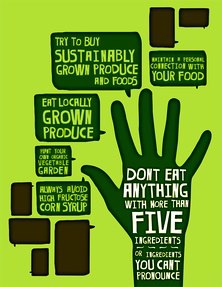
Eat food that you know where it came from (which is to say, eat food that you know is food). It is sensible to invest in the future. It is sensible to avoid packaged food with too many ingredients (I’m not sure about the number five, but the principle itself is sound) or unpronounceable ingredients. What is or could possibly be the point to them for taking care of our body in its natural state?
Or again a graphic like this one:

If we take it at its real value, it’s true. It’s spiritually true. Make it good. Don’t consume things that you don’t know what they will do (or if you must, pray about it, too). Make the food, not only good in the sense of not spiritually detrimental by being overly desired in quantity; make it good in the sense of qualitatively good. Treat your body properly. That’s actually detachment. It’s virtue. It’s dispositive to contemplation. When we begin to realize this truth by putting it into action – and when we realize the detachment involved in making healthy choices (for our body definitely pulls us the other way) – then we realize how rich the Church’s tradition has been.


 Contemplative in the Mud