
Anyone who’s been around this blog for a while knows that I ask the question, “What is the difference between meditation and contemplation?” – and I intend to answer it from many converging points of view. This question belongs to the common patrimony of the Church. Saints and Doctors answer the question in harmony. And their advice about meditation and contemplation overlaps, too.
For my part, I’ve already looked at the question from the point of view of
- the Doctors of the Church (10-05-2012)
- the spiritual family of Charles de Foucauld (11-07-2012)
- the spiritual family of Alphonsus Liguori (03-11-2013)
Today’s angle could be called the angle of “the spiritual family of John of the Cross”. But I think it might just be better to call it the angle of “family” and “relationships”. That’s the way Saint Edith Stein explains the difference between meditation and contemplation, as well as the transition from one to the other. Shorter explanations along “relationship” or “personalistic” lines have been given by Saint Francis de Sales and by Jacques Maritain. But Saint Edith’s explanation here is very precise and detailed, much more elaborated than any other I’ve found on such “personalistic” lines:
This knowledge and love have become part of the spirit’s being, somewhat resembling the relationship to a person with whom one has lived a long time and whom one trusts intimately. Such persons no longer need to gather information or to think about each other to arrive at mutual comprehension and love each other. There is scarcely any need for words between them.
Of course, every time they are together again there is both a new awakening and an increase of love, perhaps also a learning of new individual traits, but this happens almost of itself, one need not trouble oneself about it. This applies to the relationship of a soul with God after a lengthy practice in the spiritual life. She no longer needs to meditate in order to love and to come to know God. The paths lies far in the past, she has arrived at her goal. As soon as she sets herself to pray she is with God and, in loving surrender, remains in his presence.
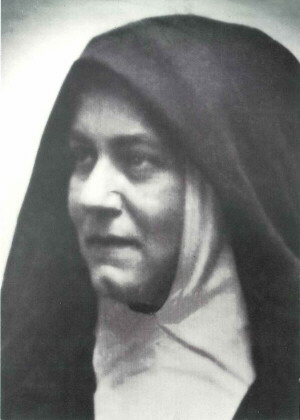
And doesn’t this make an awful lot of sense? Moving along in the spiritual life is moving along in relationship. This isn’t just a metaphor. It’s reality itself. Moving along in the spiritual life is moving along in our relationship with our Father in heaven, Jesus our brother, and the Spirit who abides, with these Two, in our hearts.
Of course, the immediate problem isn’t what’s simple. It’s what complicated.
Contemplation, as Saint Edith describes it here and as all the saints describe it, is supremely simple. What is more simple than two people, familiar, who know one another well, sitting with few words but knowing, loving, and doing in one another’s presence?
Meditation, which must come before, is the complicated bit. It can’t be dispensed with. In a relationship with someone, we can rarely skip the introductory phases, which certainly involve a lot of getting-to-know one another. We might even have to go to books to better learn about our new friend’s backstory. What is his hometown like? When she says “photography”, is there anything I can learn to better understand it? What is the slang he uses? In her profession, did they teach her certain things that might explain the way she interacts and shapes some of the sentences or critiques that bewilder me?
All that’s normal. But it’s like meditation. Only after a concerted effort to form a relationship into a stage where words can be fewer – mutual intentions are more silently and deeply understood, almost as if two wills were interpenetrating and flowing from one to the other – without there being awkwardness and confusion, can the “meditation” cease. There are signs that this time has come. There are signs in our human relationships. There are signs in our relationship with God also.
Contemplation is typically the fruit of many discursive meditations on the Lord’s life, the mysteries of faith, the mysteries and text itself of the Scriptures – or even acquired theological learning. We think. We do mental work. We put images together. We learn. Meditation forms a base of knowledge and images in the soul that are experience from which God can draw when conversing more silently, more familiarly, more contemplatively with a soul. This isn’t to say that contemplation is just another more complicated meditation. It isn’t. Not at all.
Contemplation is an enduring dart of love shot into the soul directly by God, as Saint John of the Cross says. It doesn’t originate with us. We can’t produce it. We can’t make it happen by our own efforts. If we could, it would be meditation. Meditation is like learning about someone new, finding out details about the hometown and job, working hard to know their particularity at the beginning. We can’t force and decide on contemplation or the familiar comfort that comes from being in the same room and silent. That stage is only possible by a mutual agreement, itself a silent agreement. We can’t choose it without God giving it to us.
There are signs that God, and ourselves too, want that contemplative time now.
What are the signs of falling into contemplation?
- Well, we can no longer get delight and refreshment from meditation: it tastes dry and it does not satisfy.
- Meanwhile, we worry that we’re not doing good by no longer meditating: it’s not that we want to run away, it’s that the way of meditation has become dark.
- We just want to rest in God’s presence, in a general, loving knowledge of God.
Translated into Saint Edith’s terms of everyday relationships, the analogues would be
- Well, we can no longer get delight and refreshment from talking and from looking up information about particularities that we should know. That’s not satisfying It;s not that we know everything. That’s impossible. It’s just that we’d rather simply sit with the person we know and love. We can. It’s comfortable. Thus, it’s better.
- At the same time, we don’t want to go somewhere else. We’re not being quiet because we want to leave. We’ve not stopped actively learning about her hometown or his profession because we’ve become apathetic. We still care. It matters.
- We just want to be there – together.
In all of this, the difference between meditation and contemplation – and the transition from one to the other – becomes clearer. It is a relationship. That’s no metaphor. Sure, the analogy has to be purified of anything strictly human. God is God, not human. But it is still truly, genuinely a relationship – in fact, more truly and more genuinely a relationship than any we can have below.
Some related posts:


 Contemplative in the Mud