
On 9 May 1948, Marcel Văn CSsR wrote a long, thoughtful letter to his older sister Lê. He was especially concerned about the life, general education, and religious education of his younger brother Lục, who was nine years old at the time. About halfway through this letter, Marcel begins to talk about prayer. This is a gem of a discourse for a contemplative soul – or, for that matter, for any soul taken into the love of the special place of children in the Gospel and in the Church.
 Marcel brings the subject around like this:
You know very well that in the countryside, we recite every morning and evening long prayers, and this is all very complicated. I don’t dare to slight this practice, because it is something that can console the heart of God, and what can give him as much pleasure as faithful people passing long hours close to him? Even so, following the rules of prudence, God does not oblige us to do something that is beyond our abilities.
Whose abilities? Marcel has in view his little brother. He is thinking first of his little brother, whom he loves particularly, but he also has in view “not all children, but at least… my little brother”. He thinks beyond the scope of this one letter. He is pushing his wisdom, which “some wise people consider just” (he may have asked for another opinion?), beyond one circumstance. But he is doing so gently.
What does Marcel say?
Long prayer at church is thus in itself a good practice… Even so, I consider this custom to be acceptable for adults who have the strength; I consider it a practice that really surpasses the strength of children.
In exchange, what would Little Văn suggest that his younger brother do to pray?
It is better to make [children] recite one “Hail Mary” or a short prayer such as “My Jesus, I love you a lot,” and then send them off to bed.
Of course, of course, he adds again, this is nothing to do with long prayer being bad! They are not bad. They are good in themselves. But things which are good in themselves are not good for all at all times. That is prudence. That is virtue. And prayer is intimately, inseparably connected to virtue. If adults can handle it, all the better.
But with children, ordinarily, exercises of piety must not be too long and must be proportional to their abilities, so that they do not become put off later.
Indeed, what are their abilities? Their abilities are simple. And, in the religion of the Incarnation – the religion of Bethlehem and Nazareth – that is not a bad thing.
Many children naturally have in their hearts very simple sentiments, but nobody teaches them to make use of these very simple sentiments to speak with God.
For a child who just wants to say, “My Jesus, I ate a cake. It was good. Did you ever eat cake? I like it. I like thinking of you when I do,” or “Little Jesus, I love you lots and lots and lots,” there is nothing proposed. Nothing simple. Nothing proportional to their abilities. And that’s a loss. Because these simple sentiments are good in themselves. They can be and, in fact, should be integrated into prayer. The payoff is much greater – it is supernatural – than teaching the natural disciplines of long prayer.
In addition to the natural simplicity of “many” children, Marcel adds a yet more general reason for deterring long prayer as a recommended practice for children and proposing many simple, short, happier prayers:
In addition, from the point of view of the body, this regime [of long prayers] is detrimental to their health… They are still fragile both in spirit and in body.
Children, by virtue of the way their body functions and grows and struggles, are physically weak or fragile.
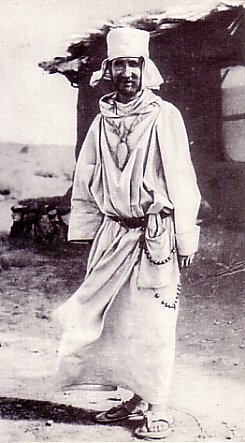 When I first read this letter of Văn’s I was struck by the similarity of argument to some thoughts of Blessed Charles de Foucauld. When he was still living with the Trappists in Akbès, Syria, Charles noticed that, due to the long prayer and complicated Office, the monastic orders were, for all practical purposes, closed to many Catholics of Armenian origin; their background, social and educational, was not suited. They did not know Latin. They preferred either simpler or, if long, less wordy prayer; even silence was easier and more fruitful. He suggested that, if he were to found any congregation himself, this was one reason for preferring silent adoration to a long vocal prayer.
Charles’ argument parallels Văn’s: one’s abilities are limited by one’s background and social development also. One must find, in Văn’s words, “the way most suited” to teaching people to pray!
From the preceding, we have a list of situations where simpler prayer seems preferable:
- actual or spiritual childhood
- physical weakness, fragility, or infirmity
- social and educational background
This is not to say there aren’t more. Poverty, weakness, and simplicity come in many external, internal, and social forms.
But…
But, if we are willing to humble ourselves and admit it, doesn’t that list cover, more or less, or more or less often, each and everyone of us?
We are all, from time to time, due to tiredness, fatigue (ponos), occasional slips in memory or indeed in our upbringing, or any number of factors – we are all susceptible to being speechless, without understanding of complicated arguments, like a child in approach to a topic, physically ill, or physically unfit for our circumstances in life and thus tired or broken down somewhat. All of these scenarios – and more – can hit us, trap us, or surround us. It is part of the human condition.
So, then, is our weakness in long prayer. When it can be done, it is good. But our abilities, our forces, and our strengths may not be there. What is the backup plan? It can be good, very good, also.


 Contemplative in the Mud