
It’s a real experience: we contemplate, but there comes a time when tasks which are good in themselves and required in themselves occupy our heart and, especially, our mind. We have to think and go about our business. We have to take care of others. We have to take care of ourselves. We have a duty. Something comes up. Our concentration is not on the love and truth of contemplation in themselves.
Our head is busy.
Where does contemplation go? It doesn’t just disappear altogether. Because, when the moment is right and if we haven’t squashed the gift underfoot, we can regain the contemplative gaze on Jesus, when our concentration is freed up again.
So where does contemplation go where our head is busy?
I’ve tried a couple of approaches to this question (first here and then here). This is yet another approach. Previous approaches asked about the structure of the human soul and about Jesus’ life. This approach is a bit different again; it is rooted in the teaching of Saint Francis de Sales on love. In that teaching, Saint Francis talks about the structure of the human soul, too. What does he say?
In the twelfth chapter of his Treatise on the Love of God, Saint Francis says that there are, in the soul, “four different degrees of reason”. To illustrate his point, he has recourse to the First Covenant, with its temple and the images and details of this temple that come to us. This temple, says Francis, is like the soul. It describes certain details and structures of the human soul, with its topography and depth. The temple which was in Jerusalem had three courts; Francis explains,
In this mystical temple [which is the soul] there are also three courts, which are three different degrees of reason; in the first, we reason according to the experience of sense; in the second, according to human sciences; in the third, according to faith.
Francis clearly gives the teaching that the soul has, as it were, a topography. There are certain levels of reason. We can apply our concentration to different parts of us. We, at different times, are, in fact, demanded by the moral law and by the love of God to do so.
But wait! All of this is about three courts. Saint Francis tells us in the title to his chapter (XII) that there four degrees of reason. Where is the fourth?
In fine, beyond this [beyond these three courts], there is a certain eminence or supreme point of the reason and spiritual faculty, which is not guided by the light of argument or reasoning, but by simple view of the understanding and a simple movement of the will, by which the spirit bends and submits to the truth and the will of God.
He reckons this fourth reason to “the [additional] sanctuary or sacred house, which was open to the high priest only, and that but once a year.”
He talks about this holy place. He gives his first two comments on it; then he adds,
Thirdly, none entered the sanctuary save the high priest; in this apex of the soul reasoning enters not, but only the high, universal and sovereign feeling [in a sense analogical to the feelings of the senses] that the divine will ought sovereignly to be loved, approved, and embraced, not only in some particular things but in general for all things, nor generally in all things only, but also particularly in each thing.
In short, in this highest degree of the human soul, the only thing that can enter is that which is, properly speaking, above reason and thus, for sure, above what can be grasped and surrounded by our attentive consciousness. It is just like a “feeling”. But it is
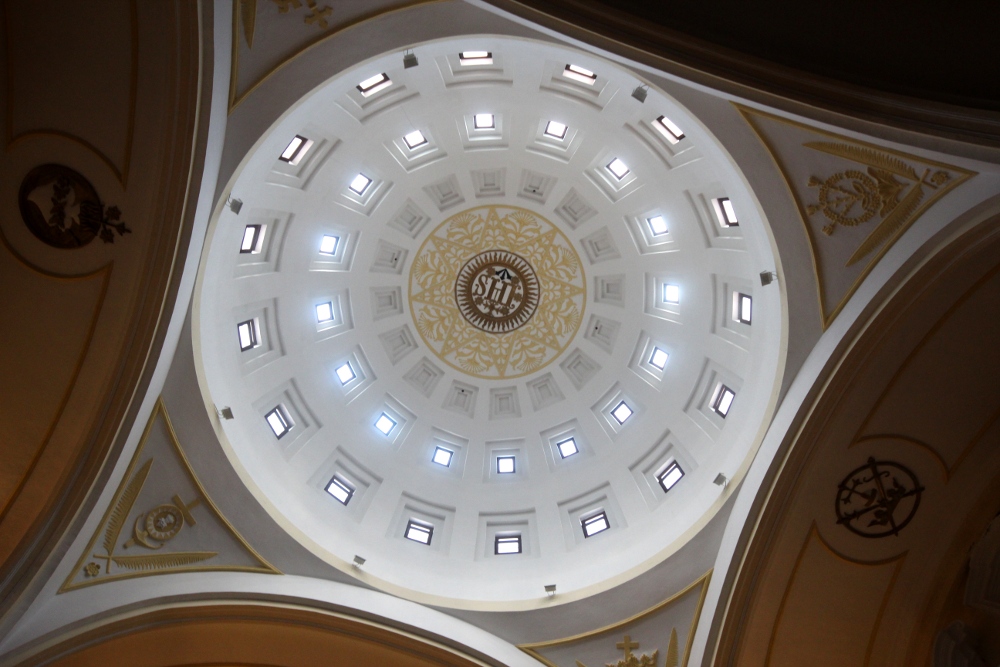 a feeling far above the senses – far, far above, into the realms above conscious reasoning itself. It is a “feeling” in the sense that it is not conscious reason in itself, in its typical course. But it is a “feeling” that is above what we normally call reason, not below it. There exists a capacity in the human soul that is like the window, at the very top of the dome, through which heaven enters.
Saint Francis adds,
For although faith, hope, and charity spread out their divine movements into almost all the faculties of the soul, as well reasonable as sensitive, reducing and holily subjecting them to their just authority, yet their special residence, their true and natural dwelling, is in this supreme region of the soul, from whence as from a happy source of living water, they run out by divers conduits and brooks upon the inferior parts and faculties [of the soul].
Because there is a certain order to the human being, created by a God who is not the god of confusion, this “fourth degree of reason” symbolized by “the [additional] sanctuary or sacred house, which was open to the high priest only, and that but once a year,” this highest point can govern, spread light and nourishment onto, and advise the other, lower parts of our reasoning, our concentration, and our attention. All of this is consistent with the doctrine of John of the Cross, who says that “His Majesty dwells substantially” in one part of the soul, the highest, most secret, most hidden even from angels and devils: substantially in the highest, but overflowing and advising and tempering and delighting the other parts of the soul. Saint Francis is more explicit and insists at greater length – and, indeed, with a more Scriptural emphasis on this point – but he and John are in agreement. Contemplation always abides in the most secret, highest, or innermost part of the soul.
Because contemplation is about a holy love, it always abides in the higher region of the soul for one who is in a state of grace. (Contemplation is, after all, a gift and promise made in Baptism.) When our head is busy, the contemplative, loving gaze on our Father the Trinity and on the Humanity of Jesus simply withdraws into that which isn’t conscious for us: the “sanctuary of the high priest”. However, the contemplation continues. Why? Simply because this “fourth degree of reason”, this “sanctuary of the high priest”, is real.
Indeed, it may be that we don’t consciously enter this “high priest’s sanctuary” very often. After all, as Francis notes, this are of the temple “was open to the high priest only, and that but once a year.” That is a far cry from frequent. It might get many cobwebs. It might get cluttered and inhabited by some animals. It might become many things while we are consciously directed at other worthy, human tasks.
Not to worry. If we are doing our real duties, it is still there. Contemplation is still there. It is ongoing. It is accessible when, “once a year,” we can enter. And the fact that it is ongoing and continual, in the higher region of the soul, means that our worthy, human tasks are sanctified; the temple is sanctified, and so are its rooms, and so are its uses.
Action – as taught by the doctrine of the “degrees” of the soul in Saint Francis – does not destroy contemplation. Not a bit. Not even a teeny, tiny, itsy-bitsy bit. Action – and this is the constant teaching of the Doctors of the Church – is made alive and more fully itself by a contemplation that is, at times (“once a year”), conscious and entered into for itself; and at times, simply overflowing and gushing onto our other faculties that we are using, to sanctify and uplift and cleanse and fortify them in their human activity.
Some related posts:


 Contemplative in the Mud