
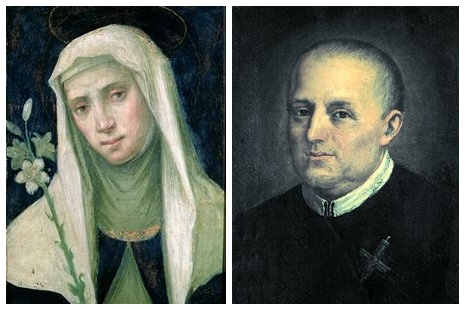
I want to write a little bit about the parallel stories of two apostolic “hermits” or “recluses”.
Yes, apostolic “hermits”.
It’s not a typo! It’s an intentional word.
1. Catherine of Siena
This Doctor of the Church has a well known case of spiritual development. A third-order Dominican who knew that action must overflow from contemplation, she shut herself up in her room for three years, communing in silence with God. She left her room for Mass, meals, and some family duties. In the meantime, she was longing for a “perfect” union with God.
When God had brought her far enough, she emerged from her “cell” into the wide world, where she cared for victims of the plague, had disciples, intervened in and also was invited into papal affairs, and, in general, became known for a very action-filled life.
She was an apostle. She started out with a life somewhat like a hermit. When she was ready, God made “more” or her. Her contemplation overflowed into specific actions. But – in Catherine’s case – not before. She very literally sought the “one thing necessary” (Lk 10:42) with a kind of strictness; after she became part of it like the fish in the sea and the sea in the fish, then she was “sent” as an apostle.
2. Clement Maria Hofbauer
This Redemptorist previously spent time as a hermit and, until a few days before he died, longed for many of the things of the hermitic life. He was a hermit in his home country and in Italy. He retained a certain independence that he acquired as a hermit (he only became a religious after attaining more than 30 years of age). He longed for – and found – silence and withdrawal amid the hustle and bustle of his work; for example, he was famous for praying the rosary while walking along the street, surrounded by others. His spirituality was forged in the fires of 18th-century hermits in Austria.
Yet Saint Clement was called the vir apostolicus, the “apostolic man” by the people of Warsaw and Vienna. He was unceasing in his apostolic labours. It was as if nothing could stop him.
What a contradiction in merely human terms!
But it is a spiritual story like Saint Catherine’s. The formation occurred in terms of silence. When he emerged to find a vocation, he was given a truly apostolic life. Where it seemed he was going was not where he ended up.
Others?
I’m not saying such radical shifts are common. But they are undoubtedly possible as God the Spirit guides us. There are some souls in whom I have long suspected the possibility: that one may pursue a contemplative vocation and find an apostolic one. (I don’t say one may find an active vocation; I mean an apostolic one, where contemplation is already found quasi-continually and the activity overflows from this alone. We are looking at, with Saints Catherine and Clement, people who only desired action after attaining a profound stability of contemplation and interior prayer.)
What do you think? What of your experiences? Or those of the saints?
Some related posts:


 Contemplative in the Mud