
The eye is the lamp of the body. So, if your eye is healthy, your whole body will be full of light; but if your eye is unhealthy, your whole body will be full of darkness. If then the light in you is darkness, how great is the darkness! (Mt 6:22–23)
There are two ways to view this passage: one regards spiritual things and another regards physical things.
As regards spiritual things, the older tradition, at least in the Latin Church, views “healthy” here as being “simple”. A “simplicity of intention” towards God and, by extension, created things, is what is heard. If we want the “one thing necessary”, we have light. I remember reading such interpretations in, for example, Blessed Elizabeth of the Trinity. Others, like Saint Alphonsus, stress that our eye has to be “simple” in itself for the sake of chastity.
This is good.
But there’s also the question of the physical meaning. Jesus clearly talks about our eyes and the fact that they are lamps.
When I was first learning about Christianity and working my way through reading the Bible the first few times, someone explained this passage to me something like this. Jesus says the eye gives light as a lamp. In reality, we know now that the eye receives light; it does not give it. This was a common scientific presupposition in Jesus’ day, and he simply works with it to make a point.
Today I would happily say that this explanation is very unsatisfying.
In fact, I think it truly misses one of the points regarding light.
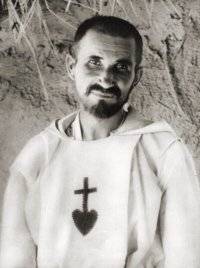 I’ve seen photos of the eyes of Blessed Charles of Jesus. I’ve seen photos of Blessed Elizabeth of the Trinity. I’ve seen photos of Saint Thérèse. I’ve met people whose appearance has given me the same impression as these saints. In the presence of holiness, it’s possible for eyes to be a lamp. It’s possible for eyes to give off light, a kind of spiritual light. It is possible, because the saints show the possibility. It is not a bright, overpowering light. It’s a serene, confident light. But it is certainly a light. It is certainly a gift from the eyes. In some very certain way, the eyes are not receiving; they are giving. And what they give is like spiritual light.
In fact, all of this is so real that Philipp Veit, a painter-friend of Saint Clement Hofbauer’s, claimed that it was difficult to capture the expression of his eyes because he “is always looking within.” It’s so real that, for some people, the reality is something of a problem: How do you describe or represent this spiritual reality?
In the measure that the indwelling Trinity takes us, burns us gently, and converts our hearts into divine love (without losing our human nature), we are transformed. But when we are transformed, we are also transfigured. The image in the tradition is that or a piece of metal thrown into the fire. It remains metal. Its impurities are burned away. It takes on the burning colour and light of the fire. So it is with contemplative love.
When all our faculties and thus, in some unpredictable way or another, our body are transfigured by the divine light, then how could our eyes only take and receive light from the earth? Surely, then, their primary, overriding function would be to give divine light. And that’s exactly what Jesus says happens.
(Transfiguration is not just an invention of the Christian tradition. It’s also a firmly Scriptural concept.)
When the eyes are not a lamp, we are in darkness. When the eyes cannot give light, we are in darkness inside. That is, when the eyes are searching, hungry, wanting to consume the world or wanting something from the world (which Saint John calls the “lust of the eyes”, 1 Jn 2:16), then everything inside is already dark. Eyes may be lamps, or they may be hungry. Eyes may give, or eyes may receive.
It seems a paradox. But that’s actually what Jesus says: the eye can be the lamp of the body. It can be the first place in our body touched by transfiguration and grace. And this makes a lot more sense than any other explanation I’ve heard of the “physical” or “biological” Gospel passage, because it actually takes Jesus’ choice of words seriously, as well as the experience of the Church.
Related posts:


 Contemplative in the Mud