
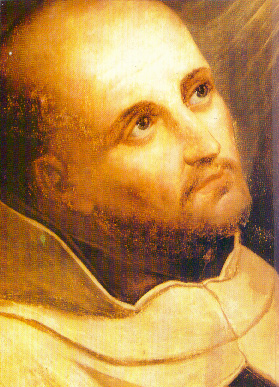
One day, only a few weeks after the first great shock of my spiritual life, when my will first resolved to become Catholic at all costs, I picked up Jacques Maritain’s The Degrees of Knowledge (or Distinguish to Unite). I was reading much philosophy. This seemed like a good book. The book spans knowledge of many kinds: scientific, philosophical, theological… mystical/contemplative. The long work ends with two chapters on the doctrine of Saint John of the Cross, the Church’s “Mystical Doctor”.
I read these last two chapters. I read and re-read these last two chapters. This was something else altogether. Nada nada nada y en el monte nada. Yes, it was exactly like that. My experience of being stripped of consolations lined up with this teaching of Saint John. There was something right here. I knew that. But the depth and conciseness of experience was extraordinary. Who was this man who had spoken so much truth so concisely? I had to know him. I had to know John of the Cross and make him my friend.
Today, 14 December, is John’s feast day. His mark is all over this blog, I hope. For today, I want to give a few words on the doctrine of the dark nights found in the writings of Saint John of the Cross. I write about the dark nights often, but maybe it is worthwhile being concise. Hopefully in a few short words I can capture something worthwhile…
Primer on the two “dark nights”:
- There are two “dark nights” in John’s writing (though, from another angle, they form one long night with one long purpose). They both mark a transition from one general way of living the spiritual life to another. One has to do with the sensible part of the soul, the other has more to do with the will and spiritual part of the soul.
- The first transition and trial is the purification of the senses. When we begin the spiritual life, when we begin to really live in a state of grace, we rely on consolations from God in our prayers. We, in turn, have many inordinate desires and actions as regards sensible, physical things. We need to get rid of these. We try; we must try! But ultimately, removing them is beyond our power aided by grace. Thus God weans us off sensible consolations, purifying our use of the senses and slowly eliminating or reducing our sins related to the senses, to the flesh, to impurity, to unchastity, to gluttony, and so on.
- It hurts. We must trust, trust, trust, and know why God is doing this to us. It’s for our benefit.
- The second transition is the purification of the spirit. When we have been purified in our senses, we’re still far from being perfect. We’re even far from being close to perfect. Our will has inordinate desires, too, maybe for unnecessary close friendships, spiritual consolations, presumption, pride, the desire to teach rather than learn, confidence in our ability not to sin, attachment to a spiritual director, disturbance of mind when we do commit unintentional sins, and so on. Well, God wants us to be perfect as he is perfect. What does he do? He asks us to kill the spiritual roots that are infected in the “old man”… and try we must! But on our own work aided by grace, we have not enough steam. God works a similar operation as he did in purifying our senses: his mode of operation will dominate to clean us up. Now he purifies our will. Temptations can be extreme, even against faith and hope. We might even fall; but if we get back up and have learned the lesson, all will be well – as far as possible in this world.
- Both dark nights in John’s writing are described from the point of view of generous souls living a predominantly contemplative way of life. Depending on our history, our generosity, and the amount of activity that crosses through our prayer life, exact psychological experiences may differ. However, the essentials are universally true. (This is why moral theologians and confessors like Saint Alphonsus or Father Garrigou-Lagrange basically follow and apply the “dark nights” to all walks of Christian life, however active or contemplative. The nugget of truth is real. The applications are diverse.)
- The goal of these “dark nights” is contemplative union with God, infused like a dart of love into our soul. The first night introduces us to contemplation. The second one brings it into every aspect and every minute of our lives, like finding Jesus everywhere and in everything, close in our heart wherein he dwells with the whole Church of Heaven. They are the normal ways of the Christian life. The goal is transformation in Christ, continual or quasi-continual.
Other key points:
Of course, John says a lot more than this.
For example, another theme that he is big on is the transformation of the soul and body into, and by, Love. We are burned in the fire of Love and begin, like metal, to glow without being consumed. We become like the fire, though we don’t lose our own nature. (This is closely related to the theme of the “dark night”, for the darkness leads to a quiet light inside, where the Trinity dwells.)
His poetry is beautiful.
He lived what he preached.
He’s a Doctor of the Church.
If you’ve never read Saint John of the Cross, perhaps the chance is open for you. He’s a wonderful friend to have.
Saint John of the Cross, pray for us!
Some posts about the teaching of Saint John of the Cross:
- Three Conversions in the Spiritual Life
- The Dark Night’s Dryness Experienced in the World
- Pardon My Spanish
- Dark Night of the Soul Lived Outside the Cloister
- Giving It All Up – On the Road
- The Necessary Logic of the Dark Nights According to Saint Alphonsus
- Dark Night of the Soul: East and West
- “Still” True


 Contemplative in the Mud