
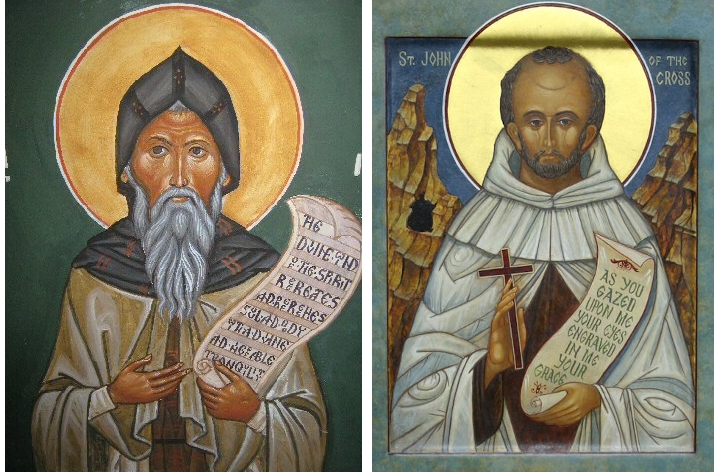
It would be interesting to see if anyone could guess whether this was written by Saint Macarius of Egypt or by Saint John of the Cross:
It remains to uproot the defects and the evil that is in man. Only the power of God can do this. It is not possible or feasible that man can uproot his defects and insufficiencies by his own power. To struggle, to fight, to be flayed, that’s man’s business. But to uproot, it’s the business of God.
It’s by Saint Macarius.
Or this:
Until a soul is placed by God in the passive purgation of that dark night, which we will soon explain, it cannot purify itself completely of these imperfections or others… In this cure God will heal them of what through their own efforts they were unable to remedy. No matter how much individuals do through their own efforts, they cannot actively purify themselves enough to be disposed in the least degree for the divine union of the perfection of love. God must take over and purge them in that fire that is dark for them…
That one’s Saint John.
The point is, Saint John of the Cross, while truly the Church’s Mystical Doctor and having truly said things in a way that is special, is part of a great tradition in the Church. It’s the tradition of humility and littleness that, when the soul is utterly annihilated and alienated from itself, opens itself to the transfiguring love of God. Love takes hold of everything in going through the dark night. And then, on the other side, consciousness of this Love and docility to this Love reign supreme:
You must be crucified with the one who was crucified, suffer with the one who suffered, so that you can enter into the glory with which he was glorified [not only in heaven but here below]. (Macarius)
God wars against all the imperfect habits of the soul and, purifying the soul with the heat of his flame, he uproots these habits from it and prepares it so that at last he may enter it and be united with it by his sweet, peaceful and glorious love, as is the fire when it has entered the wood. (John)
And when Love reigns supreme, it touches every aspect of the person, soul and body:
Like a needle thrown into the fire changes dimension and transforms into fire, in the same way bodies that are transfigured, while retaining their identity, become Spirit. (Macarius)
Note that it’s the same image that John of the Cross will use: a fire that burns without consuming!* The dark night of the soul, the transformation of the soul, the glorification of the body: they are themes of the universal Church, though with different emphases in the Eastern Churches and in the Latin Church.
Father Le Guillou, who studied the theme of contemplation and transfiguration in the Church, had a few comments that I think worth repeating in this context.
The first is that Christians in the East had a profound intuition of the universal call to the transfiguration of the body, the combat that it requires, the love it requires, and the work that is entirely God’s that it requires. Following, however, on Saint Augustine’s central conversion experience in the history of the West, those in the Latin Church have had an acute sense of the problems this entails (sometimes to the point of misreading the universal call itself). We can dispense with neither of these profound intuitions. One of the remarkable things about John of the Cross, the Church’s Mystical Doctor, is the prevalence of both themes: transfiguration and an acute sense of problems.
The second is that, even when a sense of the problems cannot exactly be considered “acute” or pointedly detailed, the theme is present:
Two themes always recur [in Eastern Christianity] when talking about transfiguration: pentos, that is, tears and compunction; and ponos, that is, fatigue to the point that we can go no further. One must be disappropriated of oneself, and this has for its road humiliation and humility
– which we can only take so far by ourselves. At some point, God will make the path dark, bring us to (seemingly) nothing, and humble us to open the only place where he can enter and reign in us: our hearts, and, by that, everything, down to the fingertips.
With the theme of the dark night of the soul uniting mystical writers in Eastern and Western Christianity, one can safely follow the advice:
Pray for humility; pray for transfiguration; pray for contemplative love; pray for prayer. Beg for heaven. Pray and weary God with these petitions, and accept what God gives us; it’s the most we can do.
– –
* The image actually recurs throughout the whole of the Christian tradition. In the context of Carmel, I can remember the image in Saints Teresa and Thérèse. Outside the context of Carmel, I can think of Marcel Văn; similarly, in Alphonsus Liguori, that great disciple of Saint Teresa, one reads,
As fire penetrates a bar of iron, and seems to transform it into itself, so God penetrates these souls and fills them with himself.
Alphonsus there is talking about the Beatific Vision and the Church of Heaven. But anyone familiar with his writings knows that he would also apply this, all proportions guarded, to the saints on earthly pilgrimage still. The image of a transforming fire that does not destroy nature is a constant in Christian spiritual literature. And it clearly spans East and West.


 Contemplative in the Mud