
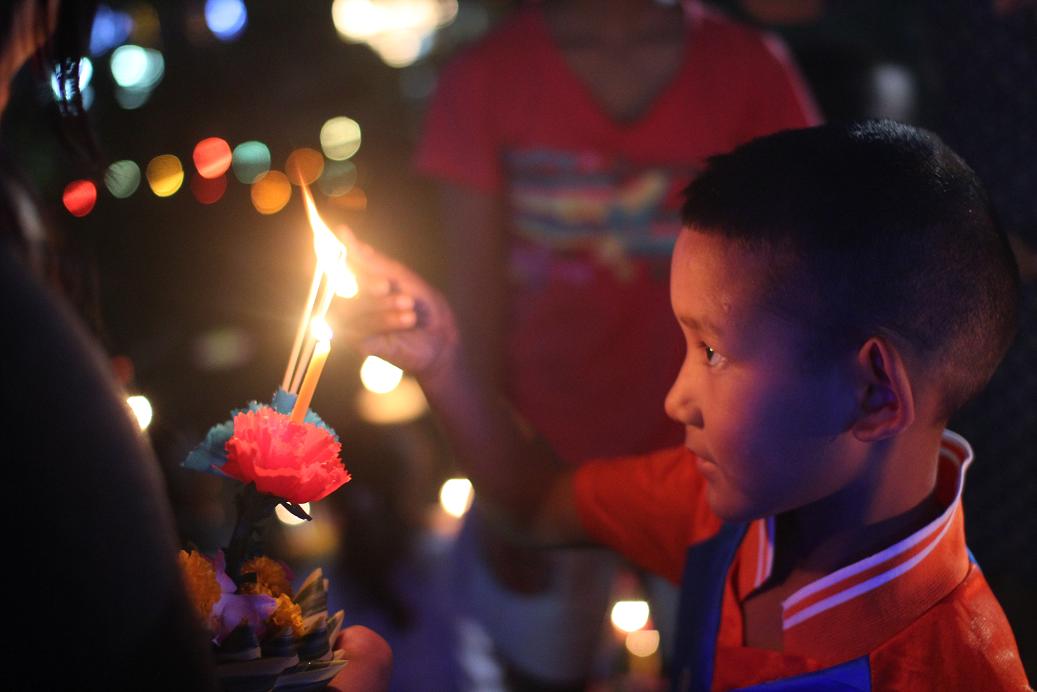
Behind Ken, with a hand on his shoulder and giving more light to his face, is Jesus.
I don’t know if this is more properly classified as an act of imagination or an act of hope (and faith and love), but it’s perfectly clear to me that it’s an act that a Christian (contemplative) in the world cannot do without. The Gospel says, “Just as you did it to one of the least of these who are members of my family, you did it to me” (Mt 25:40 NRSV). In other words, we can see Jesus in or behind everyone we meet. In fact, it’s often the only thing that gives us the strength not to sin and to do real good to those we meet.
Now, Ken is poor (certainly by Western standards). He goes to a school for kids like him. He is Thai. (For Thai people, he’s also a relatively dark-skinned Thai.) He’s participating in a festival that will “make merit”. There is also a real danger, though mitigated depending on the genuine heroism of the people he knows, that he or any of his more commonly targeted – e.g., deaf – friends at the Center might have been picked up by a gang and asked to beg on street corners and flyover bridges.
That’s not his story. Those are just some preliminaries about this photo.
Check that to not dismiss Ken, there are some obstacles that we must not trip over: economics, poverty, racism, religious differences, slavery, human rights. To really see him, be able to laugh with him, teach him, and be his sister or brother, we need to have taken enough splinters out of our eyes to be able to see him.
What splinters might these be?
- Racial prejudice which, coupled with unequal distributions of power, can have the added dimension of racism.
- Any economic theories or prejudices that revolve around laissez-faire capitalism or socialism, neither of which will give this boy a start in life.
- Forgetting that, although “abolished”, slavery is still real and could affect or could have affected him through his friends.
- Any inability to take people, in their concrete condition, as they are, including religious differences.
- Any unwillingness to talk to this boy as if he is capable or any hang-ups because he is poor.
That’s for a start.
We cannot be contemplatives in the mud of the world without taking a stand against what the mud has done, in social circumstances, to human beings. Could you look this boy in the eye and pontificate about a pet economic theory (that happens to benefit you in some way)? Could you see Jesus standing beside him and have any racial prejudice? Could you deny that you have many privileges – e.g., white privilege – that he doesn’t? Could you look down on the festival he’s celebrating?* Could you neglect the reality of slavery in the world as it is?
Of course the answers are no: No, that’s not compatible with contemplation in the world. It’s not compatible with seeing Jesus in those we meet. It’s not compatible with God lifting us up above our human nature to suffer divine things.
It’s just not possible to see Jesus and, at the same time, have eyes too blind to see past your nose.
Many Christians committed to contemplation in the world have faced these issues head-on. The guidebook of the Charles de Foucauld Lay Fraternity, for example, says,
The fraternity must take a clear position when human rights are threatened by any form of oppression but without placing individual members under an obligation to concur with or act on that position.
Little Sister Magdeleine, who founded the Little Sisters of Jesus, challenged her congregation:
Look inside yourselves. Every heart holds some hidden, secret racism and its roots go very deep. You do not admit it to yourself, but you always look at your neighbour with feelings of your own superiority. The proof of it is that you pass judgements. You wouldn’t judge if you thought of yourself as being like the other person or as a bit worse than the other.
René Voillaume, the founder of three contemplative-in-the-world religious orders, meanwhile says regarding prejudice,
In order to possess… humility, it is indispensable to have reached a degree of interior poverty that permits us to be consciously detached from our own cultural values and from all human superiority – and that is difficult, very difficult.
Situations involving power as well as prejudice are all the worse.
In recent times, a saint – Blessed Charles de Foucauld – left us all an example himself. In colonial Algeria, the French authorities were willing to let the slave trade go unpunished and unchecked. He spoke often of the topic and lobbied – as much as a man living in the middle of the desert with the local people can lobby military, government, and Church officials:
We must say – and have the authorities say – “This is not permitted.” Woe to you hypocrites, who write on your stamps and elsewhere Liberty, Equality, Fraternity, Human Rights, and who attach the shackles of slaves. You falsify the money which bears these words, in condeming people to slave galleys and permitting children to be stolen from their parents and publicly sold. You punish the theft of a chicken and permit that of a person.
We must love our neighbour as our self and do for these poor souls that which we would wish them to do for us… We must love justice and hate iniquity. When the government commits grave injustices against those who are to some extent in our charge… we must tell them… We do not have the right to be “sleeping sentinels,” “silent watchdogs” (Is. 56:10), or indifferent shepherds.
And make no mistake, the words apply today also. Sadly this reality is still formidable, and those of us who are better off are, because of the connectedness of this world, now gaining all the more by it.
It has to be known, it has to be felt, it has to be said, it has to be fought. That’s the human response. But it’s also the contemplative response.
The real situation of the contemplative soul on the highways of the world is that she must say, “I cannot look you in the eye unless I have eyes with which to see. Clean my eyes, O God, of my prejudices, let me see what privileges I have stood on, and kindle in my bones a desire to change myself and the world.”
– –
* The Redemptorists in Pattaya clearly don’t think so. They put on these celebrations for Loy Krathong (ลอยกระทง), after all.


 Contemplative in the Mud