
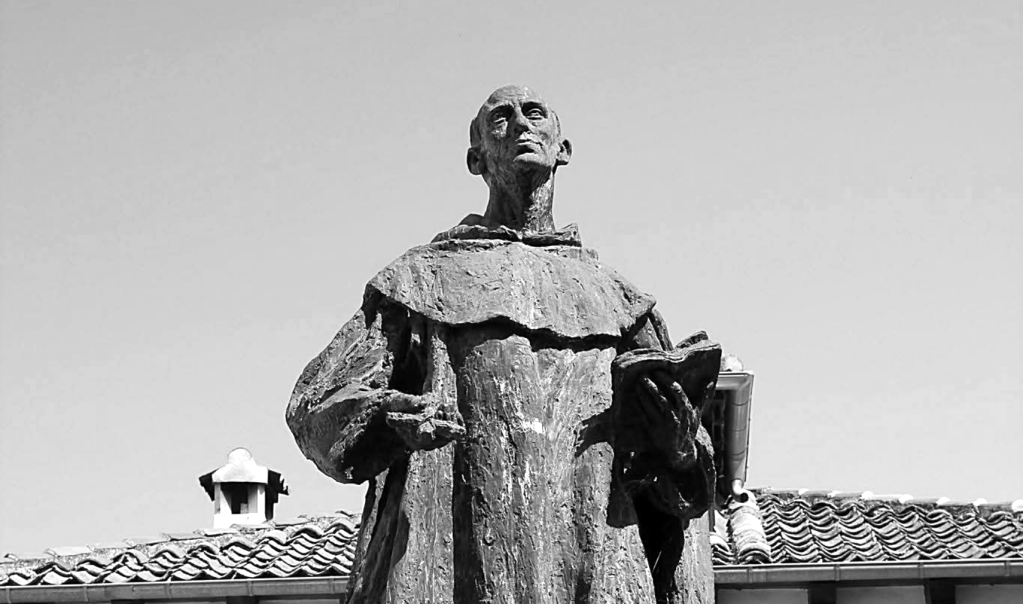
Few works on the spiritual life have influenced me more than St. John of the Cross’ Living Flame of Love. One thing that draws my attention is the detailed reproaches directed at spiritual guides who harm the souls that are entrusted to them.[1] The Flame’s an indispensable text in the abuse crisis. But there’s also something else remarkable about it. Consider the second stanza of the poem:
O sweet cautery,
O delightful wound!
O gentle hand! O delicate touch
that tastes of eternal life
and pays every debt!
In killing you changed death to life.[2]
This is a poem—and a corresponding prose commentary—about the divine touch. It’s a way of expositing spiritual experience with images and concepts that are tactile in origin, not, e.g., visual or auditory. In the grand scheme of things, this option isn’t particularly common, and the consequences are nothing to be scoffed at.
As Pope Leo recently said, we need to “constantly examine our spirituality and the ways in which we express our faith, in order to ensure that they are truly incarnate.”[3] That, someone else has pointed out to me, is what I have been trying to do since relaunching this blog. And—if we have to point out my own modus operandi so brazenly and immodestly—one of my pet projects has been to bring to light again that our relationship to God, to Christian prayer, and especially to contemplation needs a phenomenology of touch. I’ve addressed this when I’ve spoken of Pope Francis’ claim that touch is the most religious sense and when delving into the divine touch according to Bl. John of Ruusbroec. John of the Cross can contribute to this ongoing project, too.
Four images: cautery, wound, hand, touch
John’s official explanation of the second stanza of the Living Flame is simple: “The cautery is the Holy Spirit, the hand is the Father, and the touch is the Son” (Flame 2.1).[4] That is to say, each of these tactile images refers to God. It is God who is doing the cauterizing, the wounding, and the touching. The Trinity as a whole is implicated. The work, in fact, is very intimate to the nature of God. It is, so to speak, the deification of the human subject who is being cauterized, wounded, and touched.
The touch in question transpires at the deepest centre of the soul, which John calls its “substance.” It is not a physical touch, and it is not felt in a determinedly corporal way. At the ground where we are most alone with God, God is present. As if just on the other side of the veil, a breath blows. But it’s fiery. It burns like a cautery. Like a brand wielded by a medicine-worker, it heals, too. Its contact is as immediate as possible:
O, then again, repeatedly delicate touch, so much stronger and mightier the more you are delicate, since you detach and withdraw the soul from all the other touches of created things by the might of your delicacy and reserve it for and unite it to you yourself alone, so mild an effect do you leave in the soul, that every other touch of all things both high and low seems coarse and spurious. (Flame 2.18)[5]
Characteristically in the Living Flame, the author is thinking of the final stages of purification and union with God, and this paragraph is no exception. From this standpoint, the human person comes to find the phenomenology of spiritual touch incredibly, almost unbearably, but somehow gently, strong; the phenomenology of physical touch, in contrast, seems so rough and unnecessary—or, put another way, it is something, but it is not God and cannot compare with God. The soul intuits that the bodily analogue for its intimate understanding is tactile. Accordingly, the original tactile sensations of the body pale in comparison to that burning touch from the other side of the veil.
The purpose of this divine touch at the deepest centre—the “substantial touch,” to so speak—is the transformation of all the powers, abilities, capacities, and relational extensions of the soul into divine love. This is a standard sanjuanist teaching; the image used to support it on more than one occasion is the log which, in catching fire, itself becomes the fire (Night 2.10.1–4; Flame 1.25).[6] Here we get a slight modification. Fire and transformation characterize the cauterizing touch: “The wound left by material fire is only curable by other medicines, whereas the wound effected by the cautery of love is incurable through medicine; for the very cautery that causes it, cures it, and by curing it, causes it” (Flame 2.7).[7] This process continues until, “all cauterized and made one wound of love, it is completely healthy in love, for it is transformed in love” (Flame 2.7)[8]. Gone are any visions that we can be saved without being changed. God wants everything.
In a later section, I’ll address the question of what John’s teaching has to say to those of us who are not, at least consciously, so close to our deepest centre. But for now, this is a good place to start. John’s is insistently a winner-takes-all logic. The divine beloved is the winner. This should bring us hope.
Meanwhile, it’s worth noting that the language of burning conveys a sense of pain. The proposed path isn’t an easy one. But it’s the right one. The purpose of all this ardour and touching at the deepest centre of the soul is health and healing:
For you, O divine life, never kill unless to give life, never wound unless to heal. When you chastise, your touch is gentle, but it is enough to destroy the world. When you give delight you rest very firmly, and thus the delight of your sweetness is immeasurable. You have wounded me in order to cure me, O divine hand, and you have put to death in me what made me lifeless, what deprived me of God’s life in which I now see myself live. (Flame 2.16)[9]
So, while we might be inclined to speak of the crackle of the wood as being the sound of the fire, or the spark off the log as being the visual emanation of the flame, John turns aside from this imagery. He takes us away from a phenomenological perspective that is limited to sights and sounds. Where he lands is a sense that is much wider in scope. It is not localized to eyes and ears. The most basic contact with God is just that: con-tact, a tactile experience together with.
Three phenomenologies: touch, sight, hearing
The Living Flame is the last of John’s major works. Prior to it, he wrote commentaries on his poem The Dark Night, one named The Ascent of Mount Carmel and the other eponymous, and his poem The Spiritual Canticle. The treatment of spiritual touch in these works is not as in-depth as in the Living Flame, but they do cover some important terrain, specifically by relating the phenomenology of touch to those of seeing and hearing.
The Canticle and the Night in particular give us a glimpse of John’s conviction that, although the deeper union with God may be where the language of touch becomes most essential, even the more basic explanations of the earlier stages of the spiritual life cannot completely dispense with the terminology. There are even then, he says,
attributes and graces of the Beloved that by means of this union assail the soul and lovingly touch her in her substance.
The most sublime and delightful knowledge of God and his attributes, which overflows into the intellect from the touch produced in the substance of the soul by these attributes of God… is the most exalted. (Canticle 14-15.12)[10]
Yet, even in the more habitually exterior regions of the spiritual life, to encounter God through spiritual touch is virtually life-changing: “Since a substantial touch is wrought in such close intimacy with God, for which the soul longs with so many yearnings, a person will esteem and covet a touch of the divinity more than all God’s other favors” (Night 3.23.12).[11] Indeed, in his most ascetic and least mystical work, John speaks of how these “delightful touches and conjunctions” in “the substance of the soul” are essentially “spiritual feelings” (Ascent 2.24.4).[12] This shows two things. First, even discussion of our own ascetic efforts needs to involve some awareness of this most interior grace. Second, for John, tactility and sensibility merge. What they have in common is their apparent baseness, their diffusiveness, the inchoateness of their version of sensation and the manner of gaining experience of the world and the other.
This last fact leads us into the briar patch. It’s hard to penetrate much farther into sanjuanist thought without getting scratched.
Our contemplative theologian is adamant that some reference to tactile sensibility belongs in a description of the experience of the deepest centre, where the Trinitarian Persons pitch tent, where there is the substantial indwelling in the soul, where the finest point of the spirit is both held in being and conformed to God. We shouldn’t bypass it. It’s the appropriate phenomenological model. The reason for this is the following. Of all the external senses, touch is the most diffuse, since it is spread over the body, and “the breadth and capacity of an object corresponds to its refinement, and the more diffuse and communicative it is, the more it is subtle and delicate” (Flame 2.19).[13] It would be inadequate to generate a description of the spiritual life that didn’t concentrate all the breadth and diffusiveness of our sense of touch, properly abstracted from our physical imaginary and spiritualized, and place it in the substantial centre. Such a description would fail to align the incomprehensible centre with the least intellectualized of the senses. There’s just something intuitively wrong with an un-tactile spiritual core.
At the same time, when John tries to interrelate his phenomenologies, problems arise. According to him, “the feeling of the Beloved’s attributes are [sic] felt and enjoyed by the soul’s power of touch, which is in its substance, and the knowledge of these attributes is experienced in its hearing, which is the intellect” (Canticle 14-15.13).[14] This seems reasonable. Spiritual touch, which lies at the deepest centre, overflows onto spiritual hearing, which is the intellectual faculty. We might prefer to think of the mind as a spiritual power of seeing rather than hearing. No matter. Either way, it is touch that is primary, higher, more deeply aligned to the incommunicable centre. The particularized powers of knowing, or even loving and remembering, are more distinct and less conducive to tactile imagery. This is self-consistent. But it collides with John’s own stated beliefs.
John clearly states that, in his opinion, the sense of touch lies on lower ground than other senses. Specifically, he claims that hearing is a more delightful sense than feeling or touch, because it is more spiritual than they are (Canticle 14-15.13). On the face of things, this claim can’t be squared with those of the previous paragraph. Touch can’t—or shouldn’t—be both the best illustration of the highest interiority and the lowest of the external senses.
We’ve got a conundrum. I’m not sure how exactly John intended to resolve it. But since he was a pretty attentive reader of St. Thomas Aquinas and Aristotle, I’d like to offer a word from them that would help out our Mystical Doctor. We often hear from modern Thomists and Aristotelians something akin to what John says: sight and hearing are the most exalted—the most intellectual, the most spiritual—of the senses. But actually, this isn’t true. At least, it doesn’t encompass the straight and unadulterated letter of the Angelic Doctor and the Stagirite. According to their writings, it is actually touch which is the sense most connected to intelligence, because it brings the most immediate contact with things.[15] Touch is the most religious sense because it’s the most intellectual sense. That’s the principle that John uses—or should use—in the Living Flame.
Touch, putting us most intimately and immediately in contact with things, is the best phenomenological undergirding for our language about the most intimate and immediate contact with God. The divine hand burns, wounds, touches, stirs, transforms us at the deepest centre of our being, where the point is the finest. This is evidently more than we have words for, and the diffusiveness of tactile sensibility helps us understand that ineffableness, too. Meanwhile, we are whole human beings. What happens at the deepest centre is not isolated. The effects of this primordial experience of God spill over from the centre to the more particularized and localized of the things we can do, feel, and experience as human beings. The language and imagery here, as John uses them, are likewise more particularized and localized. He speaks of sight and hearing. In the perhaps debased Aristotelianism of the Renaissance, he calls these senses higher than feeling and touch. Yet, where it matters the most, the inevitable image at the highest point of the spirit, or most interior centre of the soul, is tactile—cautery, wound, hand, touch.
Two opinions: few, many
I promised a section for those of us who feel far from the centre. There are various reasons why we might identify that way. Regardless of our state of life and mind, I want to suggest that the sanjuanist teaching is at the antipodes from despair.
It’s hard to list everything that might put us off from taking John of the Cross seriously, but perhaps the most common concern is that the saint, as a Carmelite friar, is too focused on the experience of cloistered religious, not laypeople active in the world. But that’s a mistake. As the translators of the Living Flame say, “John wrote this loftiest of his works for a laywoman.”[16] This is not a work for the Carmelite nuns and friars. It is one crafted specifically for a layperson.
We find throughout the Living Flame a conviction that God leads souls as God wills: “In the first place it should be known that if anyone is seeking God, the Beloved is seeking that person much more” (Flame 2.28).[17] That is the primary order of business. The general order of events that John describes is not more important than what God does with an individual soul. Schemas do not usurp reality. It is perfectly legitimate if our journey is a bit all over the place. There might be moments when we are at the deepest centre, then at the heaviest of exterior occupations. It is not for us to determine the road: “God leads each one along different paths so that hardly one spirit will be found like another in even half its measure of procedure” (Flame 3.59).[18] God knows what is best. We do best to accomplish what is within our power, relinquish control whenever that is indicated, and allow the divine work to take place in us.
Moreover, it is of no concern that we, active as we are in the world, have wounds that are not immediately caused by the divine flame. John is quite clear that, in the deepest union at the most interior point of the soul, all the sufferings, whatever their origin, serve the transforming power of the divine cautery:
To understand the nature of this wound, which is addressed by the soul, it should be known that the cautery of material fire always leaves a wound where it is applied. And it possesses this property: If applied to a wound not made by fire, it converts it into a wound caused by fire. Whether a soul is wounded by other wounds of miseries and sins or whether it is healthy, this cautery of love immediately effects a wound of love in the one it touches, and those wounds deriving from other causes become wounds of love. (Flame 2.7)[19]
While the exact logic need not follow for the earlier stages of the interior life, the general principle remains true. Whatever the proximate cause of suffering, the remote cause is God. God can use it. The only barrier is the degree to which we are distant from God, not the wounds that come from creatures themselves. There is no reason to give up if we are harmed by hands not divine. Rather, it is even more incentive to allow God to carry us within. It is greater motivation to fall into the divine palm.
Indeed, if we should struggle with figuring out how any of this applies to us as laypeople, we’re in good company. John himself seems to work his way through the contradictions in real time. One minute, he claims: “Few persons have reached these heights” (Flame 2.12).[20] The next, he counters: “Many saints have attained to this substantial touch during their lives on earth” (Flame 2.21).[21] So, which is it: few or many? It cannot be both at once and under the same respect.
There is only one resolution to the problem that I can see. Few get to live in the state of substantial touch continually or habitually. Many might be brought to it and then find themselves released, to plod on a bit more, then united again. The latter could happen for any number of reasons. One is our sinfulness. I imagine this explanation—this accusation—will quickly leap to mind. But for as much as it does explain, I don’t think it’s a catch-all. I’d like to suggest another angle, too.
One further potential explanation, however foreign it may be to the thinking of a sixteenth-century theologian, is psychological—in the modern sense. There exist psychological partitions in the soul caused by neurodevelopmental divergence, trauma, and/or perhaps even (some) personality disorders. Such disintegration is not unheard-of, nor reducible to personal sin. Some of us may be all over the place all at once quite simply because, if the psychological sciences teach us anything, it’s that there are potential discontinuities between the conscious realm within us, crevices below consciousness, and domains that pass above our conscious apprehension. Partially visible phenomena include, but are not limited to, mismatches between willing and executive functioning, feeling and affect, and time and emotional processing; wholly interior experiences are more varied still. We are splintered within. One side of a fracture could be touched by that sweet wound of divine love before the other. There might be many fault lines. It’s extremely complicated.
At any rate, John teaches us that few arrive but many get there. This is a difficult truth. But it is no doubt part of the divine plan. For, as I’ve tried to show, the divine touch is so important to our sense of being fully human. It transforms us. It steadies us. It is gentle and supportive: “this touch of God gives intense satisfaction and enjoyment to the substance of the soul and gently fulfils her desire for this union” (Canticle 14-15.14).[22] It also communicates a sense of spiritual peacefulness: “By means of substantial touches of divine union, the soul obtains habitually and perfectly (insofar as the condition of this life allows) the rest and quietude of her spiritual house” (Night 2.24.3).[23] To get there is not necessarily to arrive—but it can be. No matter how things appear on the surface, we should never underestimate the presence, commitment, and action of God.
Concluding thoughts
One could hardly be faulted for thinking that the preferred idiom of spiritual theology is visual and auditory. We want to see God. We hear his Word. Such phrases are commonplace. They’re important. But if they’re all we have to offer, if there’s nothing else grounding our talk about prayer-experience, then we’ve got a problem. Well, actually, we’ve got problems, plural. I can see at least two.
First, there’s the confrontation with inauthenticity and artificial intelligence (AI). Talk about beauty is cheap, and discourse about truth is starting to go on sale. AI can ape human language. It can generate slop that paralyzes our sense of beauty, if not reality. Machines speak words they know not. But one thing a technology can never do is feel—possess and live a tactile sensibility. Mathematical models can’t touch grass. And that, in the final analysis, is why they cannot know. It’s why they cannot love. If Christian experience has any claim to truth, goodness, and beauty which can withstand the revolution in AI, then we must have phenomenological words for it that are rooted in the more bare physicality and sensibility of our sense of touch.
The other major thread of concern that I see is the abuse crisis. With all the physical and sexual abuse in the Church, it is absurd to try to heal the spirit with light and sound alone—even spiritual light and sound in the form of truth, love, and beauty. To be sure, I don’t disparage the transcendentals. In fact, I think the approach to contemplation through the language of beauty is one of the signature changes of the past decade—and I welcome it. But to restrict ourselves to those high-fallutin’ phenomenologies would be a fool’s errand. If nothing else, we’ll never heal the deepest centre without a prayerful look at touch and without a tactile spirit in prayer. Indeed, any abuse that targets the deepest spiritual recesses of the human person is itself an assault on the divine touch—the cautery, the wound, the hand—and it is, in my judgment, no mistake that the work in which St. John of the Cross devotes the most attention to the phenomenology of touch is also the work in which he offers a stinging critique of spiritual directors and his greatest insight into spiritual abuse.
What we need today is a renewed discussion of contemplation. We need to approach it in its integrity. Talk of beauty isn’t enough, nor are words about truth and love. Even combined, the three won’t cut it. Christian contemplation, considered in its integral state, may entail a focused gaze, absorptive of both the mind and heart—but to become so, it is rooted all the way in our most primordial external sense of touch and internal sense of memory, up to both the intellect and will, in a fusion of knowledge and love; and exceeding our own capacities, there is always the diffusiveness of the divine touch at our very centre—burning, cauterizing, transforming, and ardent with a creative love beyond our most intimate self, yet more immediate to us than the nerves in our fingers.
[1] Flame 3.30–62, in The Collected Works of St. John of the Cross, 3rd ed., trans. Kieran Kavanaugh and Otilio Rodriguez (Washington, DC: ICS Publications, 2017), 684–98.
[2] Collected Works, 52.
[3] Leo XIV, Angelus for the 2nd Sunday in the Season of Christmas (January 4, 2026).
[4] Collected Works, 658.
[5] Collected Works, 664.
[6] Collected Works, 416–17, 651.
[7] Collected Works, 660.
[8] Collected Works, 660.
[9] Collected Works, 663.
[10] Collected Works, 530.
[11] Collected Works, 454.
[12] Collected Works, 241.
[13] Collected Works, 664.
[14] Collected Works, 530.
[15] See Thomas Aquinas, Commentary on Aristotle’s On the Soul, 2.9.482–85, in Commentary on Aristotle’s On the Soul, On Sense and What Is Sensed, On Memory and Recollection, trans. Kenelm Foster et al., Latin/English Edition of the Works of St. Thomas Aquinas (Green Bay, WI: Aquinas Institute, 2023), pp. 202–3. We might also note that the sense of touch is apparently the most earthy—cf. Thomas Aquinas, Commentary on Aristotle’s On Sense and What Is Sensed, 1.2.72, p. 388. This is not irrelevant to an integral ecology of contemplation.
[16] Collected Works, 634.
[17] Collected Works, 684.
[18] Collected Works, 697. The translators note: “This observation is important also in the interpretation and application of John’s own writings” (697n16).
[19] Collected Works, 659–60.
[20] Collected Works, 662.
[21] Collected Works, 665.
[22] Collected Works, 530.
[23] Collected Works, 455.

 Contemplative in the Mud