
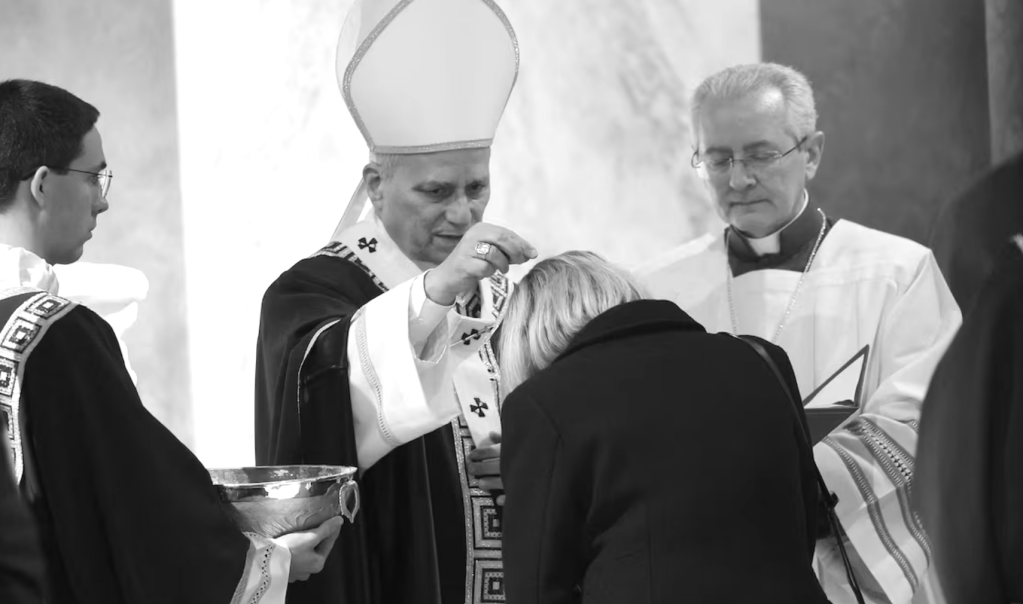
At the start of this year, Pope Leo urged us to “constantly examine our spirituality and the ways in which we express our faith, in order to ensure that they are truly incarnate.”[1] He has not been doing a bad job of that himself. In fact, just today, although he did not utter the wonderful word contemplation, he offered some words which really get to work re-examining our incarnate spirituality and its expression.
The Holy Father’s homily for Ash Wednesday pauses on some of the words and actions of his predecessor, St. Paul VI, and as that reflection winds down, he adds the following:
Today, we can recognize that his [Paul VI’s] words were prophetic as we perceive in the ashes imposed on us the weight of a world that is ablaze, of entire cities destroyed by war. This is also reflected in the ashes of international law and justice among peoples, the ashes of entire ecosystems and harmony among peoples, the ashes of critical thinking and ancient local wisdom, the ashes of that sense of the sacred that dwells in every creature.[2]
For Pope Leo, the ashes are perceived in their weight. In other words, it is through the sense of touch—pressure, contact, immediate and lingering—that the burnt palms are known to us, and it is in the jargon of tactile phenomenology that our relationships to a suffering world are presented. There is weight to a world that is burning, whether from climate change or military conflict; to the disregard for law, peace, and justice; to the shrinking ecological community, human and non-human; to the impoverishment of critical thinking; to the losses of ancient, particularly situated knowledge; to a collapse of “that sense of the sacred that dwells in every creature.” We feel—not just see or hear—what we might just as well call the cry of the poor and the cry of the earth.
But Leo doesn’t utter a peep about a cry; he speaks of a felt weight. The reference point is the ashes, not a sound. This, I think, is all the more remarkable as his homily is for Ash Wednesday. Of course, today is the most appropriate day to speak of ashes. But it’s also the most appropriate day to reference the psalm antiphon: “today, if you hear the voice of the Lord, harden not your hearts” (cf. Ps 95:8). The cry of the poor and the cry of the earth are the proximate manifestations of the distant call of the Father. God’s children cry out. Well, to the attuned ear, then, God does likewise.
That, however, isn’t Leo’s Lenten argot. It’s weight. Sound itself is a pressure, my scientific brain tells me, so this is an acceptable thematic development. But phenomenologically, there’s a gap. I don’t feel the contact of ashes on my forehead as I do a sound wave in my inner ear. The experiences are distinct, and they communicate something different about my bodily experience—and when I transfer the thoughts to spiritual things, the nuance varies with it.
We are being called not just to hear and to listen and to understand. There is something else demanded, and there is something more at stake. We need to perceive the world’s sufferings with our whole bodies, experience its contact, anguish with its pressure. We need not just spiritual eyes with which to see and spiritual ears with which to hear, but spiritual skin with which to feel. The sense of touch spreads wider and more diffusely over the boundaries of who we are. We need that in our bodies. The spiritual analogue is just as essential. Because sometimes sights and sounds get stuck beyond the edge of our perception—as is the case with today’s forehead-borne ashes.
Maybe this little presentation of the spiritual life in tactile terms doesn’t seem worthy of a whole blog post. But in a world saturated with light and sound, there’s value in recovering the primacy, that is, the primordial character, of touch. At least, that is what I’ve been thinking over the past few years. Indeed, I was pondering it more recently still; I’d already planned a new post on this theme for tomorrow. Perhaps, though, with Pope Leo’s encouragement, the topic might occupy me—us—more throughout Lent. There is, of course, enough weight to it.
[1] Leo XIV, Angelus for the 2nd Sunday in the Season of Christmas (January 4, 2026).
[2] Leo XIV, Homily for Ash Wednesday (February 18, 2026).

 Contemplative in the Mud