
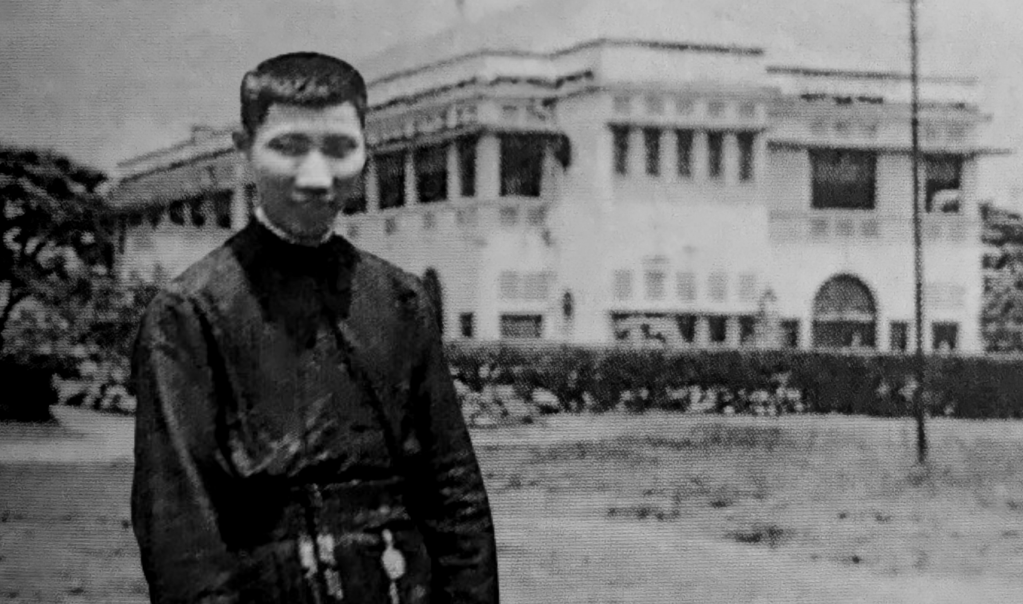
As I was thumbing through the complete works of Marcel Văn for a passage upon which to base a post for the anniversary of his death, I came quite quickly upon a poem. It’s a difficult poem. I don’t mean by that that the language, imagery, or composition is complex. I just mean that it’s emotionally and spiritually hard—rough, painful, thick, tricky to situate in experience.
Staring off the page at me were seven stanzas of four lines each. Marcel had called the poem “I Keep Secret the Wound in My Heart” (OWP18).[1] It goes like this:
My brother, I do not speak of this wound to you,
For fear of causing turmoil in your heart.
I have not the courage to do so,
In risking by that to prompt your pity.I have already shared with you the sweetness,
I beg you leave me the bitterness.
Despite the suffering, despite the sadness,
Let me sort it out in peace.O my brother, do not force me,
Since if I do not drink bitterness,
Suffering will not penetrate my heart,
And I will not understand the fire of love.The wound of my heart matters little.
It will finally heal itself.
I sorrow for those who day and night
Carry in their souls the stain of sin.And it is not all; there are still many
Of those who cry in the night far from you.
And how many others who have disowned the Gospel.
How can I resign myself to this bitter reality?Remain at peace my brother, do not bother yourself!
I take pleasure in remaining joyful when I am not so.
And for what reason have I to suffer in silence?
Because suffering is buried in my heart.My brother, I do not speak to you of this wound
For fear of causing trouble in your heart.
I love you with an overflowing love.
My sadness is nothing other than a silent joy…
What does it mean? Well, this poem was, according to its author, written on an “evening of solitude for my soul” on a “day of the month of March 1951.” That might be insignificant to the casual (or date-forgetful) reader of Văn. But spending a little time comparing his biography and the correspondence with his spiritual director, Father Antonio Boucher, situates the piece well. March 1951 is quite specifically a time of renewed spiritual abuse from a confessor and superior.
Context
I’ve covered this period in the Vietnamese Redemptorist brother’s life before, in the opening part of my series on Marcel Văn and Clerical Abuse. Accordingly, I’ll try to summarize the matter and stick to some points and quotations that I haven’t previously touched on. Suffice it to say, though, that in his two years in the Saigon Redemptorist community, immediately before he went to Đa Lạt for his second novitiate, Marcel speaks of his heart becoming “cold” and “alone,” and the Love of Christ in him seeming to become “sadness and emptiness,” “a dry pond,” “a desert closed on all sides” (2A 543).[2] The internal suffering increased greatly; external circumstances were connected, if not the cause.
Marcel repeatedly says that he knew beforehand that he would have to suffer a lot at the hand of superiors in the Congregation (e.g., A 878; To Father Boucher, 25 Mar 1951; To Father Boucher, Apr 1951; To Father Boucher, 22 Sep 1951; OWN1.60; OWN7.24).[3] Still, it hurts him badly. After all, as I document at length in the Marcel Văn and Clerical Abuse series, there’s a lot of psychological and spiritual residue in Văn. There’s a lot of stuff to trigger and reactivate.
The thing is, though, that while the priests in this community were indeed abusive about work to be done, what happens at Saigon isn’t only general workplace abuse of power in temporal matters. Marcel’s conscience and spiritual dignity are attacked too; power is abused regarding private, spiritual things. His confessor intruded into his private notebooks “accidentally” (To Father Boucher, 25 Mar 1951)—an act which psychologist-theologian Joël Pralong explicitly identifies as “spiritual abuse.”[4] A few days later, in confession, the priest says to Marcel, “I do not know why you’re tempted so often” (To Father Boucher, 30 Mar 1951). And at this point, Marcel knows without a doubt that this guy is bad news. He leaves the relationship with this confessor without even consulting his spiritual director, Father Boucher, who lives in another city in Vietnam. He removes himself from the reach of an oppressor.
In the months that follow, Marcel becomes quite concerned about the interrelated dynamics of authority and spiritual accompaniment. It does not seem as if he was actually compelled to keep any particular confessor. But he perceives the possibility that a superior will overstep his authority “in the spiritual domain, where limits are imposed on him” (OWN4.33). He talks openly about the possibility of compulsion where there should be “freedom of conscience”:
If, for example, the Superior forbids such or such a Father as a spiritual director or as confessor, that is something absolutely unreasonable, which violates the freedom of conscience of the religious. What is to be done then? It is purely an example and I dare not state that that exists in fact. It is why the superior has only the authority of the superior, he cannot usurp the authority of the spiritual director or religious, neither can he hinder the freedom of conscience of the religious. Is that not the case, my Father? (To Father Boucher, 28 May 1951)
He adds:
From the fact of being superior he has not all the powers for directing and controlling external things and affairs of conscience and the thoughts of each religious. (To Father Boucher, 28 May 1951)
In addition to hinting at abuse of conscience, Marcel in the same letter speaks about what it means for a superior to be “abusing his authority,” i.e., abuse of authority, abuse of power (To Father Boucher, 28 May 1951).
This is the period in which our poem was written, and it’s part of a period that Marcel describes as “the most sorrowful year of my life” (To Father Boucher, 1 Oct 1951). Considering everything this young man went through, that says a lot about the impact of spiritual abuse, abuse of conscience, and abuse of power and authority—because that’s certainly the context that we’re talking about here.
Discussion
I don’t want to overburden this meaningful poem with too many of my own musings. But I do want to highlight how emblematic it is of Văn’s approach to the spiritual life, which is in so many respects one of Christian salvation amid clerical abuse.
First, note the theme of woundedness. There is a lot of psychological and spiritual dysfunction and dysregulation that results from abusing someone’s psyche, spirit, and conscience. That’s exactly what we’re in the middle of here. In general, to heal this kind of moral injury, we need to both receive something from others and give something of ourselves. According to one of Marcel’s psychologizing interpreters, whom I have had occasion to quote once already in this short post, the indispensable tool of healing is
immersion in the Christian community, where, in daily life, fraternity woven together with charity, mutual listening, and attention to others is experienced. Through contact with one’s brothers and sisters, little by little, the fear of being unloved, the fear of ending up hurt, and the suspicion thrown in the direction of others all diminish, and, in turn, the resistance to letting oneself be loved by others abates too. The gift that others make of themselves stimulates my own gift of self, and love is freed up to build genuine communion. The injured person is strengthened, becoming more and more capable of welcoming and accepting the wounds and faults of others.[5]
The difficult dynamics of community are indeed present in Marcel’s poem. He keeps some things quiet. He has his reasons. But he still wants to be present in community.
Second, I’d draw attention to the theme of suffering and sadness. It runs all through the poem. Everything culminates here in Văn’s favourite call to change suffering into joy. That’s where the last line of the last stanza takes us. Hints appear earlier on, too. This isn’t the place to discuss that theme in detail. But note that it has connections to persistent internal woundedness. I think there’s a case to be made—I’ve made it before, anyway—that the Gospel-centred act of changing sadness into happiness is, for Văn, a kind of resilience in the face of spiritual abuse.
Third—and this hardly exhausts this poem, now that we’ve situated it in its historical context—I’d draw attention to the theme of silence. The author chooses silence. He works things out in silence. He asks to speak joy into the world but keep the wounds in silence. I think this has two major reflections in the teaching and life of Marcel.
In the first place, it reminds me of how the little brother learned not to lash out, but to bear patiently the wrongs done to him, so as not to multiply the spread of physical and psychological violence. But he doesn’t become a pushover. Rather, he knows the exigency to either revolt hopelessly or resist patiently—and he chooses, as much as possible, to actively resist the oppressor with gentleness and patience. This is facilitated by his deepening experience of God’s loving presence and the psycho-spiritual resilience that that enlivens us. It’s tough. When he fails to meet the ideal, it’s not by falling into affable agreeableness so much as startling rebellion. But he makes progress.
In the second place, the silence that Marcel chooses foreshadows something major. It makes me think of the manner of his own death. Arrested by the Communists, he was “locked for five months in a dark cell” (To Tế, 17 Nov 1955). Sent on to another camp, he spent a further eighteen months in a dark, isolated cell (SH 41).[6] Just as in March 1951, so too in the prison camp Marcel’s suffering was not an empty reality. The reason that he has to “suffer in silence” is that “suffering is buried in [his] heart” (OWP18). Buried—like a grain of wheat that falls to the ground and dies to bear much fruit (cf. Jn 12:24).
And so, knowing how much trust I have in Marcel—both as an intercessor and as a teacher of methods—I find in this poem of his considerable hope. The buried seed grows up, right? Văn continually prophesied this. Writing to those who had endured the same abusive presbytery as him, he assures them: “Your Marcel will help you still more when he will be in heaven” (To his young friends at Hữu Bằng, 14 Jul 1946). If them—then surely others who share in their condition. In fact, in a private writing, he’s adamant: “There are a number of things that I would wish to do on earth, but it is impossible for me to accomplish them. My sole hope is that, once in heaven, I will see all my wishes accomplished.” (OWJ 25 Aug 1952) He leaves us some stirring words at the close of the Autobiography:
And now here is the last word that I am leaving to the souls of whom you are the representative… I leave to them my love; with this love, small as it is, I hope to satisfy the souls who wish to make themselves very small to come to Jesus. That is something I would wish to describe but, with my little talent, I do not have the words to do so… (A 882)
He leaves his love. We can question what exactly that means. But there are some things we can definitively rule out. Someone’s love isn’t a thought. It’s not an ideal, a book, a pleasant memory. It isn’t stuck in the past, frozen, lifeless. In reality, “love is a force” (2A 28). It’s an active thing, because love aims at the good of the other and union of wills in the future or the present. And when the love in question is the love of God, “love is an infinite force” (OWN8.16). There are no limitations and restrictions. Marcel leaves us an unimaginably, inconceivably active force. This is his last word.
I love you with an overflowing love.
My sadness is nothing other than a silent joy…
Image: Redemptorist Monastery at Saigon, superimposed with a photo of Marcel Văn from 1952
[1] OW = Marcel Van, Other Writings, trans. Jack Keogan, Complete Works 4 (Versailles: Amis de Van Éditions, 2018).
[2] 2A = Marcel’s second redaction of the Autobiography, which is not available in full but from which I am quoting based on occasional snippets in the Bulletin des Amis de Van (1995–).
[3] A = Marcel Van, Autobiography, trans. Jack Keogan, Complete Works 1 (Versailles: Amis de Van Éditions, 2019); To = Marcel Van, Correspondence, trans. Jack Keogan, Complete Works 3 (Versailles: Amis de Van Éditions, 2018).
[4] Joël Pralong, Marcel Van, le don de soi qui guérit, Une Mission Extraordinaire 21 (Versailles: Amis de Van Éditions, 2021), 66.
[5] Joël Pralong, Les larmes de l’innocence. L’enfance abusée et maltraitée. Un chemin de reconstruction (Nouan-le-Fuzelier: Éditions des Béatitudes, 2015), 89–90.
[6] SH = Father Antonio Boucher, Short History of Van (Versailles: Amis de Van Éditions, 2017).


 Contemplative in the Mud