
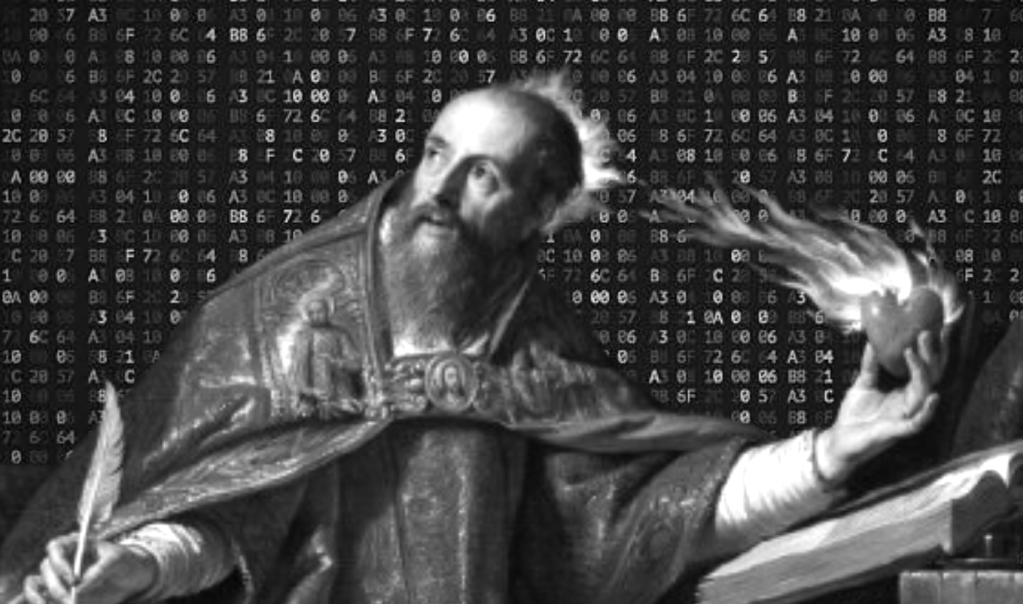
Last year on World Communications Day, I offered a few disparate thoughts on contemplative communication. This year, I want to offer what I think is the most basic sketch of a contemplative approach to artificial intelligence (AI). This is a technology which I am not reactively opposed to. In fact, I have personal experience with it, including peer-reviewed publications on its design and implementation in the field of engineering. Nonetheless, I think that not just our collective but also our personal engagement with AI needs serious discernment, if it’s not to lead to a further impoverishment of what Pope Francis called “our God-given aesthetic and contemplative sense.”
Through both Pope Francis and the Dicastery for the Doctrine of the Faith (DDF), the Vatican has been signalling pretty clearly about one of its non-negotiable principles regarding AI, and it’s actually one that has roots in Augustine—and, of course, in the circumstances of the AI revolution, we have quite providentially been given an Augustinian pope. In fact, we know that Leo XIV intends to rise to this challenge. For example, four days after his election, he said this to journalists:
As you know, communication is not only the transmission of information, but it is also the creation of a culture, of human and digital environments that become spaces for dialogue and discussion. In looking at how technology is developing, this mission becomes ever more necessary. I am thinking in particular of artificial intelligence, with its immense potential, which nevertheless requires responsibility and discernment in order to ensure that it can be used for the good of all, so that it can benefit all of humanity. This responsibility concerns everyone in proportion to his or her age and role in society.
So, maybe we should take this all seriously. My idea is to start with the principle common to St. Augustine, Papa Francisco, and the DDF.
This principle involves a distinction between the useful and the contemplative—or usus and fruitio, utility and mystery, use and the transcendentals of being.
What’s useful? Maybe applications in medicine, engineering, and other professions are matters of utility. I need mechanisms to more quickly and accurately reach a preliminary diagnosis or screening. I need tools that help with the transcription of information from auditory inputs to written outputs. I need more efficient and adaptive control systems that regulate material flows in a chemical plant. These are examples of technology helping me towards another goal. Although we might find some appeal in the niftiness or the mathematical precision, the weight of our attention here is definitely on ease or efficiency. We’re thinking not in terms of ends but in terms of means.
What’s contemplative? The truth is—truth that we can rest in and which draws the will to settle in it with a love that does not seek to modify or manipulate, but rather appreciate and admire, even when shadows strike through the light. Love, too, is contemplative—regarding the mystery of the other person or of material reality as good not merely for a purpose, but in itself, to respect and protect for itself. And if truth and love speak contemplatively, so then does beauty—for the regard for beauty is precisely that look we have at something which speaks a kind of truth to our heart, while feeling the need to respect, protect, and promote it in itself, not merely for some other end.
As I said, I didn’t just make this up for myself. This is basic Augustine, and it’s a distinction that’s been accepted in the context of AI by both Pope Francis and the DDF. As regards the holy Bishop of Hippo, you can open the first book of his De doctrina christiana (On Christian Teaching). The difference between uti and frui occurs a couple dozen times in that brief text. Here’s the first instance:
For to enjoy a thing is to rest with satisfaction in it for its own sake. To use, on the other hand, is to employ whatever means are at one’s disposal to obtain what one desires, if it is a proper object of desire; for an unlawful use ought rather to be called an abuse. (De doctrina christiana I.4)
Augustine goes on to say that “if we wish to return to our Father’s home, this world must be used, not enjoyed” (ibid.), but I think that this hard dichotomy is too much. It’s true that God is our ultimate end. And in this world there are means. But created things have God-given thickness in themselves. This is pretty clearly taught by the DDF in the context of AI. In fact, we have this gem:
True intelligence is shaped by divine love, which “is poured forth in our hearts by the Holy Spirit” (Rom. 5:5). From this, it follows that human intelligence possesses an essential contemplative dimension, an unselfish openness to the True, the Good, and the Beautiful, beyond any utilitarian purpose. (Antiqua et Nova 29)
The contemplative dimensions are distinguished from “any utilitarian purpose” and explicitly identified as truth, beauty, goodness—the transcendentals of being, original and ultimate in God, but nonetheless present in an intermediary way in created things. It’s a bit more complicated than Augustine. But Augustine’s distinction is in there.
Two remarks of Pope Francis, too, seem to me to draw on the usus–fruitio distinction. First, there is a demand made in last year’s message for the World Day of Peace:
Artificial intelligence ought to serve our best human potential and our highest aspirations, not compete with them. (no. 2)
Second, there is this complementary section of Francis’ letter to the President of France for the occasion of a summit on AI:
In my most recent Encyclical Letter Dilexit Nos, I distinguished between the operation of algorithms and the power of the “heart”, a concept dear to the great philosopher and scientist Blaise Pascal, to whom I devoted an Apostolic Letter on the fourth centenary of his birth (cf. Sublimitas et Miseria Hominis, 19 June 2023). I did so in order to emphasize that, while algorithms can be used to manipulate and mislead, the “heart”, understood as the seat of our deepest and most authentic sentiments, can never deceive (cf. Encyclical Letter Dilexit Nos, 24 October 2024, 14-20).
I ask all those attending the Paris Summit not to forget that only the human “heart” can reveal the meaning of our existence (cf. Pascal, Pensées, Lafuma 418; Sellier 680). I ask you to take as a given the principle expressed so elegantly by another great French philosopher, Jacques Maritain: “L’amour vaut plus que l’intelligence” [Love is greater, worth more than, intelligence] (Réflexions sur l’intelligence, 1938).
This clarifies what we might otherwise call “our best human potential and our highest aspirations.” There is something remarkable about the more basic attractions of the heart, for it includes genuine human propensity to love, which is distinct in this view from a utilitarian intelligence that knows not love, but only calculation, manipulation, and the use of means, without reflection on ends—for ends are, with whatever rightness or limitations, loved. Indeed, as with the DDF, we are back here at speaking of contemplative human dimensions. As I sleuthed out in February, the Maritain text that the late Holy Father refers to is in fact an essay on contemplation in its fully Christian sense. This really is all about contemplation. That is the essential battle.
Well, it seems to me that we have now some fundamental Augustinian—I mean, contemplative—principles of decision-making about AI in our individual lives.
Things are different, of course, whenever there are social factors like coercion. There’s a whole other layer of issues if, for example, employers are forcing workers to use AI or replacing them with AI, given that, as far back as Leo XIII, Catholic social teaching has suggested that workers should be involved in ownership and decision-making as far as possible and desired by the workers themselves (cf. Rerum Novarum 46).
Anyway, for the individual choice, we might want to consider two separate cases: non-generative AI (such as voice-to-text transcription, medical diagnostic applications, or engineering control system design) and generative AI (i.e., AI used to generate text, speech, images, and other enhanced products or interactions).
In the case of non-generative AI, I can’t see any reason to proscribe a well-designed technology trained on data that was obtained in an ethical manner. Such AI seems to fall, as far as I can tell, within the Augustinian category of uti, usefulness, utility. There is perhaps no moral restriction. It is perhaps perfectly human to employ any amount of AI in these domains—provided, of course, that it’s not been unethically trained and is not overly consumptive of the resources of our common home. Those can be big provisos. But I suppose they’re not impossible.
I think, however, that things get rather more complicated with genAI. Not only is this kind of technology difficult to train ethically (by which I mean not only questions of unjust appropriation of data, but also the inclusion and promotion of the voices of the poor, the oppressed, and the marginalized, who are more significant dialogue partners than the rich, the strong, and the long-since heard). In addition, we must carefully and honestly discern something about usus and fruitio.
With every use of genAI, we have to figure out whether, and to what extent, our intention is, or could legitimately be, usefulness, rather than a communication of the human contemplative dimensions of truth, beauty, and love. We need to involve self-examination (as to our goal), regard for moral norms (any abstract rules), and consideration of what our audience or interlocutors can reasonably expect from us (social awareness). This initial discernment sounds like a lot. And it is. This is new. It’s also big. At first, authentic discernment will probably take us a fair bit of time. Once we are used to it, however, the evaluation might speed up. It might take but a moment—habitus being “second nature” and all that.
Through honest and clear discernment, we will know whether, and to what extent, an implementation of genAI—the avatar of utility—is reasonable. That sets the upper limit or boundaries of its use. To exceed the measure of reason would be morally wrong. It’s fundamentally disordered to put usus where we ourselves intend, or could only ever legitimately intend, fruitio. We can’t do that without harming ourselves and/or others.
Or, to cast the same rule in a positive, rather than negative, form: At the end of the day, we should be able to say of all AI usage that there is usus (utility) only where we expect usus, and there is fruitio (enjoyment, contemplative dimensions, a human relationship to truth, artistic conception, beauty, etc.) where we expect fruitio.
This is not the whole of the AI question, but it is a substantial chunk of it. And the amount of genAI usage that passes this basic test is quite low. It is probably lower than we—certainly the enthusiastic among us, maybe even the skeptical among us—think. And that is the most generous and moderate way that I can express my thoughts on this matter.
If I can dare to mention it, there’s one more contemplative consequence. We are currently going through a social crisis in our God-given aesthetic and contemplative sense. Now, on top of everything else, there are people who replace meagre, though expected, amounts of fruitio in social spaces with more and more usus. Our surroundings become increasingly utilitarian. Our social ecosystems become increasingly manipulative. Even when the personal use of genAI might be okay, it’s being put into social spaces without first having a conversation about it in the same way we’d have a conversation about noise and light pollution. This is just making the situation worse, because right now we need more contemplative presence, more mystery, more human depths, more communication of the heart, not less. This crisis is, I think, very acute. One senses that we’re on the edge of a precipice.
It sounds bleak. But I do think that with an Augustinian pope, we have been gifted with the right person on the Chair of Peter at exactly the right time. What’s useful? What’s contemplative? It’s going to be questions similar to these, even if not entirely identical to them, which navigate us, in the barque of Peter for sure and maybe also on this little planet as a whole, through the mines that are sloshing around in the sea.

 Contemplative in the Mud