
Many of the final writings of Jacques Maritain are among his most insightful, even though they also number among the most neglected and maligned. In fact, one of those forgotten texts is a favourite of mine: a short conference given to student Little Brothers of Jesus about their future vocation.[1]
This oration was no spur-of-the-moment undertaking. Jacques and Raïssa were familiar with St. Charles de Foucauld before the Little Brothers of Jesus were founded, and they were close to the religious order for decades. After Raïssa’s passing, the old philosopher moved in with them, eventually entering a novitiate, in Toulouse. It is as part of this enduring friendship that he addresses to the Little Brothers with tenderness—and not without some self-deprecation over his temerity—a picture of how they appear in his eyes.
Still, the prepared text is much bigger than its origins. What Jacques has to say about the Little Brothers of Jesus could be generalized within the consecrated life of the Charles de Foucauld spiritual family, such as to the Little Sisters of Jesus. Then, even more broadly, the wise old philosopher’s thoughts might apply, in their own ways, to other contemplatives in the world. Indeed, the words below have been formative in my own life. I might even describe their influence on me as programmatic. That’s why I want to share them.
The following text is a bit tough. It’s technical. But I really, really think it’s worth it.
I. Two meanings of the word “apostolic”
Jacques starts his talk with some preliminaries. He distinguishes what one might mean by saying that someone or something is apostolic in character. This is essential for understanding everything that he later explains.
The word apostolic, declares our Christian philosopher, has a “variability of extension”: we can look at “the recognized meaning of the word,” or we can focus our eyes on “the reality to which it refers.”[2] Jacques is careful to point out that the “reality, taken in itself, goes beyond the recognized meaning of the word; the accepted or recognized meaning of the word does not cover it entirely.”[3] We have a circle within another circle on a Venn diagram.
Let’s think, at least for now, in terms of the words people usually use. This will help us to clarify the mode of life of a Little Brother of Jesus. Well, according to Jacques:
The apostolic life thus defined is a life that is both contemplative and active, a mixed life, according to the teaching of St. Thomas [Aquinas], and which is opposed to the purely contemplative life.
In this sense, the recognized or accepted meaning of the word “apostolic,” it must be said that the life of the Little Brothers of Jesus is a purely contemplative life and not an apostolic life. I believe this must be maintained at all costs. This is the difference between the Little Brothers of Jesus and the Little Brothers of the Gospel.[4]
The Little Brothers of the Gospel, also founded by Fr. René Voillaume (and rather contemporaneously to the Maritainian text I am looking at), started from the idea that the lifeway of the Little Brothers of Jesus was confronted with a difficulty. One needed to discern the degree to which a contemplative life in the world would yield to the requests of one’s friends and interlocutors to offer some basic instruction in the Gospel and the Christian understanding of reality—that is, the incorporation of some kind of coordinated, catechetical, evangelical, though certainly not proselytizing, works. The Little Brothers of Jesus maintained a contemplative orientation. The offshoot Little Brothers of the Gospel ended up taking a new path in response to this eventual discernment.
This means, then, that from the point of view of common language, the Little Brothers of Jesus are a contemplative order. In the typical verbal register, their vocation is not apostolic. Yet, Jacques continues, there is another way to talk. We can look not at accepted vocabulary but at deeper reality. When we do that, the Little Brothers of Jesus—these quintessential contemplatives in the midst of the world—are very much apostolic:
Not only is an apostolate the complete opposite of proselytism (the “hit list”), because in shouting the truth from the rooftops, the apostle does not think of making conquests, and he knows that it is not human agency, but grace that converts. But an apostolic work or apostolate is in no way limited to the transmission of faith in the form of words, to the proclamation of the Word of God, to teaching and preaching.
Bearing among human beings the lived testimony of the Gospel; serving as an instrument, in the silence of prayer, of the grace that brings Jesus into souls; entering like the disciples into an effective participation in the redemptive Passion and death on the Cross—all this too is apostolic, and eminently apostolic, although in a much broader sense than the recognized or accepted meaning of the word.[5]
So, then, the distinction between common vocabulary and deeper meaning tells us a first thing about the Little Brothers of Jesus. They don’t have apostolic works to do. They do have a certain Christian apostolate.
II. To do the truth—and thereby help others to do it, too
The next focal point of gentle Jacques’ reflection is the Johannine declaration that “those who do what is true come to the light, so that it may be clearly seen that their deeds have been done in God” (Jn 3:21 NRSV). He says that two moments might be distinguished in this somewhat obscure dominical assertion:
To do the truth, that is, to have within oneself the grace of Jesus which vivifies the soul and its actions, and to love with charity (this is the first moment), before explicitly knowing the truth in the light (which is the second moment and which requires that the truth be proclaimed).[6]
That much is exactly what the Gospel text indicates. Jacques goes a little farther, knowing full well that he is not committed to strict exegesis:
Glossing a little on the text of St. John, we can also say: To do the truth and thereby help others to do it too (first moment); Having come to the light, to also transmit the light to others (second moment).[7]
Again, we keep two distinct moments. One is about doing the truth. The other is about the light, known as the light, seen as the light, experienced as the light. This time, though, we are looking at things, not from the perspective of those who move in the darkness towards the light, but rather the perspective of those who are already in the light and how they might engage with those in the darkness. That’s not what Jesus is talking about—true. But it’s a necessary corollary for any extended reflection on the Lord’s statement. If there are those who are in the darkness doing the truth, which leads them to the light, what is the response of those “in the light” to their situation—both insofar as they remain in the umbra and in whatever measure they may emerge into the penumbra?
Jacques very clearly understands that the two distinct moments of doing the truth and thereby helping other people to do the truth and being in the light and sharing in words about the light have a relationship to his preceding analysis of the idea of an apostolic work or apostolate. The idea of sharing light corresponds to the accepted or recognized meaning of apostolic life. But—
before that, it is necessary (first) that testimony be given to God’s love for humanity, to the True Face of God, and to the movement of love from which the Incarnation proceeds. And at the same time, God willing, others will be helped to live according to the grace of Jesus, and to do the truth.[8]
In doing the truth and thereby helping others to do the truth, we have an instantiation of the broader, underlying meaning of the word “apostolate,” not in common parlance but in reality.
After this, Jacques stays within the thematic scope of the New Testament but moves from the Johannine to the Pauline: the differences in the Body of Christ (Rom 12:4–8; 1 Cor 12:1–31; Eph 4:11–13). In the Church, the diversity of gifts reigns, and some have a vocation to specially bring to fulfilment the second moment of sharing in the light the light known itself (e.g., bishops, mendicant orders), whereas others have had as their special contribution in the Body the flourishing of the first moment, “witness to the love of God, and at the same time, through interior prayer and humility to love, without anything more, helping others to do the truth (even if they do not yet know it or know it only very imperfectly).”[9]
These testimonies through doing the truth exist in various forms. Not every one is the same. Their emphasis varies both spatially and temporally. In ages past, these witnesses often took the form of external charity, demonstrated in, for example, the works and projects of a St. Vincent de Paul, as well as in the extremely visible structures of the great monasteries of prayer and contemplation. At no time has the witness of doing the truth been absent from the Church. In fact, we can say that it has often been writ large. But, Jacques contends, the trademark of past centuries of doing the truth is that this testimony operated in a manner that was a bit naïve as to the animal and spiritual psychology of human beings:
In the order, certainly not of what was done and accepted in practice, but of what was brought out through explicit reflection, there was a general ignorance of the unconscious, of the psychological and moral realities unconsciously present within us.[10]
This won’t do nowadays. Our awareness of the physical and spiritual cosmos is expanding:
Well, I say that today we have entered a new age, one of the essential characteristics of which is the effort to discover and conquer the infinitely small, and, in general, domains that escape the senses and are not visibly manifested.
The symbol of this new age is microphysics, nuclear physics. What happens to atoms (which absolutely escape direct grasp in the world of our senses) is that which has supreme effectiveness: since by the fission of the atom, the whole earth can be blown up.
And at the same time, there is another symbol of this new age, the infraconscious depth of instincts and the supraconscious height of the spirit. In this we have the explicit disengagement of the reality of—and liberation of—the unconscious. We become aware of all these works on the unconscious, where undoubtedly many things still need to be clarified, and among them many of the most important things, including those that concern the supraconscious region of the spirit, have only been touched upon. The fact remains, however, that, beginning with depth psychology, we witness a whole dimension that is being discovered within human beings. And in the order of human intercommunication itself, the invisible begins to take precedence over the visible.[11]
It is, I think, no coincidence that people like Jacques Maritain, Pope Francis, and myself end up in the Charles de Foucauld spiritual family. What we have in common is a solid background in not just philosophy and theology, but biology, chemistry, and/or physics—and this, in my view (and, seemingly, Jacques’), predisposes one to appreciate the genius of a contemplative life in the midst of the world. It is just a fact that our collective understanding of the capacities of nature and the human person rushes ahead. Some of us can’t bracket this from view; wherever we go, the realization is with us. It becomes patently clear that the incarnation of the Gospel must keep apace—and that’s exactly what we see in the Little Brothers of Jesus, according to Jacques Maritain. They have a particular gift for doing the truth in the modern age. This will be elaborated on in the next section.
III. A witness which is invisible, or almost invisible, and nonetheless visible
A. Almost invisible
This section starts off running. Jacques asserts that the Little Brothers of Jesus’
prophetic role is to existentially affirm the primordial value of the witness given to Jesus’ love for humanity, no longer through great visible means, but through the invisible or almost invisible means of the simple presence of fraternal love among the poor and abandoned.[12]
Thus far, however, the notion of a Little Brother of Jesus seems to be something that has always been present in the Church. Evidently, part of the witness of the Cistercian monastery at Tibhirine or the Catholic Worker movement could be captured in this description. Yet, Jacques says, that’s not quite right. The difference is that, for the Little Brothers of Jesus, this “invisible or almost invisible means of the simple presence of fraternal love” is explicitly disengaged for reflection and then set up as the vocational focal point. In Jacques’ own words:
Such a witness, invisible or almost invisible, is of primordial importance. And, of course, it has always existed in fact, without yet being reflexively recognized and affirmed for itself and for its own value. Bearing this existential witness to evangelical love decisively for itself and for its own value is, it seems to me, your [Little Brothers of Jesus’] proper affair.[13]
So far, this is progressing nicely. What follows next, though, is, in my view, one of the finest things ever committed to paper. (I can only imagine what it would have been like to sit there and hear the words roll gently off their author’s tongue!) Jacques explains why a vocation like his listeners’ is so necessary:
What do people want first of all? What do they need most of all? They need to be loved; to be recognized; to be treated like human beings; to feel respected in each and every value that they bear within themselves. For this, it does not suffice to say, “I love you.” Nor is it enough—far from it!—to do them some good. One must, in the deepest sense of the word, exist with them.[14]
That is the existential need to which the vocation of a Little Brother of Jesus responds. And the means to accomplish it are of the kind that the domains of atomic physics and depth psychology have unveiled.
It is here that, having established an existential need, Jacques is determined to hammer home the existential mode in which that need is met. He starts to become repetitious. Some might find him tedious. But the idea he wants to impart is extremely important, and we are so poorly attuned to the frequency it operates at.
There is, Jacques insists, an almost invisible testimony “conveyed through signs, but through tiny, impermanent, imperceptible signs, which are inscribed in the unconscious much more than in the conscious.”[15] There is a way of communicating through “existential signs that are so discrete, subtle, and delicate that they are usually perceived but unconsciously.”[16] That—that right here—is the particular genius of the notion of a Little Brother of Jesus. That is their distinctive contribution to the ecclesial body. It’s not, as Jacques has already insisted, that nobody ever instantiated these “existential signs” before. As long as there have been Christians, they have. But it’s one thing to incarnate a trait. It’s another thing to distinguish the trait and make it your life’s work, so to speak. That involves a whole other level of appreciation. Such appreciation enriches the whole Church.
The manner in which all these “existential signs” are transmitted to human beings, whose constitution is such that they have psychological depths and spiritual heights which pass below and above conscious reflection, is contemplative. What matters is the normal consequences of Christian contemplation:
For those whose souls are consecrated to the fundamental love of the Lord, there is all around them a sort of aura of contemplative love. They see Jesus in their neighbour. And that’s what matters; it’s this aura that truly transforms the tiny things I’ve just spoken about into microsigns of redeeming love. (Without it, these would be nothing more than banal signs of human camaraderie, solidarity, and friendship, which are, nonetheless, something very beautiful in the natural order.) And it is this aura itself which, imperceptible to the senses, invisibly reaches, at such and such a moment (but when? and who knows?—we certainly don’t know ourselves), the heart of the one we love.[17]
Just as new models in physics point to an inherent, though far from obvious, tendency of atoms to create constructive resonances between themselves, rather than live out independent trajectories, so too the resonant aura of contemplative love is not “atomistic” in the pejorative sense of the nineteenth century, but rather penetrates into another person’s heart. We don’t need a detailed explanation of how. There are things in heaven and on earth that our science hints at, but for which we lack event-by-event run-downs. Still, we have to accept the way things work. And when reality remains peripheral to our established patterns of thought, it needs stressing.
Contemplative love’s “existential signs” or “microsigns” are just that—existential and microscopic. They are not perceived consciously; “it is through the unconscious that their rare penetrating power is exerted. Normally, people’s consciousness knows nothing about this at all.”[18] But there’s something else, too. They’re unconscious in another way. The “microsigns” must
absolutely not be voluntary or intentional; they are existential signs. It would be catastrophic to deliberately seek them out. It is in their nature to be emitted unconsciously as well as to be received unconsciously. Someone who would listen to an annoying fellow, lavishing signs of passionate interest on him so as to edify him and show to him that a Christian is good, resorts to a gross macrosign. He might have a vocation for Opus Dei. He certainly doesn’t have one for the Little Brothers.[19]
That—I guess—is a pretty limp endorsement of the baroque methods of an organization like Opus Dei, which is almost invisible in a completely different, if not totally opposite, sense from the Little Brothers of Jesus.[20] But I digress.
B. Invisible
Up until now, we have given an exposition of how the spiritual vocation of the Little Brothers of Jesus is a kind of quasi-visible, quasi-invisible demonstration—though never intended as an overt demonstration—of the Love of God for human beings, particularly the poor, the marginalized, and the little-heeded. In this, it is a response of grace to the discoveries of nature. And it does something which is not utterly new in the Church, but which nobody previously thought of disengaging for itself as worthy of building a vocation around.
The question that emerges at this stage is: Where does the witness of a quasi-visible, quasi-invisible aura of contemplative love come from in the first place? And the answer is contained in the question itself. There is not just a quasi-visible, quasi-invisible manifestation of contemplative love in the human social sphere. There is also, at a stage before that and surrounding it all the way to the end, an invisible testimony of love towards the Lord and the Church of Heaven. The testimony that straddles the border of visibility and invisibility
in itself is only secondary in comparison to the testimony—this one absolutely essential—which is the invisible testimony borne before God and before the angels. I mean by this love itself and suffering itself, through which the soul completes what is lacking to the Passion of Christ—in terms of application of the Passion across the eons of time—and participates in the redemptive work of Jesus and in his death on the Cross.[21]
There is thus a hierarchy between the invisible and the almost invisible:
The first, invisible witness, is a property inherent in infused contemplation; the second, almost invisible witness, is an additional effect of this contemplation. There is absolutely nothing apostolic about it in the narrow, accepted, and recognized sense of the word, in the sense of the transmission of the Word of God through human speech, and of the work carried out to teach, preach, enlighten, and convert souls.[22]
These considerations help us join back up to where we started when we talked about the different senses of the word “apostolate.” The parts of Jacques’ meditation are well connected one to another. Insofar, he says, as offering in the first instance and primarily an invisible witness,
a Little Brother of Jesus is strictly and exactly in the same situation as a Carmelite nun or a Carthusian monk, whose contemplation similarly bears (through co-redemptive love) an invisible witness, and (not, perhaps, through microsigns, but through the very sacrifice one has made by cloistering oneself) an almost invisible witness to the Lord’s love for humankind. In the accepted or recognized sense of the word “apostolic,” a Little Brother of Jesus does not lead a more apostolic life, nor does he exercise more apostolic activity than, a Carmelite nun or a Carthusian monk. One must admit that he lives like them a purely and exclusively contemplative life.[23]
However, there’s a difference. No Little Brother is living within a cloister. Instead, “they throw themselves into the misery of Jesus and the world, where it is no longer a set of enclosure walls, known to Carmelite nuns and Carthusian monks, but rather the demands of a constantly purified love of one’s neighbour which will guard and shelter their contemplative love.”[24] It is the very demands of love in the concrete that serve to purify and try the contemplative soul. This is a radical proposal. But there is no theory or doctrine preventing it from being true.
C. Visible
This seems pretty thorough. Still, there is not just an invisible testimony, before God and the Church of Heaven, and an almost invisible testimony, through the transmission and reception of signs of love in the psychological and spiritual unconscious. There is a really visible testimony in the vocation of a Little Brother of Jesus. Jacques calls it “enigmatic” but real.[25] The Little Brothers’ visible testimony is
the existence they lead, the existence of the common poor, this existence they have chosen, in the midst of the world and the misery of the world. They do not wear any religious habit except in the choir; they do not live in one of those great fortresses that monastic life builds to shelter its poverty (and which cost so much). The visibility of the witness they bear is the simple fact of being there, Dasein, existing with the common people.[26]
In sum, the Little Brother’s vocation to contemplation of Christ in the other finds its visible sign and firm guarantee in an orientation towards, and tangible immersion in the lives of, the poor.
This visibility can of course be further broken down. It includes living arrangements, companionships, friendships, and daily work and its concomitant human contacts—all dimensions which mark the Little Brothers as being the same as everybody else and especially the most disinherited. This witness that we can see, quite clearly and not in the way of unconscious signs, is “a visible appearance behind which they hide the very substance of their life—this contemplative love, this doing the truth through love, which they are tasked with making present in the world and among people, especially among those who are ignorant of Christ and who live far from the light of the Church.”[27] Particular aspects of this are worth mentioning. Jacques indicates the visibility of the Brothers’ devotion to the Blessed Sacrament, to Jesus human and divine, and fraternal love in all its forms that the eye can make out. Yet there are countless other signs, depending on the circumstances.
D. Summary and unity
There is, then, a specific combination of the visible, the quasi-invisible, and the invisible which make up the vocation of a Little Brother of Jesus. It is this that makes him a contemplative. Yet it makes him a contemplative in the world, not behind the cloister wall.
The effects of such a vocation—as bizarre as it may seem—are themselves a bit peculiar. Yet they are also very ecclesial. Through their oblative vocation in the world, contemplatives serve as a kind of sacrament for other souls, allowing them to live and die, perhaps without a change of state of life, in a state of grace:
This is how the Little Brothers of Jesus make the love of Jesus present and operative (mysteriously, existentially operative) in non-Christian lands and non-Christian cultures, among people who are completely ignorant of Jesus—Muslims, Hindus, Buddhists, atheists, Marxists, etc.—and yet who rightfully belong to Christ, the Head of the human race, and whom we now consider (this is an immense step forward in Christian awareness) as capable of possessing within them the grace of Christ and invisibly belonging to the Church, not by some quasi-miraculous exception or extraordinary favour, but by virtue of the ordinary laws by virtue of which the disciples of Jesus pay with Him, by applying His infinite merits throughout time, for the salvation of those who ignore Him or even seem to deny Him.[28]
Indeed, there would be nothing “more beautiful” for a Little Brother of Jesus “than to be the instrument God used to ensure that a Muslim lived by the grace of Christ and died in Christ without ceasing to be a Muslim.”[29] The thing is—he’ll never know. This side of the grave, it is absolute silence, unknowability, “a complete night.”[30] These things are “invisible.”[31] They constitute a permanent ascesis in the life of a Little Brother of Jesus.
This view, Jacques argues, is totally different from thinking of doing the truth as a “pre-apostolate.” What a way to ruin everything! If it is worthy of the name, love is what the theologians call “disinterested.” It doesn’t aim at something else. It is wholly given to the other as they are, here and now. It doesn’t come with strings attached to move them into a new state of life. It is totally for their good, as they are. And if that entails no conversion—well, then, Jesus’ merits are enough, and his providence is enough, and we will “make up what is lacking” (Col 1:24) as to the extension of those merits, and the Church is like the “sacrament of salvation” for the world.[32] All of this is enough, even if costly. But very well. That is our vocation. It’s the vocation of any Christian. It’s especially the vocation of, focused on with laser-like precision by, a Little Brother of Jesus.
IV. The immense task of those who have nothing to do in the Church
Jacques has now surveyed the meaning of the word “apostolate,” the diversity of gifts in the Church, and the kinds of visible and invisible witness concomitant with contemplative love in a state of life that refuses both enclosure and a particular commitment to apostolic work. From this, the wise old philosopher is confident to conclude of the Little Brothers of Jesus: “their vocation is not the highest, but the most abased, the closest to the ground—and at the same time, the freest and most universal.”[33] They have explicitly understood the most universal substratum of Christian life. Everybody does what they do. But most do it unknowingly. In contrast, the Little Brothers are so attuned to it that they have disengaged it for itself, for its own proper value, without distorting its unconscious properties into deliberate self-consciousness. We have here an eminent sign of catholicity. It’s also a prominent sign of being human in the sense of humble, humus-like, low to the ground.
The Little Brothers’ contemplation is neither dissipated into the frightful particularities of Catholic culture (in the negative sense) nor polarized into a specific genre of apostolic work to be done (in the positive sense). Their contemplation is simply for God and for love of the other.
A Catholic with some kind of ecclesial task that needs to be done—at any rate, those who live polarized, not dissipated—can certainly have a greater love than a Little Brother. But that love is inherently ergogenic. It is preceded and enveloped by a particular active commitment. The Little Brother, in contrast, has no specific funnel. No such equipment is strapped on his belt. Though his be the most modern and scientifically astute of Christian vocations, he has no technical apparatus. He is stripped of all that. He lives such that full amplitude is given to the immanence of the love within the heart, activating all the parts of the soul as a lover of God and human beings. Someone else may have an equal or greater intensity or merit of love—no argument there. But no matter how intense and good, that love will be less contemplative in modality, less interior in scope (on both sides of the almost-invisible unconscious divide, in both giver and receiver), more exteriorly polarized, more particularly formed, more instrumentalized.[34]
The vocation of a Little Brother is thus limited, as all vocations are, but less, perhaps not at all, particularized.[35] As Jacques recalls: “Didn’t Fr. de Foucauld want to be the universal little brother?”[36] This universality or catholicity has limited range, but it sticks flattest on the ground. And that gives rise to another consequence:
This is why, when bishops question him about what the Little Brothers of Jesus do, Father Prior [René Voillaume] (I remember a talk he gave at our house in Princeton, in front of several American friends) likes to reply that they do nothing. No work. No ministry. Not even mathematics to be taught in a college or accounting to be kept in an episcopal chancellery. Nothing at all. They are content to be there: in certain sensitive areas of the world, where people have a terrible need to be loved by hearts devoted to contemplation. The Little Brothers, too, can say [like St. Thérèse of Lisieux]: my whole vocation is to love.[37]
This love extends to all the chasms that human beings know within themselves:
The human being here below, in the night of his carnal condition, is as mysterious as the saints in heaven in the light of their glory. There are inexhaustible treasures within him, endless constellations of pain and beauty that demand to be recognized, and which, in the usual course of things, entirely escape the futility of our gaze. Love seeks to remedy this. It is a matter of overcoming this futility and seriously trying to recognize the uncountable universes that our neighbours carry within themselves. This is the task of contemplative love—and of the gentleness of its gaze.[38]
It is—and here we again rejoin Thérèse[39]—the job of the Little Brother of Jesus to ransom even, or especially, those who lie in the depths of despair and revolt, whether against society, against themselves, or against God. This is the abyss. There is nothing lower, nothing more abased, nothing less respectable and comfortable. Nobody and nowhere needs the vocation of a Little Brother—as expounded upon by Jacques Maritain—like those in despair and revolt.[40]
It is the condition of human beings this side of paradise to have an immense yearning, nearly totally unconscious, but nonetheless real and volcanically deep, to be loved by a soul which is consecrated to contemplation. People need this. The world needs this. What the Little Brother of Jesus does is a great task in the Church. Those who do nothing do much. They are—and this is Jacques Maritain’s word, not mine—“indispensable.”[41]
In the heart of the Church, some will be love. But the heart itself only pumps. It doesn’t carry blood. The circulatory system has its arteries, veins, and capillaries, and those vessels need their walls, and each of those walls has its component cells. In the ecclesial body, there is a need for those who are, in their way, just love by vocation, but nonetheless not in the heart of the Church, as Thérèse said she was—not so enclosed, but rather less ambitious, smaller, dispersed, even more hidden, and dedicated not to pumping, but to channelling the blood while it brings and carries away. The body needs its endothelial cells. The Church needs its contemplatives in the world.
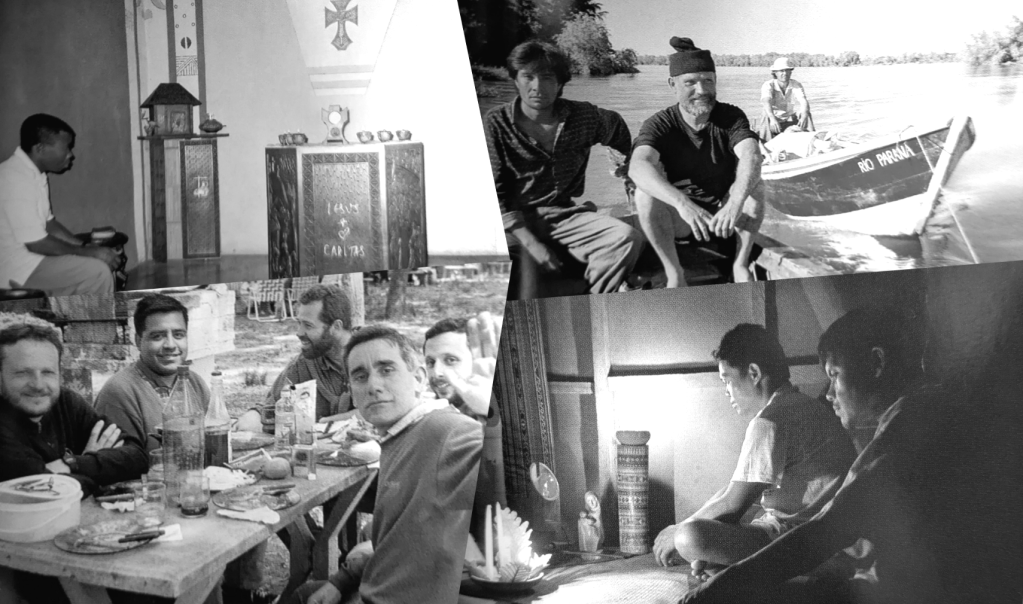
Featured photos (clockwise from top left): Little Brothers of Jesus in Eucharistic adoration (Foumban, Cameroon); at work (Puerto Viejo, Paraná, Argentina); in prayer (Manila, Philippines); in fellowship (Ingeniero Budge, Buenos Aires, Argentina). Plates from the book Frères au coeur du monde, à la suite de Charles de Foucauld (Paris: Karthala, 2002).
[1] Jacques Maritain, « À propos de la vocation des Petits Frères de Jésus » (14 December 1964), in Œuvres complètes de Jacques et Raïssa Maritain, vol. 16 (Fribourg: Éditions Universitaires, 1999), 1061–1083.
[2] Ibid., 1062.
[3] Ibid.
[4] Ibid., 1063. For the Angelic Doctor on different states of life, see Summa theologiae II-II, questions 179–182.
[5] Maritain, « La vocation des Petits Frères », 1063.
[6] Ibid., 1064.
[7] Ibid.
[8] Ibid., 1064–1065.
[9] Ibid., 1066.
[10] Ibid., 1067.
[11] Ibid., 1068.
[12] Ibid., 1069.
[13] Ibid.
[14] Ibid.
[15] Ibid., 1070.
[16] Ibid., 1083.
[17] Ibid., 1070.
[18] Ibid., 1076–1077.
[19] Ibid., 1070.
[20] Given Jacques’ views on politics, the reference to Opus Dei is probably meant to be a backhanded compliment. It is not unlike the shade thrown when, in Laudato Si’, Pope Francis mentions two models of Christian work. The Benedictines in ages past articulated and designed a system of work and prayer. Today, “the Christian spiritual tradition has also developed a rich and balanced understanding of the meaning of work, as, for example, in the life of Blessed [now St.] Charles de Foucauld and his followers” (nos. 125–126). Work is not an instrument for the gain of power; labour was redeemed in Nazareth. And this truth is seen in some vocations more than others. The late Holy Father’s omissions speak as loudly as his inclusions.
[21] Maritain, « La vocation des Petits Frères », 1071.
[22] Ibid.
[23] Ibid., 1071–1072.
[24] Ibid., 1072.
[25] Ibid.
[26] Ibid., 1072–1073.
[27] Ibid., 1073.
[28] Ibid., 1074.
[29] Ibid., 1075.
[30] Ibid., 1077.
[31] Ibid., 1076.
[32] Cf. Vatican II, Dogmatic Constitution Lumen Gentium (21 November 1964), 48: “Christ, having been lifted up from the earth has drawn all to Himself. Rising from the dead He sent His life-giving Spirit upon His disciples and through Him has established His Body which is the Church as the universal sacrament of salvation.”
[33] Maritain, « La vocation des Petits Frères », 1079.
[34] Cf. ibid., 1079–1080.
[35] Cf. ibid., 1080.
[36] Ibid.
[37] Ibid., 1081. The allusion to the Little Flower aims at her autobiographical manuscripts, Ms B, 2v–3v.
[38] Maritain, « La vocation des Petits Frères », 1081–1082.
[39] In particular, I have in mind Thérèse’s concern for and sacrifices for the convicted murderer Henri Pranzini: see Ms A, 45v–46v.
[40] Cf. Maritain, « La vocation des Petits Frères », 1082.
[41] Ibid.

 Contemplative in the Mud