
I’d like to tell you a few stories about Jacques and Raïssa Maritain. Then, I guess, you’ll be in a position to make up your own mind. I certainly wouldn’t want to force you to a conclusion. In fact, I’ll tell you up front: these thoughts are downright wild. No logic will ever prove my point here. A strict academic analysis would declare that I’m making connections out of coincidences and that correlation does not equal causation. I willingly grant that.
But we should also grant just how improbable our situation would have appeared a century ago. If, in the 1930s–’50s, you had told anyone that we would have popes from the social and temporal locations that the Maritains worked in in the Americas, they would have laughed in your face. If you’d insisted, they would have maybe reluctantly granted you Toronto or New York–New Jersey. But the other two major associations—Buenos Aires and Chicago? You’d be thought a lunatic.
But we have those popes. Two of them. Originating in exactly the time and place of two of the Maritains’ transatlantic engagements: Buenos Aires in 1936 and a decades-long association with Chicago that includes the mid-1950s. In the most peripheral places that Jacques and Raïssa leavened the dough,[1] the Church found its feast.
So now, maybe you want to know what dreams Jacques and Raïssa planted in northeast Argentina and the Midwest of the United States of America.
Chicago
Chicago is an important node in the story of Jacques Maritain. It is in fact the first place in the Americas that he says he received an “extraordinary reception”[2] and appears to be a surprise and fortuitous part of his first voyage to the continent.[3] More importantly, however, it is one of the jumping-off points for both Integral Humanism[4] and Man and the State.[5] The first book took Maritain’s 1934 lectures at the University of Santander (Spain) and gave them to a wider audience. Its purpose was to sketch a “concrete historical ideal” of the future which was fully evangelical but of a totally different secular type from the Middle Ages, centred on the full dignity and diversity of the human person, activating the capacity of nature and the structures of the world from within. Maritain spoke specifically on this topic in Chicago:
On [March] 30 [1936], I will give a conference on “Socialist Humanism and Integral Humanism.” But I tell myself: what is the good of that? It could be that, in thirty or fifty years, a little harvest is raised up; but even then, supposing that they were to become Thomists, people wouldn’t be any smarter for that, they’d be just as thick and hard-hearted, and there would be just as little love in them…[6]
At around the same time, he wrote to his friend Yves Simon, who would go on to work, in fact, at the University of Chicago: “In two hundred years, we might see an American Thomism flourish.”[7] This Thomism that Maritain envisions is not the bastardized Thomism of the integralists and backwardists. Rather, it is the Thomism of an Integral Humanism Future. It sounds similar, but it’s something totally new.
As for Man and the State, it is a product of Maritain’s 1948 lectures at the University of Chicago itself. In this most important sequel to Integral Humanism, the horizons of Maritain’s political thought expand, on the other side of Vichy and Auschwitz, to precisions on human rights and a new kind of world order. These are thoughts which specifically originate in connection with Chicago—a long-term association which existed both on Maritain’s own initiative and through enduring friendships with John U. Nef, Mortimer Adler, Yves R. Simon, and Saul Alinsky,[8] all of which continued until he and Raïssa left for France definitively in 1960.
Buenos Aires
A.D. 1936 was an eventful year. Between Jacques’ winter trip to North America and his autumn voyage to South America, Integral Humanism itself was published. This was the moment that the Spanish Civil War exploded and the year before Pope Pius XI’s encyclical letter condemning Nazism. Numerous political events had ensnared the masses of Catholics, especially clerics. Maritain was not deceived. Integral Humanism was met with staunch opposition.[9] And although he had exhibited some hesitation about embarking on a new adventure before the book’s publication,[10] in the weeks after, Jacques quickly reached a decision.[11] He—along with Raïssa and her sister Véra—took off to encourage dreams elsewhere.
After a very brief stop in Dakar[12] and a little longer one in Rio de Janeiro (some implications of which I’ve written on before), the Maritain trio ended in Río de la Plata. The atmosphere on arrival was remarkable:
The Catholics who invited me have a good and admirable intention, and the welcome I receive is rather moving. But many of their people are fascists. Everywhere we find this poisonous problem. I am torn here between the socialists (or more generally, the “intellectuals”) and the Catholics, practically all fascists, who greatly want me to join their side, and between whom it is important to create a little understanding and peace. If not, the terrible example of Spain could be contagious.[13]
Faced with this situation, Jacques, Raïssa, and Véra put their hands to the plough: “a formidable work and absolutely uninterrupted during the whole 61 days.”[14] For Jacques, the labour comprised 24 conferences and 14 lessons; given the situation, this was a sowing of the seeds of Integral Humanism and its long-term goal of a future.[15] But Raïssa, too, contributed at the insistence of their contacts; she gave a conference on the development of historical consciousness using the story of Abraham as a framework—biblical, hermeneutical seeds of a Christian philosophy of history.[16]
Indeed, there’s another topic that Jacques broached in Argentina—and for the first time: the question of how to think of freedom in the context of angelology.[17] This topic is becoming timely once again thanks to modified, but much more crass, authoritarian-leaning arguments that are surfacing in some of the more popular and well-connected corners of online Catholic apologetics. Jacques was well aware of his study’s significance. He later remarked: “It’s important, like everything that touches on the angels, on freedom, on evil.”[18] The positions we take regarding the life of the angels have political consequences. Jacques’ plan of attack started in Buenos Aires, and it finished two decades later during his tenure in the United States. He didn’t give up on the work; he knew the threat was going to come back.
Many voices have said that what happened in Buenos Aires was momentous. The Maritains may well have initiated a change of intellectual era for a whole continent.[19]
A different kind of marriage
So, now you know a little bit about the Maritains in Buenos Aires and Chicago, and why these American cities are, arguably, the southern and northern “ground zeros” of a long-term project to bring about a new civilizational attractor. In Francis and Leo XIV, we have two popes from exactly these two locations. Before you dismiss that as a quaint little coincidence, I have another story to tell you.
Jacques and Raïssa had an exceptional marriage. Although they were madly in love, they chose to deliberately redirect the fruitfulness of their marriage in a non-corporal direction. Some years after their baptism, they took temporary, then permanent vows giving up biological children in favour of spiritual fecundity. Annotating Raïssa’s journal, Jacques writes:
It was after extensive consultation with [our spiritual director] Father [Humbert] Clérissac, and with his approval and advice, that by mutual agreement we decided to renounce that which in marriage not only satisfies a profound need of human beings, both flesh and spirit, but is also a legitimate and inherently good thing, and at the same time we renounced the hope of surviving each other in sons or daughters. I’m not saying such a decision was easy to take. It did not contain a shadow of contempt for nature, but in our race toward the absolute and our desire to follow at all costs, while remaining in the world, at least one of the counsels of the perfect life, we wanted to clear the way for the search for contemplation and union with God, and to sell for this precious pearl goods that were excellent in themselves. The hope of such a goal gave us wings. We also sensed—and this was one of the great graces of our lives—that the strength and depth of our mutual love would thereby increase, as if to infinity.[20]
Jacques further clarified in his own published notebooks that, in his and Raïssa’s view,
the sacrament of marriage was only more profoundly lived by them, because one of the essential ends of marriage, the spiritual companionship between spouses in order to mutually help themselves to advance towards God, found itself strengthened and realized in a higher manner in mad, boundless love for God. As to the other essential end, procreation, it was not denied but transferred to another plane, it was a spiritual progeniture that these spouses awaited from God, and it was to it that they devoted themselves. Centuplum accipietis [He will be repaid a hundred times over].[21]
The couple sought a “spiritual progeniture” and expected, though they knew not how, the centuple (cf. Mt 13:8; Mk 4:8; Lk 8:8). This may all sound odd. But the Maritains thought in terms of centuries. As we have already seen, specifically in Chicago, for example, they intended to sow so that in three or four decades a little harvest could be reaped, and in a couple centuries, the whole American continent would flourish. Raïssa affirms the same:
Jacques did not worry about opinion or the immediate results; he thought with anxiety of the future of the spirit, and knew that the too pure wisdom of Saint Thomas [in the Maritainian, not integralist sense] was liable to be disregarded at first.[22]
The long-term thinking is striking. A Maritainian idea of spiritual fecundity is immense in geographical and temporal—literally, secular—scope.
For Jacques and Raïssa, one cannot plan to see the harvest that will be reaped, and their human contacts, too, were not always continuous. They could be sporadic, even chaotic. Still, they believed in sowing seeds through all those storms; some of them would snag on the right rocks or sink in a suitable soil—and thrive. This was not carelessness. It was a profound trust in the workings of divine providence such that, if we allow ourselves to become beggars for heaven, God will supply the rest.
It sounds like madness. But then again, Jacques and Raïssa may have been right. Maybe we’re living right now in the world that they engendered.
Discerning the signs of the times
When I saw Leo XIV appear before the crowd on the central loggia of St. Peter’s, I said to my mother, who is not Catholic, “He looks like he’s about to cry.” She replied, “He’s overwhelmed.” The words sunk deep. From that first moment, I’ve felt, like nothing before, a profound need to offer myself in prayer for Pope Leo. I saw the expression on his face. He just seemed so fragile. I was straightaway drawn. But the more I know and reflect, I wonder if this is why, if there is also something else.
We can’t pretend to know where the Spirit is blowing, but the wisdom of the Spirit nonetheless “enables us to look at things with God’s eyes, to see connections, situations, events and to uncover their real meaning.”[23] The Lord asks us to discern the signs of the times (Mt 16:3; Lk 12:56). It seems to me that this kind of discernment is inherently unsatisfied with the noise that resounds across the earth’s surface; it turns its attention elsewhere.[24] Wind whispers through the aquifers, and spiritual dowsing, despite its spotty track record, is a noble profession.
Indeed, since the passing of Papa Francisco, I have already set my hand to a small amount pneumatological hydrogeology. I think it is not irrelevant that Francis personally identified with the title of a biography of Jacques and Raïssa, “beggars for heaven.” He used the words. He acted like it. He asked us to do the same. In response, I called him “the Jacques Maritain of Popes.”
But now we have Leo XIV. We’re bringing in the peculiar social locations of the development and reception of Integral Humanism and Man and the State. And on top of that, there is also the fact that all these projects evolved from Jacques Maritain’s experience in the 1920s: the Action Française crisis, as well as friendship, encounter, and accompaniment with LGBTQ+ people. These experiences were refined into a general political vision that was planted as a long-term concrete ideal first in Latin America. Is this not all familiar? Who else but the Maritains put their fingers in all of these pies?
Well, then there’s the broader picture. Integral Humanism sketches a new society of the future when we become finally convinced to reject both capitalism and communism. In this, of course, Maritain was critiquing the errors on both sides, rather as Leo XIII and successors had already done. But he was using a much finer-toothed comb, and he took a further step: he envisaged a real future, a “concrete historical ideal” of a different type and attractive force than the nostalgic-for-far-too-many “concrete historical ideal” of the Middle Ages (or, worse, the Baroque Age).
Fast forward to today. The empires of communism have collapsed. Actually, when the time was right, we were given a pope from the inside to deal precisely with that situation. Right now, the empires of capitalism are crumbling, in part but not entirely under the weight of technology. We have just received a new pope, again from the inside, who has a history of engaging with exactly this situation. The taking down of communism was but an intermediate step. We also need to move past capitalism. Leo XIII inaugurated that path. Now we have a Leo XIV. Is it time for a bookend?
I know that when I speak these words aloud, they lose some of the magic they hold in the soul. But I’m willing to look the fool. The contemplative is often a prophet. And at any rate, the genuine contemplative wants to utter any words, however half-witted, which can spur, focus, energize, and network our prayer.
Is it really Integral Humanism Future Time? If so, it’s come far sooner than the Maritains intended. I would like to say that I’m so, so ready for this. Except I’m not. Nobody is. We’ll need to buckle up.
If it’s truly Integral Humanism Future Time, then, “we’re so back”—that go-to phrase of a generation younger than mine—would be the understatement of the century. It’s not back. Not at all. It’s a future that has as its dynamic attractor a concrete ideal of a new historical type.
Of course, then again, maybe my thoughts are too parochial. Maybe it’s Integral Humanism Future Time combined with a Peruvian Dash of Liberation. That would also be very much appropriate, given the affinity of Leo XIV for the home country of Gustavo Gutiérrez.
On the other hand, if it’s not yet time for an Integral Humanism Future, the signs still seem pretty clear that ours is a Maritain moment—a major one. With everything that the new pontiff has signalled about his name choice and a “response to another industrial revolution and to developments in the field of artificial intelligence that pose new challenges for the defence of human dignity, justice and labour”[25], the comet is evidently breaking increasingly free from its solar system of origin and is, if not slipping into a new orbit, nonetheless careening towards the solar system of a new historical attractor. It wouldn’t hurt to point things out and clear away the debris so that our prayer can find the right space and nodes of attachment that it needs to be expansive and intensive.
At the very end, we will not remember a moment when God was not there. Evil will not prevail. The Father is with us. Jesus is Lord. The Spirit is on the move.
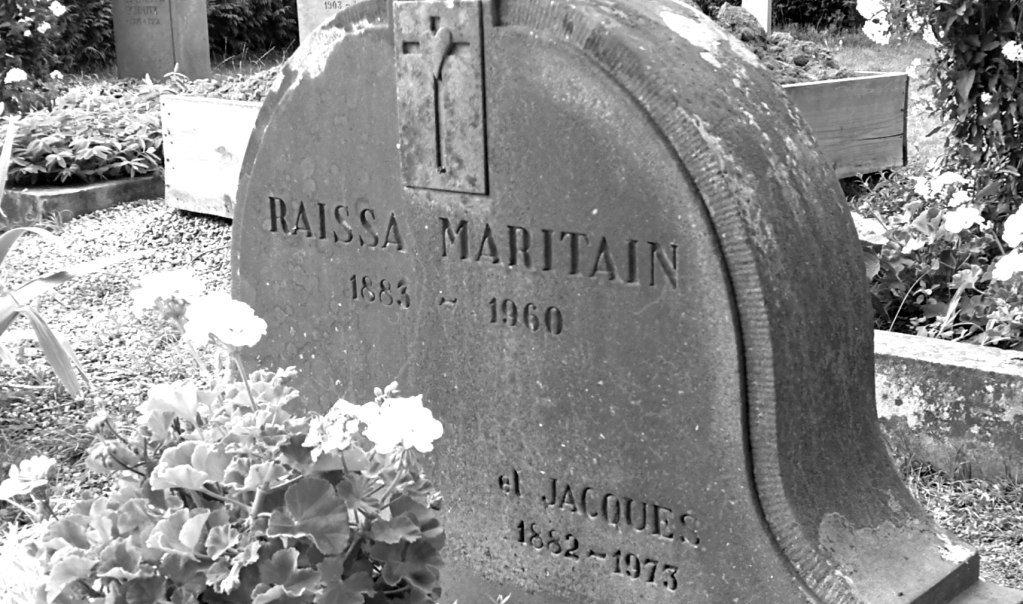
Image: Grave in Kolbsheim, “Raissa Maritain (1883–1960) … et Jacques (1882–1973).”
[1] Within Europe itself, the Maritains’ most peripheral association was with Kolbsheim. This tiny village lies just outside Strasbourg, which interestingly became the centre of European integration and the new international order that that entails.
[2] Cf. Letter from Jacques Maritain to Charles Journet, 20 November 1934, in Journet–Maritain Correspondance, vol. 2 (Fribourg: Éditions Universitaires, 1997), 422: “Extraordinary reeption in Chicago and in New York, like in Québec [City] and Montréal.” In contrast, Maritain notes some time later “the anguish, physical and moral, that I passed through in Toronto” (Letter to Charles Journet, 11 July 1936, in Journet–Maritain Correspondance, 588).
[3] Raïssa, in a letter to Charles Journet (16 October 1934) only mentions prospects in Québec, Montréal, Ottawa, Toronto, and New York, and this seems to be the planned itinerary: cf. Journet–Maritain Correspondance, 2:418–419.
[4] The earliest English translation of Humanisme intégral was as True Humanism, trans. Margot Adamson (London: Geoffrey Bles, 1938); see Œuvres complètes de Jacques et Raïssa Maritain, vol. 6 (Fribourg: Éditions Universitaires, 1984), 291–634.
[5] Jacques Maritain, Man and the State (Chicago: University of Chicago Press, 1951); Œuvres complètes de Jacques et Raïssa Maritain, vol. 9 (Fribourg: Éditions Universitaires, 1990), 471–736.
[6] Letter from Jacques Maritain to Charles Journet, 13 March 1936, in Journet–Maritain Correspondance, 2:548. This letter is written from Toronto.
[7] Letter from Jacques Maritain to Yves Simon, 9 February 1936, in Jacques Maritain–Yves Simon: Correspondance, vol. 1, ed. Florian Michel (Paris: Éditions CLD, 2008), 234.
[8] Some of the longer biographical coverage of the periodic Chicago visits and relationships is in Jean-Luc Barré, Jacques et Raïssa Maritain, les mendiants du Ciel (Paris: Fayard, 2009), 445–450, 467, 483, 494, 516–517, 523–527. As regards Alinsky, the bête noire of U.S. reactionaries, Maritain refers to him as “one of my great friends” and notes that “among those of my contemporaries still living as I write these lines, I see in the Western world no more than three revolutionaries worthy of the name—Eduardo Frei [Montalva] in Chile, Saul Alinsky in America, … and myself in France, who am not worth beans, since my call as a philosopher has obliterated my possibilities as an agitator…” (The Peasant of the Garonne, trans. Michael Cuddihy and Elizabeth Hughes [London: Geoffrey Chapman, 1968], 23; Œuvres complètes de Jacques et Raïssa Maritain, vol. 12 [Fribourg: Éditions Universitaires, 1992], 698). The Alinsky–Maritain correspondence has been published: The Philosopher and the Provocateur: The Correspondence of Jacques Maritain and Saul Alinsky, ed. Bernard E. Doering (South Bend, IN: University of Notre Dame Press, 1994).
[9] Maritain was not understood at Rome, even or especially by Reginald Garrigou-Lagrange, and the sufferings of Toronto were judged a “premonition” of what was to come: cf. Letter from Jacques Maritain to Charles Journet, 11 July 1936, in Journet–Maritain Correspondance, 2:588–589. In the longer term, Maritain was very much counted as an enemy of the totalitarian state: “Upon arrival in Paris, the Gestapo went to fetch him from the Institut Catholique. The villa in Meudon [i.e., the Maritains’ house] was requisitioned, his books withdrawn from the bookstores, his classes inevitably suspended: one could not be at the same time the author of Integral Humanism and the husband of Raïssa Oumançoff, the defender of the Jews, the adversary of the Francoists, the detractor of [Charles] Maurras, and the friend of [Henri] Bergson and Max Jacob, finally an iconoclastic and wrong-thinking Catholic, without counting, in June 1940, among the natural prey of the bearers of the ‘enemy cross’” (Barré, Mendiants du Ciel, 458).
[10] Cf. Letter from Jacques Maritain to Charles Journet, 8 June 1936, in Journet–Maritain Correspondance, 2:572.
[11] Cf. Letter from Jacques Maritain to Charles Journet, 27 June 1936, in Journet–Maritain Correspondance, 2:575.
[12] Cf. Letter from Jacques Maritain to Charles Journet, 8 August 1936, in Journet–Maritain Correspondance, 2:612.
[13] Letter from Jacques Maritain to Charles Journet, 29 August 1936, in Journet–Maritain Correspondance, 2:617.
[14] Letter from Jacques Maritain to Charles Journet, 23 October 1936, in Journet–Maritain Correspondance, 2:620.
[15] Ibid. The first four conferences were on science and philosophy, moral knowledge, freedom, and the distinction between individual and person (cf. Letter from Jacques Maritain to Charles Journet, 17 November 1936, in Journet–Maritain Correspondance, 624–625 and 626n2). Evidently, many others were from Integral Humanism and related contemporary texts.
[16] Letter from Jacques Maritain to Charles Journet, 23 October 1936, in Journet–Maritain Correspondance, 2:620. This became the book Histoire d’Abraham (1942), in Œuvres complètes de Jacques et Raïssa Maritain, vol. 14 (Fribourg: Éditions Universitaires, 1993), 567–617.
[17] The earliest reference to this point of angelology is in one of the surviving texts from Buenos Aires: « Du savoir moral », in Œuvres complètes, 6:923–949, at 947–948. That this is indeed the earliest discussion of the topic and that it is a pivotal assertion can be gleaned from René Mougel, « La position de Jacques Maritain à l’égard de Surnaturel : le péché de l’ange, ou Esprit et liberté », in Cardinal Henri de Lubac – Jacques Maritain, Correspondance et rencontres (Paris: Cerf, 2012), 85–115, at 89: “Following very strictly St. Thomas Aquinas, for whom impeccability is, absolutely speaking, proper only to God, Maritain had affirmed, without ambiguity and restrictions, the opposite of his Thomist-majority interlocutors and claimed the natural peccability of he angels [i.e., their possibility of sinning] in a conference in Argentina in 1936, thus breaking metaphysically, in its created principle, the system of extrinsic nature–supernature parallelism—parallels, by definition, having no points in common—in which the theologians had let themselves be trapped.” Note again the context that Maritain chose to give the conference in; he was in large part in Argentina to teach on a world of Integral Humanism (cf. the subsequent lesson « Conception chrétienne de la cité », in Œuvres complètes, 6:951–980). This was not an apolitical project. The “fascists” were of great concern.
[18] Letter from Jacques Maritain to Charles Journet, 28 October 1954, in Journet–Maritain Correspondance, vol. 4 (Fribourg: Éditions Universitaires, 2005), 420. Cf. Jacques Maritain, « Preface to The Sin of the Angel: A Re-Interpretation of some Thomistic Positions » (1956), in Œuvres complètes de Jacques et Raïssa Maritain, vol. 16 (Fribourg: Éditions Universitaires, 1999), 580–585, at 580, 582: “the matter has primordial importance, for the philosopher as well as for the theologian: because what is at stake is […] the genuine understanding of the nature of free will [just as] the mystery of evil is of primary importance.”
[19] Cf. Alceu Amoroso Lima, « Maritain et l’Amérique latine », Revue thomiste 1-2 (1948), quoted in Barré, Mendiants du Ciel, 422–423: “It was a true renaissance. And we can say that our generation owes it above all to the teaching of Jacques Maritain. The phenomenon has been reproduced throughout Latin America. If we ask fifty-year-old men from Mexico, Colombia, Peru, Chile, Argentina, Uruguay, Ecuador, and Paraguay, as I personally did with many of them, the information is the same. There was a parallel revolution in all our Latin American countries. The names change, the circumstances are not the same, and each country has its own nuances. But the whole is the same.”
[20] Journal de Raïssa (note of Jacques for 2 October 1912), in Œuvres complètes de Jacques et Raïssa Maritain, vol. 15 (Fribourg: Éditions Universitaires, 1995), 141–507, at 175. This note is omitted in the English translation, Raïssa’s Journal, presented by Jacques Maritain (Albany, NY: Magi Books, 1975).
[21] Jacques Maritain, Notebooks, trans. Joseph W. Evans (Albany, NY: Magi Books, 1984), 253; Œuvres complètes, 12:744–745.
[22] Raïssa Maritain, Adventures in Grace, trans. Julie Kernan (New York and Toronto: Longmans, Green and Co., 1945), 203; Œuvres complètes, 14:1022.
[23] Francis, Message for the LVIII World Day of Social Communications (24 January 2024).
[24] Cf. Leo XIV, Address to the College of Cardinals (10 May 2025): “It is up to us to be docile listeners to his voice and faithful ministers of his plan of salvation, mindful that God loves to communicate himself, not in the roar of thunder and earthquakes, but in the ‘whisper of a gentle breeze’ (1 Kings 19:12) or, as some translate it, in a ‘sound of sheer silence.’”
[25] Ibid. Regarding the challenge of artificial intelligence, Pope Francis himself invoked the help of Maritain, particularly a text on love and contemplation.

 Contemplative in the Mud