
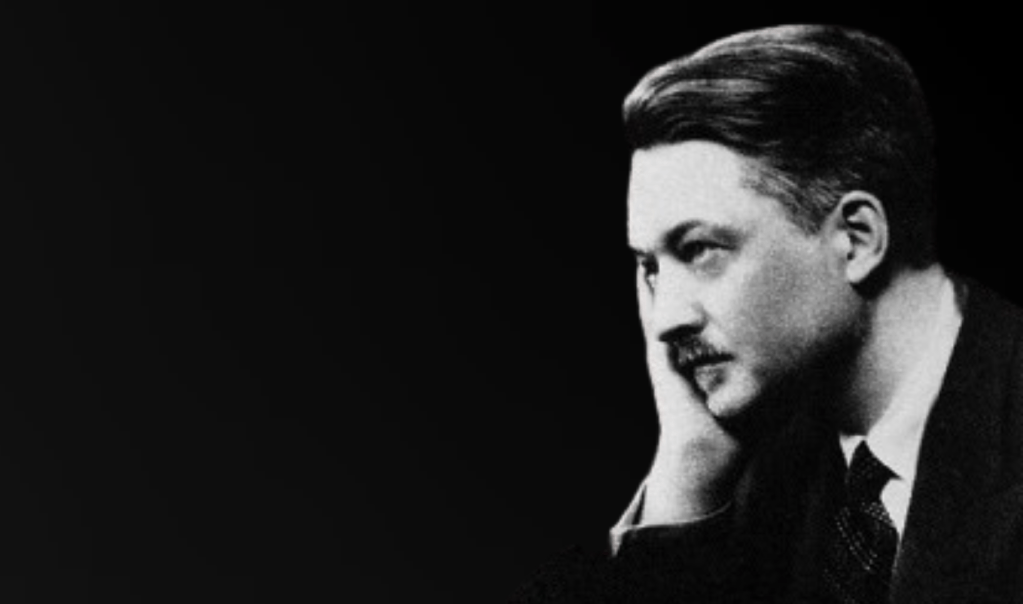
In his final year, Pope Francis did a pretty good job of pointing us towards Jacques Maritain. As a result, I’ve been going back to my roots. Aside from the lacklustre and painful RCIA that I went through, the lives and works of Jacques and Raïssa—and Véra—were my primary initiation into Catholicism. Returning to the stored sap has been fruitful this spring. In part, I am revisiting the adventure that the Maritain trio lived throughout the 1920s. I find it to be increasingly important for my own understanding of the present crises.
In the interwar years, Action Française was a monarchist political movement that the Church had to put a stop to. Action Française was massively popular, especially among the youth, and the Maritains, misled by their docility to more than one spiritual director and wearing some metaphysical blinders, ended up in its orbit. At the same time, though, Jacques had become one of the darlings of Thomistic renewal among its promoters in the Vatican. He was known to both Popes Benedict XV and Pius XI. The Maritains were caught right in the middle.
When Pius XI started to intervene to bring all the “politics first” ideology under control, Jacques “defected” to Rome. It was a messy effort. Extricating himself from everything connected to Action Française was not simple. But he did it. In the process, he wrote several important tracts on the relationship between the spiritual and the temporal. This ultimately led to a complete abandonment of right-wing ideologies tending towards totalitarianism, which had perched themselves atop the deeper, and remarkably non-ideological, commitments to the poor that had characterized Jacques’ youth. In the following years, Jacques launched one democratic project after another. This was a massive turning point in the lives of the Maritains, in the history of the Church in France, and—thanks to all the doors that were opened in Europe, South America, and North America—ultimately in the history of the world.
Now, what does all this have to do with contemplation?
One of the books that Jacques wrote during the Action Française crisis ends with a lengthy meditation on the primacy of contemplation. Much of its content prefigures a more developed essay on contemplation that I have covered before. But one part is different. It’s particularly relevant for trying times like ours. It goes like this:
Without contemplation, all philosophy and theology, even that which is true, turns into a sect; all zeal, even that which is good, becomes rivalry. Because contemplation makes the human being one spirit with God, it truly creates unity within the person, and among persons.[1]
We might add today that, making spiritual unity with the Creator, contemplation also makes unity with creation, our common home. Regardless, the main point stands. Contemplation has a fundamentally unifying, not divisive, effect.
One of the ways to see why this is the case is to look at the contemplation of Christ. I might never tire of quoting St. John Paul II on this:
If we have truly started out anew from the contemplation of Christ, we must learn to see him especially in the faces of those with whom he himself wished to be identified: “I was hungry and you gave me food, I was thirsty and you gave me drink, I was a stranger and you welcomed me, I was naked and you clothed me, I was sick and you visited me, I was in prison and you came to me” (Mt 25:35-37). This Gospel text is not a simple invitation to charity: it is a page of Christology which sheds a ray of light on the mystery of Christ. (Novo Millennio Ineunte 49)
I quoted this passage as recently as yesterday. As I insisted then, what John Paul II taught is that the Parable of the Sheep and the Goats is Christology. Care for the poor is not, as some are trying to pass it off as, a derivative “moral implication” of the Gospel. It goes beyond that. It is somehow Christological, and it is somehow tightly linked with the gratuitousness of contemplation.
Take away the contemplation, however, and you’re left with tatters. Jesus’ last parable does no more than issue an invitation to Christian charity at best, to moral virtue at worst. Part of the mystery of Christ is erased. Action leaps away from contemplation—and, the experience of Jacques would add, politics probably cuts past spirituality to the front of the queue.
Now, of course, all this disparagement of division doesn’t mean that we let our minds go into neutral and avoid all distinctions. It’s worth distinguishing one thing from another. Nobody wants confusion. But there are two ways to make distinctions. We can either distinguish in order to unite, or we can make intellectual categories in order to separate things one from another.[2]
The glue that holds this all together, however, can only come—at least at a lived, existential level, for one can only deal with possibilities that can be made real—with contemplation. There needs to be a focused gaze, absorptive of both the mind and heart, rooted all the way in our most primordial external sense of touch and internal sense of memory, up to both the intellect and will, in a fusion of knowledge and love. There needs to be an actualization of the whole human person. It’s necessary. Only with such moments, however fleeting, do we know unification, both within and without.
If we have this fused experience of knowledge and love, surpassing by grace all that we could proffer and produce for ourselves, then we know divine beauty. If, however, we don’t know it, we settle for the knockoff of aestheticism or aesthetic relativism. Our personal sense of beauty undergoes a crisis. This happens to more and more people. It snowballs into a social crisis, seeking out ever new—or old—aesthetics of worship, ceremony, and status, instead of knowing how to rest in the beauty that is the contemplation of the whole Christ.
If we find Christ where he told us he wished to be identified—in the poor, marginalized, excluded, and vulnerable—we will act on this, but our action will not be disconnected from contemplation. On the other hand, if we don’t find him there, contemplation loses its savour; Christology loses its practical face. The whole spiritual edifice collapses into moralism. That’s all that will be left. Well, aside from the politics. There will definitely remain the politics.
Ultimately, the choice is either unity or fragmentation. Without contemplation—which means contemplation of the whole Christ, just as the Paschal Mystery includes the Parable of the Sheep and the Goats which immediately precedes the plot to kill Jesus, and just as Christology includes the gratuitous presence of Christ in the poor, marginalized, excluded, and vulnerable—without the unifying testimony of contemplation, there is division. There will always be division. There will, in the final analysis, be only division.
Of course, with contemplation, the path is still no walk in the park. The climb up the mountain is arduous. Nor is it easy to be carried in the Father’s hands, for that requires us to be small enough to fit in them. But with contemplation, at least unity is possible. And that unity will be possible within. And that unity will be possible without.
[1] Jacques Maritain, Primauté du spirituel (1927), in Œuvres complètes de Jacques et Raïssa Maritain, vol. 3 (Fribourg: Éditions Universitaires, 1984), 899.
[2] It’s not that long ago that this was still well known in theological circles. Referencing the title of one of the French philosopher’s most famous works, Gustavo Gutiérrez speaks of “the old Scholastic principle of which Jacques Maritain so perceptively reminded us all in recent decades: we must ‘distinguish in order to unite,’ not in order to separate or confuse” (The Truth Shall Make You Free, trans. Matthew J. O’Connell [Maryknoll, NY: Orbis Books, 1990], 121–122).

 Contemplative in the Mud