
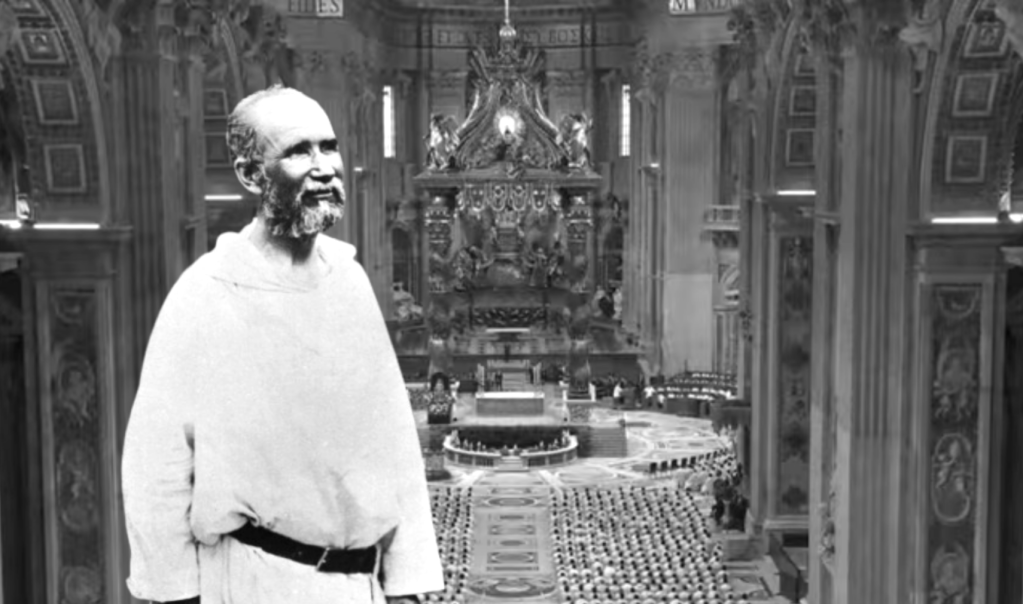
Pope Francis is back, at least in some capacity, after his recent hospitalization, and he’s brought with him his love for and emphasis on Charles de Foucauld. At today’s Chrism Mass in Rome, the homily prepared by the Holy Father centres around Nazareth.
This is of course not the first time that the Pope’s thoughts have gone to Charles de Foucauld and his spiritual family on Holy Thursday. Two years ago, he gave a “book” by René Voillaume to the priests of the Diocese of Rome. (You can read that “book” here.) Nonetheless, today’s theme is different. It’s definitely related. But it’s different.
Today’s papal homily was in large part about rejection:
Naturally, if Jesus is the Alpha and Omega of our lives, we too may encounter the dissent he experienced in Nazareth. The shepherd who loves his people does not seek consensus and approval at any cost. Yet the fidelity of love changes hearts. The poor are the first to see this, but slowly it unsettles and attracts others too.
Where are the poor the first to see this? Well, in that same Nazareth, says Pope Francis. It is there that, like Jesus, we need to put down roots and understand the ground on which we can walk forward:
The passion, death and resurrection of Jesus, which we are about to relive, are the soil that solidly sustains the Church and, within her, our priestly ministry. And what kind of soil is this? What kind of humus allows us not only to survive, but also to flourish? To understand this, we need to return to Nazareth, as Saint Charles de Foucauld so astutely realized.
Once we end up in Nazareth, we see so many of the habits that grew in Jesus there. For one thing, he read the Scriptures assiduously—as Brother Charles kept reading the Gospels until they, like the slow drip of water, reshaped his rocky heart. And when Jesus read the Scriptures, he read them in the context of explaining his own life—as Brother Charles did in finding the biblical message that he had lived and was called to. Without so many explicit links to the saint, the Holy Father says all this at length:
“When he came to Nazareth, where he had been brought up, he went to the synagogue on the sabbath day, as was his custom. He stood up to read” (Lk 4:16). Here we see at least two “customs” of Jesus: that of frequenting the synagogue and that of reading. Our lives are sustained by good habits. They may become routine, but they reveal where our heart is. Jesus’ heart was in love with the word of God: at the age of twelve that was already clear, and now, as an adult, the Scriptures are his home. That is the same soil, the vital humus, that we find, once we become his disciples. “And the scroll of the prophet Isaiah was given to him. He unrolled the scroll and found the place” (Lk 4:17). Jesus knew what he was looking for. The synagogue ritual allowed for this: after the reading of the Torah, each rabbi could read prophetic words to apply the message to the lives of those who were listening. Yet there is more here: Jesus chose to read the page of his own life. That is what Luke wants to tell us: from among the many prophecies, Jesus chooses the one he is to fulfil.
If you want, the whole homily is worth a read on this Maundy Thursday. Like the gifted Father Voillaume “book” before it, it is ostensibly about a certain kind of vocation, but its hold on our lives is much broader and more universal than that. To Nazareth we can go, with Jesus and Jorge and Charles, and there we can find roots and the story of our lives.

 Contemplative in the Mud