
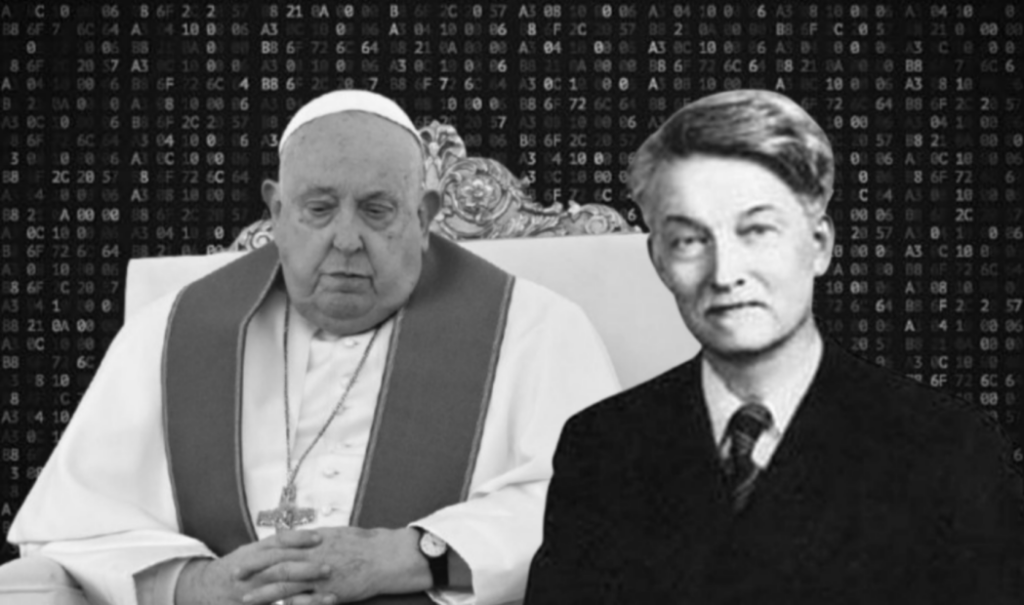
Shortly before his recent hospitalization, Pope Francis made two interventions into global political debate to assert that love is greater than intelligence and worth more than thought. In fact, both interventions went up on the Vatican website the same day.
The one that grabbed the most attention was, of course, the letter which was addressed to the Bishops of the United States. I already dealt with this indirectly when I commented on the ordo amoris, or rational ordering of love and moral duty, which Marcel Văn set about deconstructing in his Vietnamese context. Pope Francis’ point was largely the same. He wrote—and this is worth quoting again—on how Christian love does not proceed step by step, as if rationally controlled and delimited, outwards from ourselves:
Christian love is not a concentric expansion of interests that little by little extend to other persons and groups. […] The true ordo amoris that must be promoted is that which we discover by meditating constantly on the parable of the “Good Samaritan” (cf. Lk 10:25-37), that is, by meditating on the love that builds a fraternity open to all, without exception. (no. 6)
The true order of love, asserts the Holy Father, is one that does not order itself strictly and rationally. It responds energetically to the neighbour at hand. This is the message that caught the most attention.
The same day, however, Pope Francis sent a message to the President of France because of a summit taking place on artificial intelligence (AI). In this brief message, the Holy Father made an important reference not just to Blaise Pascal, regarding whom he had previously written an apostolic letter, but also to Jacques Maritain, whom the Holy Father had previously spoken of as a liberating example for Catholic philosophers. This is what the Pope had to say:
I ask all those attending the Paris Summit not to forget that only the human “heart” can reveal the meaning of our existence (cf. Pascal, Pensées, Lafuma 418; Sellier 680). I ask you to take as a given the principle expressed so elegantly by another great French philosopher, Jacques Maritain: “L’amour vaut plus que l’intelligence” [Love is greater than, worth more than, intelligence] (Réflexions sur l’intelligence, 1938).
Despite my best efforts, I have not been able to track down this quotation in Réflexions sur l’intelligence.[1] I have, however, rather easily located the phrase in Maritain’s later work Questions de conscience. A confusion in the citation may have arisen from the fact that the earlier work, published in 1924 (not 1938), contained two chapters on Pascal. In any case, the later work, which was indeed published in 1938, contains a chapter dear to the core mandate of my own blog: an essay entitled “Action and Contemplation.”[2]
This essay is well worth reading in its entirety, but I would like to draw attention to a central section which illustrates most of its themes. The primary contention is that “Christianity has transfigured everything.”[3] Maritain proceeds by noting four ways that Christianity has transfigured our notions of action and contemplation—and love and intelligence.
Love is greater than intelligence
Christianity has transfigured everything. […] First, it teaches us that love is better than intelligence [l’amour vaut plus que l’intelligence]. St. Thomas admits, like Aristotle, that considering the degrees of immanence and immateriality of the powers of the soul in themselves, intelligence is nobler than will, but he adds that considering the things we know and love, these things exist in us by knowledge according to the mode of existence and the dignity of our own soul, but by love they attract us to them according to their own mode of existence and their own dignity, and therefore it must be said that to love things that are superior to man is better than to know them. It is better to love God than to know Him; it is also better to love our brethren, in whom the mystery of God’s likeness is concealed, than to know them. And the love which is Caritas is, not in the moral order only, but in the ontological as well, that which is most excellent and most perfect in the human soul and in the Angel.[4]
The main point here is that Christianity brought a revolution in thinking to the ancient Mediterranean world. Whereas the Greeks, especially the philosophers, had prioritized knowledge over love, Christian revelation turns this preference on its head. Wherever there is a trace of the infinite beauty of God, it is better to love it than to know it. Sure, all things being equal, engagement with beauty entails both knowledge and love. But the priority is with love. We have to be drawn towards and act for the good of these traces of divine beauty. Nothing compares to that. Without it, knowledge is just thought—perhaps even just computation or analysis.
Pope Francis is applying this principle to the development and use of AI. Even if we suppose—and this is a big supposition, I know, for I have my own peer-reviewed publications on machine learning in the field of engineering—that AI could ever be called intelligent, it still lacks a heart. It always will. It lacks love. It always will. Technology lacks “the ultimate orientation of all these speculations and deductions towards the highest wisdom, which is a work of love.”[5]
No ethical choices, properly so called, can ever be made by a technology. In the human being, prudence is dead without the loves that orient it. No actual moral decision-making occurs except by humans. No machine will ever know, feel, believe in the depths of a heart, that the human person, from whom data is stolen or against whose interests an algorithm acts, is the image and likeness of God. Nothing that a machine generates is art in the sense that it passes through the heart and is produced in immediate conjunction with the heart, grasping the object it wishes to create and holding reality and a new product together with the desiderative force of love. All of these are qualitatively different. AI can indeed be of some use in some domains, especially technical fields of screening and detection like medicine and engineering. But there is one thing it has no access to and never will. It knows nothing of love, and love is worth more than intelligence.
The new meaning of contemplation
Second, Christianity has transfigured the notion of contemplation, and endowed it with a new meaning. Albert the Great sums it up in his admirable treatise de Adhaerendo Deo: ‘The contemplation of the philosophers’, he writes, ‘is concerned with the perfection of the contemplator, and hence does not go farther than the intellect, so that their end is intellectual knowledge. But the contemplation of the saints is concerned with the love of the one who is contemplated—of God. And this is why, not content with the intellect, with knowledge as its ultimate end, it attains the heart through love, transit ad affectum per amorem.’ And love indeed is its own instrument, love’s dark fire is its light. Quia ubi amor, ibi oculus. This leads to consequences, which we shall presently see, and which make the word ‘contemplation’ rather unsatisfactory.[6]
A natural consequence of revaluating love and knowledge is the change in the meaning of contemplation. Contemplation becomes primarily a work of love. It is by love that we enter into God. In Christianity, this is no longer attained through knowledge (like the Greek philosopher), nor by the controlled cessation of all our cognitive processes, including the propulsion, desire, and attraction of love (like so many of the meditation techniques of the Eastern religions). Contemplation in a Christian sense is a kind of love.
This newfound contemplative activity is love that envelops us in God: God in himself, creator and Trinitarian mystery; God in the Humanity of Jesus, crucified and risen; God present in, behind, and through the members of Christ’s Body broken and extended until the end of the world. While Christianity has given a new emphasis to love, it has also elevated its ultimate attainment and expanded its immediate field of realization.
The new meaning of action
Third, Christianity has also transfigured the notion of action and has given it a new meaning. Christian wisdom has seen, better than the wisdom of philosophers, that the action which man exercises on matter or other men, though it is transitive, cannot be reduced to transitive action such as is found in the world of bodies. It is an essentially human activity. It has not only been thought and willed before being exercised, being born in the heart before being made manifest in the external world; it not only necessarily proceeds from an immanent act, but, moreover, it goes beyond the work it serves, and by an instinct of communication which demands to be perfected in goodness, proceeds to the service of other men. You can give high wages to a work-man for work manifestly useless,—for instance, the task, which used to be imposed on convicts, of digging holes and then filling them up,—and this workman will be driven to despair. It is essential to human work that it be useful to men.
As has often been remarked, Christ in assuming for Himself the work and condition of an artisan in a small village, rehabilitated labour, and manifested its natural dignity, a dignity which Antiquity had denied. The hardship of work is a consequence of the Fall and of the loss of privileges proper to the state of innocence, but not work in itself. Adam in the state of innocence worked—without any pain—and had the mission of cultivating and keeping the Garden.
Man’s labour in its first and humblest stage is a co-operation with God the Creator, and Christianity’s rehabilitation of labour in the moral order is bound up with revelation, in the dogmatic order, of creation ex nihilo. Pater meus usque modo operatur, et ego operor. My Father worketh hitherto and I work too. Here is the foundation of labour ethics, which the modern world is seeking and has not yet found. The work which Antiquity most despised, manual work, imposes the forms of reason on matter, and delivers man from the fatalities of material nature (provided however he does not turn his industry into an idol which enslaves him even more); thus, work has a value of natural redemption; it is like a remote prefiguration of the communications of love. Man is both homo faber and homo sapiens, and he is homo faber before being in truth and actually homo sapiens and in order to become the latter.[7]
I have continued my reflections to this point for two reasons. First, this is important in itself. But second, this is relevant for Pope Francis’ reflections on AI. There is a real possibility that AI will be employed not to the benefit of the dignity of labourers, but to their detriment. A danger exists that new technologies will serve only to remove from people the more creative kinds of employment, while increasing the numbers labouring for things that matter little or even matter not. For example, imagine the appalling state of a workforce automated in terms of AI-generated texts and “artwork,” while more and more people become unemployed or forced into justifying the “choices” of the algorithms which determine our lives. This would be dehumanizing.
The dignity of work and the worker is one of Christianity’s primary contributions to the entire history of society. Christ was a labourer. The Apostle Paul deliberately supported himself by his trade. The Body of Christ is really or at least potentially present in each worker. Every single worker is a potential locus of that highest contemplation, passio divinorum, entering lovingly into the states of God. In each person, we can meet Christ. In oneself and one’s own realized love, each person can meet him also.
The total reassessment
Fourth, and this is a consequence of the preceding considerations, another innovation which Christianity has introduced, relevant to our subject, is that contemplation (supernatural contemplation, which would be better called entrance into the very states of God, of God Incarnate) is not only the business of specialists or of the chosen few. This was an astounding revolution in the spiritual order. Greeks and Jews, masters and slaves, men and women, poor and rich (but the poor, first), souls who have known evil and souls (if there be such) who have not, whatever their condition, race and wounds,—all are called to the feast of divine Love and divine wisdom. That wisdom calls them all, it clamours in the public places and in the roadways. All, without exception, are called to perfection, which is the same as that of the Father who is in heaven; in a manner either close or distant, all are called to the contemplation of the saints, not the contemplation of the philosophers, but to loving and crucified contemplation. All without exception. The universality of such an appeal is one of the essential features of Christianity’s catholicity.[8]
Well before the Second Vatican Council, Maritain advocated for the universal call to holiness, manifested in the perfection of love. This entails some encounter with contemplation. Christian contemplation is an experience of divine beauty realized primarily and overwhelmingly through God-given love. Love and contemplation, contemplation and love: they go together.
This does not mean that everyone sits down, successfully blocks out distractions, and meditates. Still less does it mean that everyone acquires conceptual knowledge of the Triune God.
In Christian terms, love is the highest science. It is love which is contemplation. And thanks be to God—Jesus is the Christ. God is incarnate, crucified, risen, ascended into heaven, and living in the members of his Body battered, broken, and healed throughout history. Love finds God in the prayer that happens with the door closed, encountering any of the Persons of the Trinity in the heart or the Humanity of Jesus revealed in the Gospels. It experiences him as creator, sitting in the forest or by a brook. Love also sees God in the faces of others, especially the poor, the marginalized, and the vulnerable—both sees and acts for them and their full dignity and liberation. Arguably, however, this last is the measure and end goal of the other acts of contemplation, for Jesus in his very Humanity and in the Gospels themselves has told us as much.
Love is greater than intelligence; it is worth more than thought. The implications of this revelation are countless. Like Jacques Maritain before him, Pope Francis seems insistent that every nook and cranny of our anguished world has need of them. There remains a lot to work out.
[1] Jacques Maritain, Réflexions sur l’intelligence (1924), in Œuvres complètes, vol. III (Fribourg: Éditions Universitaires, 1984), 9–426.
[2] Jacques Maritain, “Action and Contemplation,” in Scholasticism and Politics, trans. Mortimer J. Adler (London: Geoffrey Bles, 1940), 170–193; “Action et contemplation,” in Questions de conscience (1938), in Œuvres complètes, vol. VI (Fribourg: Éditions Universitaires, 1984), 679–729.
[3] Scholasticism and Politics, 173; Questions de conscience, 683.
[4] Scholasticism and Politics, 173; Questions de conscience, 683–684. Note at the end the clear indication that the love of charity is the greatest ontological quality that can exist in an angel. This claim features in Maritain’s argument against the fascist-leaning or -submerged integralists, when they argue that God loves some people more than others, along the lines of natural hierarchies, because God loves the angels more than he loves us. Maritain consistently argues against the confusion of the order of natures and the order of exercise, specifically, the order of freedom and love in the case of persons. More on that in this post.
[5] Réflexions sur l’intelligence, 367.
[6] Scholasticism and Politics, 173–174; Questions de conscience, 684–685.
[7] Scholasticism and Politics, 174–175; Questions de conscience, 685–689 (there are footnotes in the French version that were left out of the English edition).
[8] Scholasticism and Politics, 175–176; Questions de conscience, 689.

 Contemplative in the Mud