
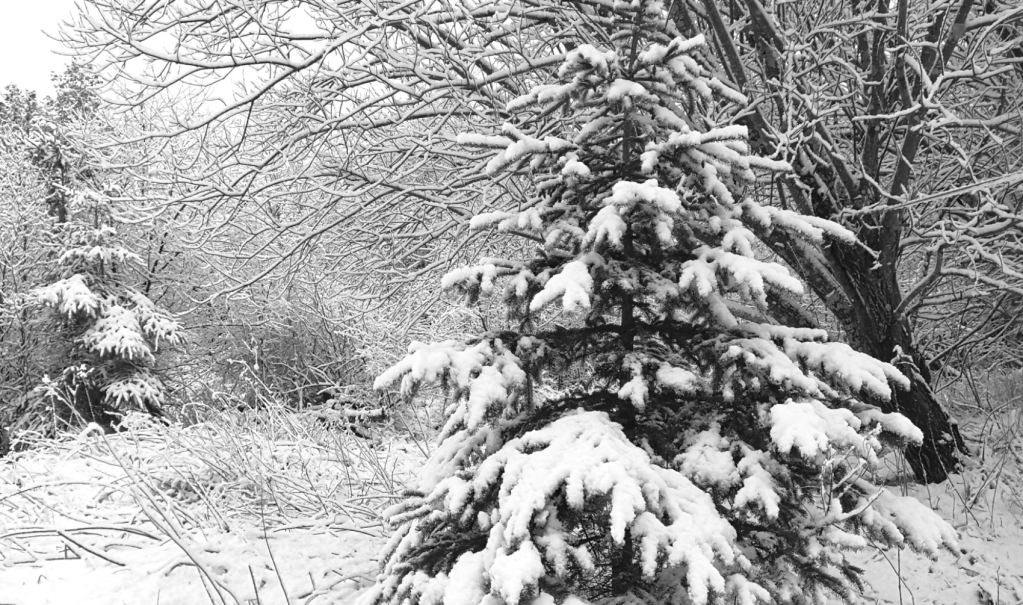
Winter means different things to different people. It also means different things to different peoples—different people groups, nationalities, geographies. In Thailand, December’s momentary bursts of coolness are a welcome respite, though the level of bundling-up often leaves the foreigner wondering what’s going on. In England, there is typically much cloud-cover and dampness, though rarely below freezing (or at least that’s how I remember it). In Canada, however, something different is afoot.
Canadian hibernal months are not all of the same character. The onset of winter always feels to me the worst. It sinks the chill into the bone. But once we get to February, in the typical year, the world has become something new altogether.
It’s still cold in February. Definitely it’s cold. No doubt about it. But it’s bright. I mean really, really bright. Not every day. Some days are snowy or cloudy, of course. But the vast majority are actually sunny. And if you know a snow-covered landscape, you know that sunlight reflects mightily off the banks and drifts. In fact, the Mi’kmawi’simk name for February is Apuknajit—snow blinding time.
February here is frigid and luminous, cold and bright. While the thermometer tells me that the mercury sits far lower than in the other places I’ve lived, it doesn’t necessarily feel like it. Of course, there’s no comparing temperatures in Canada and Thailand; I’ll grant you that. But when I compare my memories of an English winter and one here in the Dawnland, I know which one makes me shiver. Just like the damp Canadian autumn seeps into the bones, so does the Mancunian winter. Yet when I have stood outside most days this past month, so long as the wind has abated, it hasn’t felt so bad.
All this is to say that, to my mind, Apuknajit is an image of the spiritual life. There are days where it is objectively cold—very, very cold. It might even be cold in a way that numbs the mind. We don’t form coherent thoughts. Everything remains general. Maybe we even have a bit of autopilot as we go about our tasks. Because it’s cold. There’s no dallying about for other things.
Yet it’s also exceedingly bright. That’s Apuknajit, snow blinding time. The light is all around us. Nothing sits between us and the sun. The sky is full of light. Even the landscape radiates with it. It’s constant. And if that’s not enough, then as we walk along our way, new sparkles and shimmers appear on one mound of snow after another. In the aftermath of freezing rain, the effect is magnified. But it’s there no matter what. We’re surrounded by light, and we know it.
Of course, all this is true only if there aren’t too many barriers between yourself and the open spaces where snow can fall and stick. If you remove it all with a snowplow, if you have city streets and thoroughfares, if your innumerable buildings rise too far from the ground the Creator made—then all you’re left with is the cold. Nothing bright. Just the cold. I’d recommend against that. God has set it up so that the human has to stick close to the humus to get the benefits. Our condition requires an act, I guess, of humility. But one that pays off in February.
It seems to me that snow blinding time is something like John of the Cross’ dark night. Or maybe it’s like Francis de Sales’ description of his friend Jane Frances de Chantal: she sings but doesn’t know how beautiful her voice is. Then again, maybe snow blinding time is a third reality altogether.
Things can be cold and bright at the same time. Not a few people seem to think that this is impossible. Some of them have just never been to Canada in February. Others have lived here their whole lives but cramped up in the distractions of cities that separate them from the land. It doesn’t have to be that way. Whatever the spiritual meaning of those high-rises and plowed boulevards—if they’re absent, then when we’re led to a place where, eventually, February comes ’round, maybe even on a regular basis, then although it’s cold, it will still be bright.

 Contemplative in the Mud