
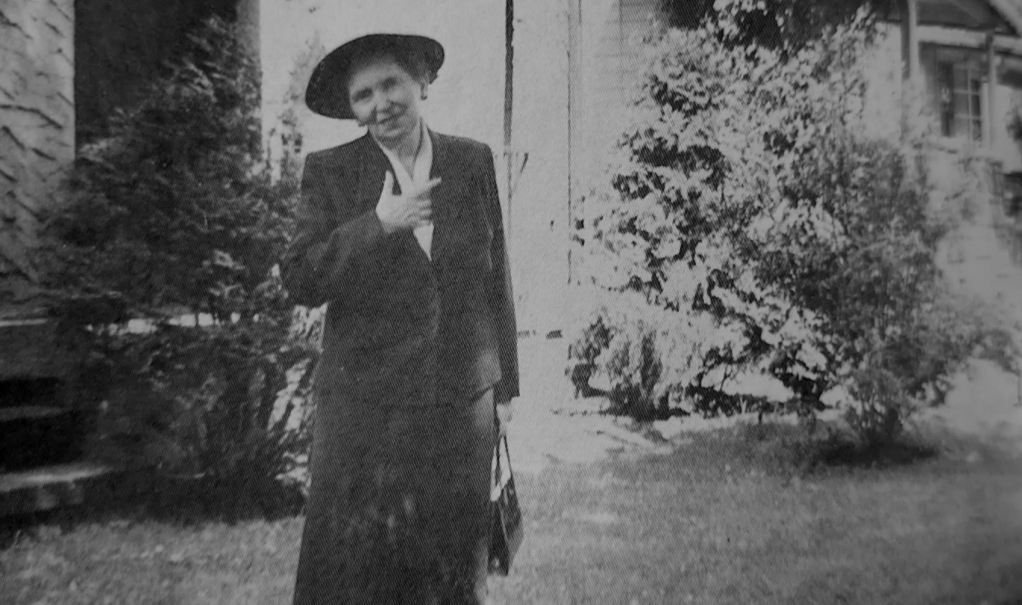
I would like to tell you about someone very important and dear to my heart but whom I’ve never met. In fact, she died many years before I was born—65 years ago today.
Véra Oumançoff was born in Mariupol (then Russia, now Ukraine) on June 20th, 1886, in the Julian calendar, or July 2nd in the Gregorian calendar. She was the younger sister of Raïssa, who would go on to marry Jacques Maritain. This is how I know of her, but I have found her to be a beautiful companion in her own right.
When I set about writing this little post, I had originally been hoping to reread the book by Nora Possenti on the “three Maritains”[1]—Jacques, Raïssa, Véra—but I didn’t find the time for that. Instead, I’ve had to content myself with memory and the pages on Véra in Jacques’ notebooks.[2]
Perhaps you know who the philosopher Jacques and poet Raïssa are, but you’ve never heard of Véra. So, why three Maritains? Were they not two? By name, yes. But the fact of the matter is, Véra followed the married couple in becoming Catholic, then stuck with them as a helper all along the way. She had gifts that they didn’t have between them. And she put these gifts to the service of her sister and brother-in-law. That was where she felt she was called.
Jacques remarks that Véra was born on the Feast of the Visitation,[3] and that seems particularly fitting, for so much of what we know about Véra has to do with receiving people, preparing the way, simplicity, unexpectedness, and being transfigured in joy.
The running theme of Véra’s life is that she was both younger and weaker than Raïssa, but she was her defensive wall and foundation nonetheless. “It was to protect [Jacques and Raïssa] that Véra employed her own strength,” because she found herself “more at ease in the confusion of the here-below”; but this meant, given Véra’s weaker bodily constitution, that “the weaker supported and protected the stronger.”[4]
Always she served a function of very practical, often extremely immediate support. She would fill in what was needed, stand in the gaps, hold things together. In their household of three, Raïssa likens Véra’s role to Martha’s (cf. Lk 10:38–42):
You know that during the fifty-two years that she lived with us she had assumed the role of Martha, yes, but it was a way of hiding a life of prayer and of union with God which she hardly spoke of, but which we knew to be very profound. (Raïssa to Henry Bars, 19 Jan 1960)[5]
Jacques, for his part, acknowledges the Lukan comparison, but stresses that it shouldn’t be pushed too far; she was not just busy with the affairs of this world but deeply immersed in a life of prayer.[6]
I’ve mentioned that Véra felt she was called to live and work alongside Jacques and Raïssa. Both Jacques and Raïssa describe it as a consciousness of a calling, a vocation:
It was in this spirit, and with a perfect clearness, that Véra became conscious of her destiny. If she chose to remain with Raïssa and me, it was for no kind of temporal reason, be it for love for her sister, it was by reason of her personal vocation and of her free gift, and of a call which she knew came from the depth of eternity.
The vocation of which I have just spoken is the supernatural root of the sublime devotion which she had for us.[7]
Véra loved very much some young girls who left the world to form a small contemplative community. They then invited her to join them. Véra refused. At the time we knew nothing of this incident, she spoke of it to me only much later. I mention it because it shows an important aspect of herself. If she preferred to remain with us, it was certainly not only because of the love which bound us to each other, it was first and above all because she believed that this was her own religious vocation, and her manner of consecrating herself to God. (Raïssa to Henry Bars, 19 Jan 1960)[8]
In this respect, Véra can be a reference point for a lot of people on the margins. She never married. She never pursued the consecrated life. The way God was calling her to live out the Baptism which she had consciously chosen, in following Jacques and Raïssa, was to follow and support Jacques and Raïssa in all their adventures across the Western hemisphere. To make matters more awkward in the prying eyes of pious Catholics, she lived with her brother-in-law and her sister. They had an unusual family structure to say the least. And they not only lived it in France, but dragged it to Buenos Aires, Toronto, New York City, Princeton, and Rome.
What kind of personality leads one to such a life? Well, she was always close to Raïssa and, despite being her younger sister, fiercely protective of her. But she was also a bit of a character—to say the least.
She liked the nickname of “Barbed Cat”; her taste for extremes and for a certain irrationality caused us to call her the surrealist of the house. However disarmed she was, for she was in a holy ignorance of the century’s sharp practices, she had no fear of facing the external world, of protecting me against invaders and of showing so much inflexibility to friends who asked for me on the telephone that she drew the resentment of many…[9]
There was definitely something to this. Jacques adds later:
If intelligence was the native land of Raïssa, the proper climate of Véra was the quickness and the exactness of sensibility. She amused herself, though without attaching any importance to it, by pencilling sketches, birds, boats, exaggerated silhouettes and then writing satirical captions under them… On her sickbed she still drew them with her trembling hand, was happy as a child with the sketchbooks and the colored pencils we brought her. She wrote stories for children in which all the animals of the earth figured, short fanciful poems which could have been very good if she had wished and which Raïssa begged her to work on, but which she left as seedlings.[10]
Can you imagine a person like this? And living with one of the century’s most important philosophers and a bilingual poet of excellent calibre? What a life—surely the Maritains’ life was not what many who have read cursorily about them have supposed. At the same time, it’s a paradox. Véra’s seemingly innate ability to stand in the gaps, hold the walls up, and keep things running now comes across as almost inexplicable, given her natural character. She was the disorganized satirist, the chaotic element, the fanciful dreamer.
Of Véra’s spirituality, I need to say some words, too, because it is necessary to explain her gap-filling magic and because it is here that I myself find a lot of inspiration. At the same time, it’s difficult to say much of her deep prayer life. According to Raïssa, “her spiritual life was wholly secret” (Raïssa to Henry Bars, 19 Jan 1960).[11] Jacques offers a little speculation on her interior life, based on his experiences with her:
I believe that unlike Raïssa she received many sensible graces, and that she was fortified by their sweetness, as well as by the sweetness of tears she wept with tenderness and with amazement much more often than with sadness. (At Rome, when I presented the two of them to Pius XII, Véra never left off streaming with tears the whole time that this audience lasted. I teased her a lot afterwards…)[12]
Not only were there sensible consolations, there were also words heard—perhaps “substantial words” in a sanjuanist terminology, words that effect in the hearer what they say. If the souls hears, “Do not be afraid,” it isn’t afraid, or if it hears, “Be confident in my love,” so it is. It’s a reality beyond the possibility of forgetting or ignoring.
We suspected that God spoke to her often. And in an altogether particular case, when it was a question of strengthening us during our exile [to New York] and the anguish of war, she made an exception [to her habit of privacy and secrecy]. She communicated to us the words which she heard from time to time, above all during Mass, and which transfigured her with joy, and which always told us to have confidence, to fear nothing, to know that God watched over us. (Raïssa to Henry Bars, 19 Jan 1960)[13]
Of course, Jacques and Raïssa were too good disciples of Thomas Aquinas and the Carmelite Doctors to just accept extraordinary phenomena and private revelations at face value from just anyone. They knew it’s usually better to ignore all this, at least for those called to contemplation in a cloistered sense. They knew that most things like this are too easily manufactured by one’s own psyche. They knew all this.
However, everything in Véra was too clear, too pure and too simple, her whole conduct too balanced, and the so-to-speak substantial peace, the recollection, the joy, the light which emanated from her when she brought to Raïssa, sometimes to me, the few lines cast by her on a scrap of paper, bore a too evident witness for us to imagine the slightest illusion in her. She herself never doubted that what was said to her came from Jesus.[14]
The interior manifestation of this purity is hard to get glimpses of, because Véra made sure to destroy all her own notebooks. But she missed one. Jacques found it.[15] In that book, from a period just half a decade after their Baptism, Véra writes about her urge “to give everything by Jesus, everything, absolutely everything” (16 Apr 1913).[16] This was so palpable to the other two Maritains that Raïssa could remark: “The spiritual strength of Véra, her love, her union with God, were a pillar of our life” (Raïssa to Henry Bars, 19 Jan 1960).[17] But of course, this doesn’t just mean God alone. She was at home with the Church of Heaven. As regards the Angels, “she seemed on such good terms with them,” and it is for this reason perhaps that she seemed most like an Angel in her protection, support, and defence of her sister and brother-in-law.[18]
Due to all this familiarity, Jacques is able to speak of “the total confidence in God and the total abandonment to His will, and the hoping against all hope! The strength of soul of our little sister aided the least strong among us as it aided the strongest.”[19] Confidence and strength—supernatural.
That strength held out until the end. In 1956, Véra was struck by a car. Some time later, breast cancer led to an operation. Then, starting in the spring of 1958, her body weakened. There had been so much toll in fulfilling her vocation—protecting, supporting, going out, travelling the world, gluing the fragile world together, telling it no when enough was enough, all for the sake of two people who brought her to Christ and for the fulfillment of their own God-given their mission—that her body could no longer hold it in. She received her last message from God that spring: “Your sacrifices are like a dew for me, tell this to your little sister and to your brother. You are my little flock. I am always with you and I shall be always with you, fear nothing. I guard you and shall guard you.”[20] Then, until the last day of the year 1959—spiritual dryness combined with a body that could no longer keep up.
Finally, after many months of suffering, she fell asleep in the morning. As she slept, her last words were, “Papa, papa.”[21] Was it God the Father come to get her? Perhaps. Perhaps, too, it was her own father, who had been baptized on his deathbed. After all, she’d had a dream the April before: “I saw Papa radiant with youth and with light; he approached me; I said to him: ‘Papa, are you coming to take me?’ And three times he replied, ‘No, not yet.’”[22] But on the evening of December 31st, 1959—it was time. Today Véra is buried in Princeton.[23]
In me, there’s a lot of Jacques. There’s a good deal of Raïssa. There’s also a generous dose of Véra. For what can be seen on this blog, there’s my interest in the spirituality and theology of hospitality, perhaps—thus my curiosity about the new Testament’s Pheobe and Lydia. Maybe, too, my fierce protectiveness of Raïssa and Jacques. I can also detect some of my early introduction to Véra in my appreciation for Guite Catez, sister of Elizabeth of the Trinity. But there’s a lot more. Really, a lot. Véra Oumançoff, the third Maritain, means a world to me. I haven’t yet made it to Princeton to visit her grave. But maybe one day I will. And if not—I’ll see her where she is now. Where she was already at home here-below.
[1] Nora Possenti, Les trois Maritain, trans. René and Dominique Mougel (Paris: Parole et Silence, 2006). The original is in Italian.
[2] Jacques Maritain, Notebooks, trans. Joseph W. Evans (Albany, NY: Magi Books, 1984), 186–218; Carnet de notes, in Œuvres complètes de Jacques et Raïssa Maritain, vol. XII (Fribourg: Éditions Universitaires, 1992), 359–401.
[3] Notebooks, 186; Carnet, 359.
[4] Notebooks, 207; Carnet, 386.
[5] Notebooks, 217; Carnet, 399.
[6] Notebooks, 190; Carnet, 364.
[7] Notebooks, 204; Carnet, 382.
[8] Notebooks, 217; Carnet, 400.
[9] Notebooks, 191; Carnet, 365.
[10] Notebooks, 194; Carnet, 369–370.
[11] Notebooks, 208; Carnet, 287.
[12] Notebooks, 207; Carnet, 387.
[13] Notebooks, 208; Carnet, 387.
[14] Notebooks, 208; Carnet, 388.
[15] Notebooks, 207; Carnet, 386.
[16] Notebooks, 190; Carnet, 364.
[17] Notebooks, 218; Carnet, 400.
[18] Notebooks, 205; Carnet, 383.
[19] Notebooks, 207; Carnet, 386.
[20] Notebooks, 211; Carnet, 391.
[21] Notebooks, 216; Carnet, 398.
[22] Notebooks, 215; Carnet, 397.
[23] Notebooks, 217; Carnet, 399.

 Contemplative in the Mud