
As Advent winds down and Christmas approaches, once again focus begins to shift to the little Child in the manger, in his Mother’s arms, on Joseph’s knee. His whole life marked out from eternity to be one of chosen vulnerability—from the fragility of a Child, to the arms spread open on the Cross. This is the vulnerability of Jesus.
Most people say that God took up this vulnerability in the Incarnation, but I rather think that, in his vulnerability too, Christ is “the image of the invisible God” in whom “all things in heaven and on earth were created, visible and invisible” (Col 1:15–16). I think that the Humanity of Jesus makes manifest the primordial and pre-eminent vulnerability of God.
God the Almighty is the most vulnerable of beings. This is a belief that I’ve held firmly since my RCIA days (thanks to Jacques and Raïssa Maritain), rediscovered in Indigenous Christian voices (especially Randy Woodley), and found to be a tantalizing possibility lurking in some recent musings and writings of Pope Francis.
Throughout the past autumn, much of my lectio divina was accompanied by a book by Brendan Byrne on Galatians and Romans.[1] On more than one occasion, I was confronted with thoughts on the vulnerability of God—or, as Byrne prefers it, the “vulnerability” of God, in quotation marks—and I thought I’d share and record those experiences here.
God’s initiative
The first passage in the commentary that caught my attention here is the long and fruitful discussion of Romans 8. Byrne writes this captivating sentence: “Nowhere else does Paul express the divine ‘vulnerability’ displayed in the Christ event so poignantly as here.”[2] Where, exactly, you may ask? Well, this is the larger context:
The phrase “[God] did not spare his own Son” [Rom 8:32] consciously echoes the language of Genesis 22:16 (LXX). The angel who stays Abraham’s hand from slaying his son Isaac praises him for being prepared “not to spare” his beloved Son. The suggestion is that what God did not in the end require of Abraham, God did require of God’s self: the “giving up” to death of his own Son, Jesus. Nowhere else does Paul express the divine “vulnerability” displayed in the Christ event so poignantly as here. The extremity of divine love already shown in that event, when in fact we were “sinners” and “hostile” (5:6-10), guarantees that God will continue to be “for us” to the end—that God will in fact give us “all things” with him, namely the full residue of salvation. Evoking more explicitly the final court scene, Paul defies any being to get up and bring a charge against the elect, when God has already delivered (in justification) a verdict of acquittal and when the defense attorney is none other than the risen Lord himself (vv 33-34).[3]
Byrne says that, in his reading of Paul, “the divine ‘vulnerability’” (in quotation marks) is made manifest, or “displayed,” at a particular juncture of “the Christ event.” And that juncture is the choice to “be there” for us, and to offer himself to all the rebuffs and violences of refusal, “to the end.” It’s clear that, although he uses quotation marks around the word “vulnerability,” Byrne has in mind the Godhead itself. The characteristic in question applies not just to Jesus, but also to the Father. Indeed, the adjective “divine” precedes the noun “vulnerability.” It’s unquestionably the “vulnerability” of God that we’re talking about.
I think this is a wonderful meditation, and it expresses pretty much exactly what French Thomists Jacques and Raïssa Maritain, Cherokee Baptist theologian Randy Woodley, and I mean by the vulnerability of God. It is our refusals, the utter setbacks to divine offerings of truth, goodness, and beauty—super-compensated for by divine providence, omnipotence, and beatitude, to be sure, but nonetheless real refusals and nullifications of God’s offerings of truth, goodness, and beauty—that necessarily imply vulnerability. The kind of Love that God shows is intrinsically vulnerable. In his self-giving love, he is more susceptible to rebuff and denial than we could possibly imagine or conceive. And the Christ event shows this to us in a special, unique way.
So, I love this brief meditation—and I have only one thing to say in return: Why the scare quotes? I see no basis whatsoever to use them. When I speak of “the knowledge of God” or “the love of God,” I expect full well that my listeners understand these to be analogical notions. No orthodox Christian thinker believes that God “knows” and “loves” in the same way that we do. Yes, the suitable words are “knowing” and “loving.” But our own piecemeal and composite experience of these activities and states is a vague echo of the whole-cloth Divine Being where everything is Knowledge and Love. So, why do we need quotation marks specifically for the divine “vulnerability”?[4] I submit for consideration, as I have never ceased doing as a good Maritainian disciple, that God is in fact the exemplar, or model, of vulnerability.
Our continuation
That God is the exemplar cause here comes out in the second of Brendan Byrne’s mentions of vulnerability in his Romans commentary. Because of the divine vulnerability, we ourselves as Christians take on vulnerability. We take it on not just as something imposed and endured, but as something willed or accepted, insofar as we are susceptible to shattering in our being or in our options, but remain open to goodness and not locked in on ourselves.
Commenting on the ethical code proposed or promoted by Paul in Romans 12, Byrne writes:
The world may not understand but it may be impressed when believers express in the outward pattern of their lives the vulnerable love they have already experienced from God. Nonretaliation means leaving “vengeance” to God (v 19a), as commanded by Deuteronomy 32:35, quoted in v 19b. The meaning is not the hope that refraining from retaliation will lead to one’s enemies receiving all the more severe punishment at the judgment (“wrath”) from God. Rather, it is a surrender of one’s cause to God in the confidence that God in comprehensive wisdom will see to an outcome that is just.[5]
Christians in their mode of living instantiate “the vulnerable love they have already experienced from God.” Those are Byrne’s words. It’s really hard to avoid the subtext here. I think this shows that Byrne, like the Maritains, Woodley, and myself, believes that God is really and substantially vulnerable in his Love. Whether he’d express it so directly or not, I don’t know. But how can one write this sentence without holding at some level the belief that divine love is vulnerable?
Taking this passage together with Byrne’s remark on Romans 8:32, of course we have some scare quotes, then a lack of scare quotes. But the overall impression is one of approval, not caution.
In two paragraphs, the motion of thought goes something like this.
God loves vulnerably. This is shown in Jesus, not just insofar as Jesus lives vulnerably and lovingly, but also insofar as the Father offers vulnerably. And that offer, while extremely visible in the Christ event, is a constant, a modus operandi of the divine nature. It never ends. Offers of truth, goodness, and beauty flood the human landscape. We can say yes or no. God is vulnerable before us, on a scale beyond human imagination and thought. He is the most vulnerable of beings. He is vulnerably.
Now, human beings perhaps should always have known this. But we didn’t figure it out. At least, the vast majority of us didn’t. So Christ comes. Divine vulnerability is made manifest. We are incorporated into Christ’s Body. As a result, it is natural—in that supernaturally natural Way—for us to live “the vulnerable love that [we] have already experienced from God.”
What strikes me in Byrne’s presentation, as in the Maritains’ and Woodley’s, is the continuity. Most people, as I’ve remarked, talk as if Jesus’ Humanity is a discontinuity as regards vulnerability. But for these writers, as for myself, it’s the unmistakable continuity that is in play. In Christ, and (in Byrne’s formulation) in the Christ event insofar as it tells us of the Father, God’s vulnerability, his vulnerable love, the vulnerability concomitant with his kind of love, is displayed, shown, made manifest. It’s a revelation—though it existed from all eternity. It’s an unveiling—though the hiddenness was all in our minds.
What is at stake in the question of divine vulnerability is massive—as Byrne seems to hint at but the Maritains and Woodley have made explicit and rightly stressed—and if we zero in on the difference between discontinuity and continuity, whether vulnerability is new to God like an assumed human nature is, or whether it is divine from all eternity, then we start to grasp the personal and societal stakes most clearly.
When we set about finding models for our lives, we can’t fall back on that old staple of a God who is powerful but invulnerable. It was always vulnerability from the beginning. In the things of God, if it’s turtles all the way down, then every single one of them is missing a carapace. Jesus shows to us the vulnerability of himself and the whole Trinity, and when we participate in the divine nature, that’s what we’re participating in.
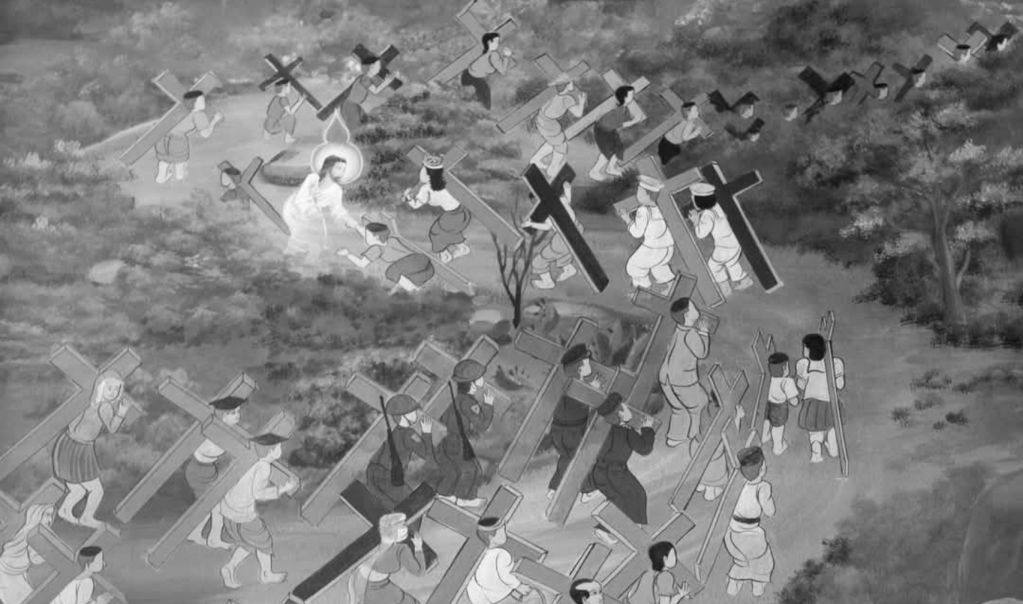
Image in header: Detail of a mural in the chapel at the Father Ray Foundation, Pattaya, Thailand (“Take up your cross and follow me,” presumably)
[1] Brendan Byrne, Galatians and Romans (Collegeville, MN: Liturgical Press, 2010).
[2] Ibid., 130.
[3] Ibid.
[4] If I wanted to be curious and critical, I might further remark that Byrne himself has an entire book called The Hospitality of God (Collegeville, MN: Liturgical Press, 2015; rev. ed.)—which is indeed the very reason I became interested in his works in the first place—and we find no quotation marks in the title of that book, nor in its later chapters, though usage does begin with the application of quotation marks to the word “hospitality.” It should be obvious that hospitality is a virtuous or graceful disposition and that divine hospitality is an analogical, not univocal or metaphorical, use of the term. The whole case is reminiscent of that of divine vulnerability.
[5] Byrne, Galatians and Romans, 152.


 Contemplative in the Mud