
When I started this blog, I deliberately did two things. First, I referenced contemplation in the title. Second, I eschewed bland prose for metaphor. It seemed natural to me that the notion of putting contemplation on the roads of the age—as I indicate in the blog’s mission statement—was the way to go. I shook that up a bit by remarking how muddy these roads are, at least for those who dare to go barefoot.
A diligent and extremely helpful reader has pointed me in the direction of what, in some other universe where my precise influences were just slightly different, might have been an alternate title for this blog. In fact, the person actively popularizing the potential alt-title is Pope Francis. He’s been talking about something called mysticism with open eyes.
Open-eyed mysticism connotes hopeful contemplation of Christ in others, especially the poor
The first indication of this theme came in the preface to the Pope’s new book, Hope is a Light in the Night, which can be found online thanks to Vatican News. Describing his various addresses, speeches, homilies, interventions, and writings on hope, the Holy Father says that
to live hope requires a “mysticism with open eyes”, as the great theologian Johann-Baptist Metz called it: knowing how to discern, everywhere, evidence of hope, the breaking through of the possible into the impossible, of grace where it would seem that sin has eroded all trust.
This turn of phrase is fascinating. I’ve always had a penchant for speaking of contemplation more than mysticism, but the reason for that is largely that I fear to be more misunderstood with the latter, especially in English. At the end of the day, however, words are just words, and the two terms can mean largely the same thing.
The metaphor of “open eyes,” meanwhile, is intriguing both for what it says directly and for the imagery that we might drag into its train. Of course, in the first place, a “mysticism with open eyes” is obviously not one where the eyes are closed. We are seeing. This isn’t navel-gazing. But specifically what we are seeing is the most important detail.
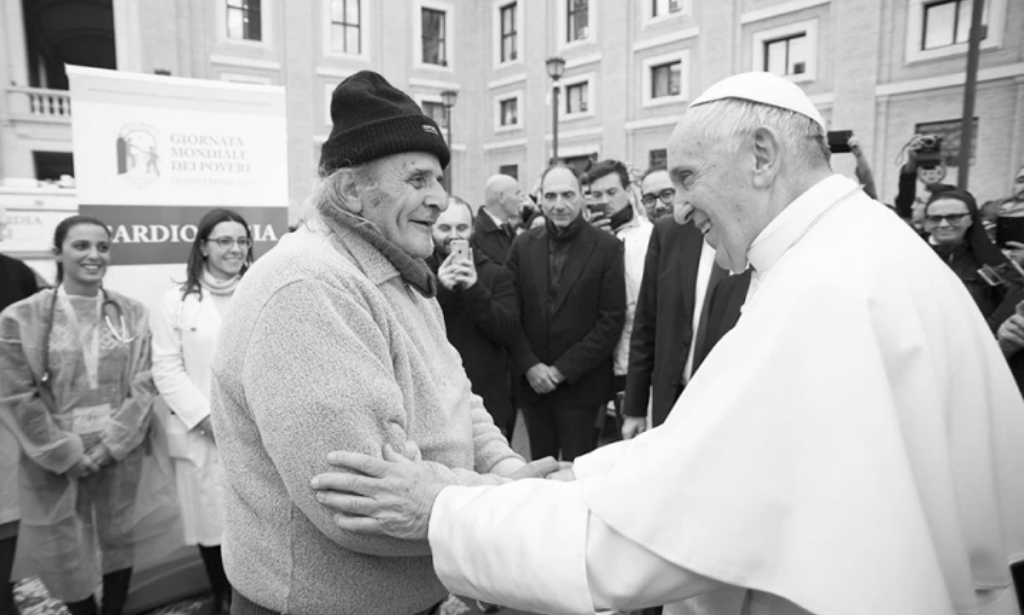
According to the gist of Pope Francis’ remarks, what we see with open eyes is the inherent and Christ-bestowed value of our wayfaring neighbours, and among our fellow wayfarers, particular mention and emphasis land on the poor, the discarded, and the vulnerable. Those are keys points where we contemplate the goodness of human beings and Christ in his wounded members today or, to use the new jargon, where mysticism operates with open eyes.
As far as contemplating Christ in others goes, there have been at least 21 discussions of this topic in seven of the pope’s encyclicals and apostolic exhortations. So it’s safe to say the idea isn’t foreign to this pontificate.
The precise terminology of “mysticism with open eyes,” though, has been elaborated by Pope Francis in his recent homily for World Day of the Poor:
A twentieth-century theologian said that the Christian faith must generate in us “a mysticism with open eyes,” not a spirituality that flees from the world but – on the contrary – a faith that opens its eyes to the sufferings of the world and the unhappiness of the poor in order to show Christ’s compassion.
As in the book preface, it is the muddied, suffering, vulnerable faces and hearts of our fellow saints and sinners whom we regard in open-eyed mysticism. The Holy Father gives more indications as he continues:
Do I feel the same compassion as the Lord before the poor, before those who have no work, who have no food, who are marginalized by society? We must look not only at the great problems of world poverty, but at the small things all of us can do each day by our lifestyle; by our attention to and caring for the environment in which we live; by the tenacious pursuit of justice; by sharing our goods with those who are poorer; by a social and political engagement in order to improve the world that surrounds us. It may seem a small thing to us, but the small things that we do will be like the first leaves sprouting on the fig tree, our little actions will be a foretaste of the summer that is near.
We come here into territory more immediately covered by Johann-Baptist Metz himself in his coining of the phrase. There is a requirement for social and political engagement which is not a kind of domination, but rather a kind of service and an elevation of the downtrodden, both in their inherent value and in what is owed to them. This is what Metz wrote:
Christian witnessing to God is guided through and through by political spirituality, a political mysticism. Not a mysticism of political power and political domination, but rather—to speak metaphorically—a mysticism of open or opened eyes. Not only the ears for hearing, but also the eyes are organs of grace! Jesus is not Buddha! With all respect for Eastern mysticism and spirituality, let me stress that. In the end Jesus did not teach an ascending mysticism of closed eyes, but rather a God-mysticism with an increased readiness for perceiving, a mysticism of open eyes, which sees more and not less. It is a mysticism that especially makes visible all invisible and inconvenient suffering, and—convenient or not—pays attention to it and takes responsibility for it, for the sake of a God who is a friend to human beings.[1]
While we might argue with Metz about whether Buddhism promotes navel-gazing or an engaged ethic of political and social service, it’s clear that Jesus-centred mysticism—comporting contemplation of the whole Christ, including his suffering members today—has genuinely open eyes from the get-go and seeks to actively find the presence of God in the world, thus sparking hope and entailing political or social action. It is, in that sense, “a political spirituality,” though emphatically not one that puts the Church at the service of overly-hardened social structures, nor engages in the least speck of worldly domination.
Open-eyed mysticism’s hope is childlike and Christ-conforming
If, in both Pope Francis’ and Metz’ formulations, a mysticism of opened eyes is a kind of hope, then what are its other features, insofar as it is an act of the second theological virtue?
Well, this is a vast topic. An entire treatise on hope would be required. In short, hope is not just wishful thinking but is lived in tension and action striving towards an arduous good. But hope is also many other important things. As the Holy Father notes in his book preface,
hope is indeed a “childlike virtue”, as Charles Péguy wrote. And we need to go back to being like children, with their sense of wonder, to encounter the world, to know it, and to appreciate it. Let us train ourselves to recognise hope. We will then be able to marvel at how much good exists in the world. And our hearts will light up with hope. We will then be able to be beacons of the future for those around us.
Hope is quite simply a childlike virtue. It has a littleness about it. So, amid all the political and social action that we are, as it were, compelled to undertake by our mystical gaze on Christ in others, we are called to have the spirit of the child in the hands of the Father. This is clearly at the antipodes of domination and cynical calculation, even on a far-flung continent from the organization of plans and processes that exclude the immediate, personal value of human beings. Children—at least childlike children—don’t think like that.
The kind of childlikeness that we have, though, is informed by the fact that we are little sisters and brothers of Jesus, who is our older brother in faith. We know the Incarnation. God has been with us. He is with us. Thus, Pope Francis adds:
To hope is to savour the wonder of being loved, sought, desired by a God who has not shut Himself away in His impenetrable heavens but has made Himself flesh and blood, history and days, to share our lot.
Hope knows that we are children of the Father with and because of Jesus. Mysticism with open eyes lives in hope, and hope is inherently a Christian response and a God-given virtue.
Mysticism with open eyes, or contemplation on the muddy roads of the world, is both a love of God and an inherently political or social mode of being. But it, like the Kingship of Christ, is also a wrecking ball directed at this world’s structures of domination and oppression, in the living hope of a universe where the Father gathers all his scattered children, brings them home in his arms, wipes away each one of their tears, and in the end succeeds at making them laugh.
November 24, 2024—11th anniversary of the apostolic exhortation Evangelii Gaudium and Solemnity of Christ the King
[1] Johann-Baptist Metz, A Passion for God: The Mystical-Political Dimension of Christianity, trans. J. Matthew Ashley (Mahwah, NJ: Paulist Press, 1998), 162–163.

 Contemplative in the Mud