
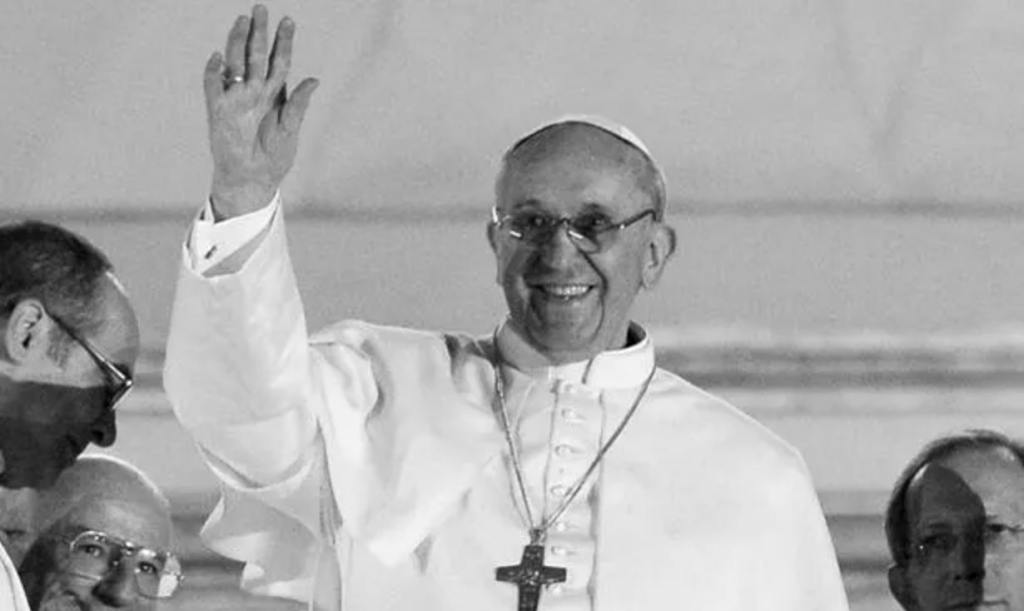
I’ve been slowly making my way through Pope Francis’ new encyclical letter on the human and divine love of the Heart of Jesus Christ, Dilexit Nos. But as I’ve been going along, it has struck me that, in order to say anything useful about this dense and nourishing text, I’m going to need to go back to the beginning: Pope Francis’ first encyclical, Lumen Fidei.
Admittedly, Lumen Fidei is a bit of an odd duck. As the author notes, his immediate predecessor “had almost completed a first draft of an encyclical on faith” and that he himself had “taken up his fine work and added a few contributions of [his] own” (no. 7). In other words, both Popes Benedict XVI and Francis had a hand in this early document on faith. We’ll never entirely know who wrote which part. If we want to discern Francis’ own contributions, we’d need a really well-trained eye—and maybe some luck to boot.
Still, I think that after more than a decade of Pope Francis writing, speaking, and acting, the main through-lines of his thought on Christian contemplation are pretty clear. And the fact of the matter is, Pope Benedict hardly gave a word to contemplation as such, whereas the current Bishop of Rome talks about it like it is his life’s goal to re-organize theological thought on the matter with a devotion and an imprint that no pontiff has had since Gregory the Great.
And what Pope Francis says in his first encyclical strikes me as a very sound basis for understanding what matters he raises in his most recent one.
Models or phenomenologies of contemplation: Sight, hearing, touch
Dilexit Nos will put a lot of emphasis on the human and divine love of the Heart of Jesus Christ. Lumen Fidei, I think, opens the door to understanding the contemplation of the fully human and fully divine natures of Jesus Christ by talking about contemplation as rooted in the experience of faith, and by giving three distinct models or phenomenologies for Christian faith.
The main portion of the older encyclical that deals with these matters is a section on “faith as hearing and sight” (nos. 29–31). At the heart of this long meditation, faith is linked to contemplation:
The truth which faith discloses to us is a truth centred on an encounter with Christ, on the contemplation of his life and on the awareness of his presence. Saint Thomas Aquinas speaks of the Apostles’ oculata fides — a faith which sees! — in the presence of the body of the Risen Lord. (no. 30)
In other words, faith has a model in the human sense of sight. Faith sees. And what does it see? It sees Jesus Christ—a Person with human and divine natures, crucified and risen. Every bit of that is relevant for Lumen Fidei, and every bit of it sets up Dilexit Nos to come a decade later.
But Pope Francis is not content to let vision be our only phenomenological basis for faith. No, he had already been talking about the auditory aspect of human experience:
Precisely because faith-knowledge is linked to the covenant with a faithful God who enters into a relationship of love with man and speaks his word to him, the Bible presents it as a form of hearing; it is associated with the sense of hearing. (no. 29)
So, as the section title announces, we know “faith as hearing and sight.”
Yet appended to these two models is a third: faith as touch. Maybe Pope Francis added this rumination after the section on sight and hearing was largely finished by his predecessor. After all, as I’ve shown before, Pope Francis has a penchant for regarding touch as “the most religious sense,” and “the best form of communication,” indeed “the most human.” It’s a theme dear to him specifically. That would explain the discordance between the section’s title and content.
The final paragraph in this section on models or phenomenologies of faith, and implicitly contemplation, is entirely about the tactile dimension of human experience. It goes like this:
It was only in this way, by taking flesh, by sharing our humanity, that the knowledge proper to love could come to full fruition. For the light of love is born when our hearts are touched and we open ourselves to the interior presence of the beloved, who enables us to recognize his mystery. Thus we can understand why, together with hearing and seeing, Saint John can speak of faith as touch, as he says in his First Letter: “What we have heard, what we have seen with our eyes and touched with our hands, concerning the word of life” (1 Jn 1:1). By his taking flesh and coming among us, Jesus has touched us, and through the sacraments he continues to touch us even today; transforming our hearts, he unceasingly enables us to acknowledge and acclaim him as the Son of God. In faith, we can touch him and receive the power of his grace. Saint Augustine, commenting on the account of the woman suffering from haemorrhages who touched Jesus and was cured (cf. Lk 8:45-46), says: “To touch him with our hearts: that is what it means to believe”. The crowd presses in on Jesus, but they do not reach him with the personal touch of faith, which apprehends the mystery that he is the Son who reveals the Father. Only when we are configured to Jesus do we receive the eyes needed to see him. (no. 31)
This is important. Touch precedes sight. “Only when we are configured to Jesus”—in the initial, foundational, and ongoing reception of him through the experience of being touched by him—“do we receive the eyes needed to see him.”
So, since faith is so intimate and so necessary to Christian contemplation, we have three models for contemplation just as we have three models for faith: vision, hearing, touch.
Jesus Christ in both his Humanity and his Divinity is the object of Christian contemplation
Bearing in mind the threefold phenomenology that undergirds the Pope’s thought, we can look at some details of how this plays out.
In the first place, we need to reject some errors.
There is something fundamentally wrong with any viewpoint that would eliminate the historical dimensions of faith, God’s saving plan, and Christ’s Sacred Humanity. Contemplation isn’t only about what the mind can come to on its own. Nor is it about static patterns. Jesus Christ is the same yesterday, today, and forever, yes—but Jesus Christ entered human history and told a story with his life. Pope Francis explicitly rejects the “Greek” error:
At times, where knowledge of the truth is concerned, hearing has been opposed to sight; it has been claimed that an emphasis on sight was characteristic of Greek culture. If light makes possible that contemplation of the whole to which humanity has always aspired, it would also seem to leave no space for freedom, since it comes down from heaven directly to the eye, without calling for a response. It would also seem to call for a kind of static contemplation, far removed from the world of history with its joys and sufferings. From this standpoint, the biblical understanding of knowledge would be antithetical to the Greek understanding, inasmuch as the latter linked knowledge to sight in its attempt to attain a comprehensive understanding of reality. (no. 29)
In the same spirit, Pope Francis tells us that the Gnostics were wrong, because Jesus spoke words that could be heard and had a Body that could touch and be touched:
The Gnostics held that there are two kinds of faith: a crude, imperfect faith suited to the masses, which remained at the level of Jesus’ flesh and the contemplation of his mysteries; and a deeper, perfect faith reserved to a small circle of initiates who were intellectually capable of rising above the flesh of Jesus towards the mysteries of the unknown divinity. In opposition to this claim, which even today exerts a certain attraction and has its followers, Saint Irenaeus insisted that there is but one faith, for it is grounded in the concrete event of the incarnation and can never transcend the flesh and history of Christ, inasmuch as God willed to reveal himself fully in that flesh. (no. 47)
Both the “Greek” and the Gnostic errors are counteracted by the truth of the matter. The Holy Father is adamant about looking to Jesus on the Cross and in his Resurrection.
The issue of contemplating the crucified Jesus is raised twice. First, Pope Francis says that
it is precisely in contemplating Jesus’ death that faith grows stronger and receives a dazzling light; then it is revealed as faith in Christ’s steadfast love for us, a love capable of embracing death to bring us salvation. This love, which did not recoil before death in order to show its depth, is something I can believe in; Christ’s total self-gift overcomes every suspicion and enables me to entrust myself to him completely. (no. 16)
Second, we get a startling sentence of great luminosity, which connects well with later teachings of the Holy Father:
By contemplating Christ’s union with the Father even at the height of his sufferings on the cross (cf. Mk 15:34), Christians learn to share in the same gaze of Jesus. (no. 56)
The language here is reminiscent of a meditation in Laudato Si’ entirely devoted to “the gaze of Jesus” (LS 96–100). Perhaps that leaves us with more confidence that this, as with so much of the language of contemplation in Lumen Fidei, is a Bergoglianismo. But even if not, it is a line of continuity in papal teaching. It’s compelling either way. We learn to share the gaze of Jesus, which matters so much, by gazing on him, by being with him, on the Cross.
Christian contemplation is not content to leave things on the Cross, though. There is also the experience of the Resurrection:
Easter morning thus passes from John who, standing in the early morning darkness before the empty tomb, “saw and believed” (Jn 20:8), to Mary Magdalene who, after seeing Jesus (cf. Jn 20:14) and wanting to cling to him, is asked to contemplate him as he ascends to the Father, and finally to her full confession before the disciples: “I have seen the Lord!” (Jn 20:18). (no. 30)
We contemplate the suffering and death of Christ, yes. That is essential. But the wounds that we know today are transfigured. They’ve been taken into Heaven. They persist. But they are something else than they were on Golgotha. That is Christian faith. And since contemplation is of faith, that too is Christian contemplation.
Contemplation—union of intellect and will, union of mind and heart
Finally, in Lumen Fidei we get a foretaste of the magisterial teaching on contemplation which I’ve taken as the cornerstone of the relaunched Contemplative in the Mud blog. In Querida Amazonia Pope Francis associates Christian contemplation with a particular exercise of “our God-given contemplative and aesthetic sense,” a single sense used multiply (QA 55–56). In Amoris Laetitia he teaches at length about how the “aesthetic experience of love is expressed in that ‘gaze’ which contemplates other persons as ends in themselves” (AL 128).
In other words, for Pope Francis, love is tied up with seeing things—and people—in a certain way. Contemplation, so to speak, fuses mind and will. Beauty is its object. Beauty is something desired and gazed at, but it is not used, appropriated, expended, extracted, or interfered with. Christian contemplation is a particular kind of experience of beauty—divine beauty, worth of persons loved infinitely by God—and as such it is a particular union of intellect and will. The two faculties operate concurrently. They focus on the same object. Indeed, they jointly rest in it.
Well, all this was already coming on the horizon in Lumen Fidei. The Holy Father writes:
William of Saint-Thierry, in the Middle Ages, follows this tradition when he comments on the verse of the Song of Songs where the lover says to the beloved, “Your eyes are doves” (Song 1:15). The two eyes, says William, are faith-filled reason and love, which then become one in rising to the contemplation of God, when our understanding becomes “an understanding of enlightened love”. (no. 27)
He also adds later:
Genuine love, after the fashion of God’s love, ultimately requires truth, and the shared contemplation of the truth which is Jesus Christ enables love to become deep and enduring. This is also the great joy of faith: a unity of vision in one body and one spirit. (no. 47)
Contemplation, in the Christian sense, is not merely an experience of truth, mind, and intellect. It is also an experience of love. To be sustained, it must manifest itself in loving actions. But in itself, contemplation is not action; it is gaze, hearing, and touch. This teaching is in some sense complex. But it’s also simple. What we see here is that action and contemplation are united. Each contributes to its counterpart. They support and strengthen each other in a positive feedback loop. This is Christian living in a nutshell.
And the object of that contemplation? Well, it is wherever divine beauty is to be found. But the primary locus is always the whole of Jesus on the Cross and in his Resurrection, who can be seen, who can be listened to, who can be touched, and by whom we can be touched—that is, contemplation holds onto the entirety of “the human and divine love of the Heart of Jesus Christ” in the words, coming a decade later, of Dilexit Nos.
And having meditated on that much, maybe now I can finish slowly making my way through the Pope’s latest encyclical.

 Contemplative in the Mud