
Jacques Maritain (1882–1973) is one of the most widely known and important Catholic philosophers of the 20th century, and some of his hallmark contributions have been in the areas of moral-political philosophy and the philosophy of art and beauty. These are not two entirely unrelated fields. They’ve started to become more and more intertwined in philosophical debates, not to mention the teaching office of the Church, especially in the writings of Pope Francis when he addresses the beauty of creation and our duty to protect it. It’s surprising, then, that Maritain doesn’t have anything to say on the interplay between the beauty of the natural world and political ethics.
Or does he?
I’m struck by a passage towards the beginning of his Creative Intuitive in Art and Poetry.[1] This is a long, masterful text written in English, while the French philosopher was teaching at Princeton, and adapted from a series of lectures delivered for a general audience at the National Gallery of Art in Washington, D.C.—the inaugural A. W. Mellon Lectures in the Fine Arts, in fact. Well, as the title says, the book is about the arts. The main focus is painting, sculpture, and the like. It’s not ostensibly about our experiences of beauty in other areas, like in the natural world. Yet as Maritain runs through an initial overview of his topic and scope, he says some things that I just can’t get out of my mind.
Let’s visit Rio and Marseilles
In his opening essay, Maritain makes sure that we recognize that, while in aesthetic experience, something from outside, something of Nature even, enters into us, so too “there is always, to some degree, a sort of invasion of Nature by man.”[2] It goes both ways. This is so even, Maritain thinks, in the beauty of a mathematical demonstration, a geometrical pattern, or (seemingly) untouched natural landscapes. What we can identify is our own mental capacity for number or form or colour. It’s thrown back into things that exist, from which it originally came. Nature comes into us, and we go out to impress upon Nature. The proportion, balance, clarity, luminosity, or whatever it is that delights us with an experience of beauty is received (knowledge) and then re-focused on (out of desire, inclination, love).[3] This duality is necessary for something to be beautiful.
Thus far, nothing is so out of the ordinary. The duality of knowledge and a desire that seeks to focus on the object known, but not to (merely) use, manipulate, alter, or extract from it, is characteristic of many explanations of beauty. The Christian tradition especially gives rise to such talk. Marcel Văn speaks this way. So does Pope Francis.
What I think offers an interesting avenue of criticism and political progress is Maritain’s next move. He ranks experiences of the beauty of Nature. And the (presumably quite incomplete) criteria that he suggests have to do with the amount of the human that there is in what is Nature itself.
That sounds a bit confusing. Maybe Maritain’s own text would be better. This is how he starts:
The bay of Rio de Janeiro, immense, luminous, exquisitely delineated, is one of the most rightly admired natural sites. But how much more beautiful, how much more moving—I mean moving the very sense of beauty—is the entrance, at nightfall, into the port of Marseilles, as it opens its man-managed secretive basins one after another, in a forest of masts, cranes, lights, and memories![4]
Guanabara Bay, which Maritain had visited 17 years earlier on a lecture tour, is contrasted with the landscape more imprinted with history, memory, and human experience that is a pre-Roman, Greek-founded harbour in southern France.
The reason is not that one is pristine, while the other is industrially developed in a way consistent with a Eurocentric model of society, property, and technology. Maritain’s Rio de Janeiro is not an empty place. The world-famous statue of Christ the Redeemer had been completed by the time of Maritain’s visit to Brazil, for example. Nor did Marseilles look the same 70 years ago as it does now. It was then a centre of shipping, but not on the incomprehensible scale of today.
What Maritain specifies as his reason is much more nuanced—much more interesting and with impacts that reach much farther—than a simple preference for linear “progress.” His reasoning relies on the extent to which the existing natural beauty of the land, the waters, the skies, and the earth are imbued with everything human, from technology that befits the place, to memory and associations that stretch past one’s own lifetime into history and even prehistory. Beauty of nature is enhanced by humanity, if humanity be considered in its positive dimensions. Pessimistic views of humanity-as-a-plague are rejected. If we look with the right eye, they can give way to a certain anthropocentrism. This need not be what Pope Francis has called an “excessive anthropocentrism” (Laudato Si’ 116), but might become a “situated anthropocentrism” (Laudate Deum 67). Nature and humanity are enhanced by being related, situated, and interwoven in Maritain’s view.
Journeys through New York and Virginia
Beyond Rio and Marseilles, it’s another pair of examples that Maritain gives that’s the real kicker. He provides a little passage to which one needs to give a critical look-over, but the fact of the matter is that, taken in its most explosive form, he delivers an idea that is hard to forget, dismiss, or minimize:
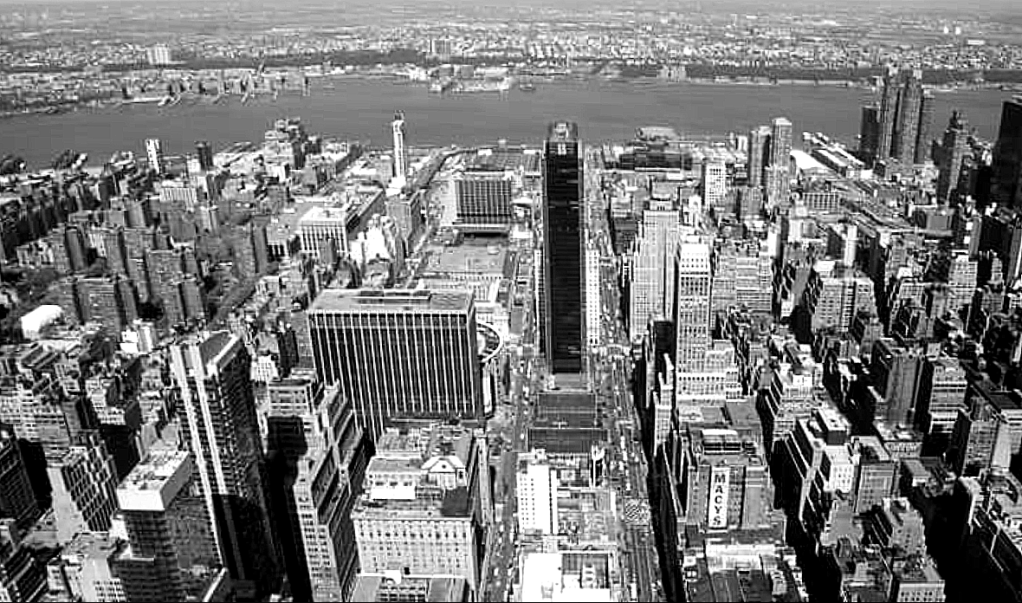
When you drive along the Hudson River or through the hills of Virginia (it is not a question of walking, Americans do not know this meditative pleasure), imagine for a moment that the country you contemplate is still populated with Indian warriors and tents: then the beauty of Nature will awake and make sense all of a sudden, because the relationship between Nature and man has been re-established; modern inhabitants have not yet had the time to permeate the land with the form of man.[5]
Aside from living in Princeton in the ’50s, the Maritains (Jacques, his wife Raïssa, and her sister Véra) had lived in exile in New York City throughout the Second World War. They were familiar with the Hudson River (also known as the Mahicannittuk, Ka’nón:no, or Muhheakantuck). I suppose Jacques also ventured down to Virginia, perhaps while in D.C. We don’t know exactly where. In any case, about both New York and Virginia, the author speaks from experience. Insofar as he does so, I expect that he and especially his wife, who was a poet, formed reasonable judgments about beauty.
But even concrete experience needs a little critical eye.
The critical eye that I think must be brought to bear on Maritain is this. He’s been hoodwinked by the colonial history. Indigenous people are “Indians,” and “Indians” are “warriors.” They’re apparently gone. Traces of their history, memory, and implanted experience have moved out of human reach. “Modern” life has no access to this, nor has yet to create its own sufficiently deep interaction with Nature. No doubt the dominant culture in the 1940s and ’50s told this foreigner such a version of the facts.
But it’s wrong. And Maritain’s own focus on the Hudson River itself issues the challenge.
The Hudson River, if we have a good handle on Euro-American history, is actually a place of enormous significance. First, it was because of Dutch exploration and trading along this waterway that an orally established treaty first took the form of a two-row wampum belt (gaswéñdah). This happened sometime early in the 17th century. Then, once the British took over from the Dutch, it was in 1664 at Albany, on the river’s western bank, that the first formal treaty was entered into with the Aboriginal Peoples of Turtle Island. The second two-row wampum, like the first, signified that the Haudenosaunee (Iroquois) and the Europeans would sail down life’s river—here we might connect the metaphor especially with the Hudson—in two canoes, not interfering with each other and, notably, the First Nations not surrendering the land, their sovereignty, their self-government, or their self-determination in any way. If we want history to penetrate into the land and the waters—oh boy, here we have it. The Hudson is full of watershed moments in the history of nation-to-nation protocols and agreements. And all the broken promises from all the settlers who have in their own way descended from the first Dutch and British treaties? By Maritain’s stated logic, they are scars on the richness of this history. They hinder connection to the land and the waters, because the land and the waters are less imbued with cultural resonance if we forget the Dutch–Haudenosaunee wampum, the Fort Albany wampum, and all the historical and ongoing relationship with Indigenous Peoples that they should call to mind.
So, Maritain’s historical facts are askew. About the “vanishing Indian,” he made a grave mistake—doubly so with his example of the Hudson River. In all probability, the problem lies with trust mistakenly placed in some American friends and acquaintances whose own views were deficient, whose prejudices were too strong, and whose education was lacking.
But even though he committed a severe lapse of judgment, the philosopher is still worth listening to. He is drawing a line in the sand. He is making a point that should challenge everyone involved in the culture of settlers and newcomers in the Americas.
According to Maritain, the Indigenous techno-cultural interaction with the land—the human activity and contemplation of the Lenape (especially, Munsee), Mohicans, and Haudenosaunee (specifically, Mohawk) in the case of the Hudson River, though these peoples are not named by the philosopher—matters a lot more for a beautiful state of Nature than what is currently on offer.
Maritain is unflinching about this. You might have to “imagine” the distant past. Forget the horrendous technological and cultural use of the space that is your automobile, the roadways that are mere efficiency, and the manner in which they function, almost on top of the land rather than with it. Those hinder beauty. They’re unintegrated with the land. They are part of a separation, a disjunction. Get away from them. Go back in time in your mind—not to a time without significant humans there (terra nullius). Maritain agrees that the land was not empty, neither in a physical nor a cultural-technological sense. And he suggests we think of that rather than a pristine, entirely unhumanized landscape. Venture, he says, imaginatively back to the time of the First Nations. Mentally place yourself in a world of the people before European contact (or maybe in a world of side-by-side living and sharing in the style of the two-row wampum). That imaginative space works. It would be more beautiful to place oneself there than to experience Nature in its alternative states: brute Nature or how the colonial history has by now left it.
Of course, Maritain needs some further correction and clarification. He could sound slightly too romantic about Indigeneity. Romanticizing others people. It helps no one. And since the “vanishing Indian” trope is wrong, Maritain is wrong, too, that all we have to rely on is isolated imagination, that there’s no hope of involving the experience, notions, and storytelling of living Indigenous Peoples. If we refuse to write them out of society, then they can be listened to. Their input is available. Dialogical engagement with them is not only possible but, as Pope Francis insists, one of the great exigencies of our age. This might be made more difficult in the cases of the Lenape and Mohicans, due to historical displacement over longer distances, but they remain part of society nonetheless. And in other cases, aside from Maritain’s Hudson, the possibility and immediacy of dialogical engagement might be even greater.
There is no cut-off point. First Peoples’ experience can be acknowledged as a continuity. At the most basic level, their “monuments,” as Mi’kmaw poet Rita Joe calls Indigenous place names, and “road signs,” as Passamaquoddy researcher Donald Soctomah calls the same, always signify; they continue to convey deep meaning. In more general terms, their histories continue. At the wholly human level, we can return to listen to them as persons and peoples. We can have an ongoing relationship. Nothing is stopping us now, aside from ideology.
So, I insist, Maritain is factually incorrect. The original inhabitants likely are not exactly as he, a European, imagined them in the ’50s, and they have not disappeared. They can still be found. Their voices are not silent.
But I insist yet further that the philosopher’s more deeply meditated point is trenchant: “modern” society in the colonized lands of North and South America has not achieved the Nature–human beauty symbiosis that predated European arrival. Or if it achieves this symbiosis in places, vast swaths of land are less beautiful now than they were. For a mid-century European author to say this is, I think, notable. Maritain, of course, is far from anti-Aboriginal and pro-conquest. He mentions Bartolomé Las Casas, the great early-modern defender of Indigenous Peoples, a good dozen times in his writings, always in lavish praise. But his reasoning for this is not just moral. He doesn’t only think people have rights to be protected. He further thinks that there is a qualitative difference in the level of beauty—an objective, ontological value—in Indigenous interaction with and life among the land.
Maritain values the beauty of the land in the hands of Indigenous lifeways more than widespread settler ones. He doesn’t do this by appealing to a preference for antiquated simplicity, a tendency towards being a luddite, or a romantic belief that Indigenous Peoples had no impact whatsoever on the land (pre-contact peoples were usually extensive rather than intensive users). Rather, he says that the imprint they had made on the land was more complete, full, continuous, memory-laden, and technologically interactive with the natural functions of the land. It’s not a question of Indigenous use of the land being “more natural” and “less human.” This dichotomy is, as in Indigenous thought, avoided altogether. Nature becomes more itself, and accordingly more beautiful, as its interaction with humanity increases, while it too remains recognizably itself. That’s what Maritain is admiring in the pre-contact Indigenous world.
If then, for our own part, we “have not yet had the time” to establish a new historical-cultural-aesthetic relationship with the land after so many centuries, then maybe, even from the most pragmatic point of view, even if we forget the justice demanded by the treaty history including the two-row wampums of the Hudson, even if all we care about is the practicalities of attaining a beautiful experience—even then, maybe the fastest way to address the problem would be to return to the fires that, despite the best efforts, have not been quenched and the sources that, despite long policies of rerouting rivers, haven’t run dry.
Stops in settler society, Gibraltar, and Campagna
Immediately following his discussion of the river known in common by the Lenape, Mohicans, and Kanien’kehà:ka, the philosopher directs our attention towards settler society in the Americas. Things were generally more beautiful before (though the fact that we have denied our access to the continuing memory and cultural imprints of Aboriginal Peoples is actually a moral decision, still reversible). Nowadays, human–Nature interactive beauty rises to remark only in some places where the newcomers have planted themselves:
But look at the violent forms, laden with human labor, that have been here and there planted in fields or along rivers by industry: here the relationship is established, Nature avows a new beauty.[6]
Perhaps? It all depends on what kind of “industry” Maritain has in mind and what he means by “violent.”
I have something of a personal relationship with the Hudson River myself. When I was in university, my parents lived in an upstate town on its banks. My father was plenty involved with industry on the Hudson River. And I’m more than sure that pollution-heavy industry does not unambiguously increase the river’s beauty. That wouldn’t be the exact right kind of “relationship” to be “established.” These relationships have moral components, which, insofar as they connote goodness, impact on the desirability and even truth of the matter. They affect its beauty.
A little familiarity with the significant historical moments of the Hudson River confirms the same. When the Mohawk first encountered the Dutch, they would have taken news of this back to the other members of their Confederacy, headquartered at Onondaga. It’s from there that the wampum peace would have been sent back out to Fort Orange. But by the middle of the last century, Onondaga Lake could be named as one of the most polluted on the continent. “Home,” if that be the right word, to the Solvay process and a whole realm of chemical manufacturing, the waters became a no-go zone for human bodies and to this day give no food safe for human consumption. Where the Haudenosaunee Peacemaker had paddled and assembled Five Nations into the oldest still-living democracy, humans have gone to war with the earth and the waters themselves. The prelude was Washington’s breaking of treaty promises and deliberate extermination policies during the Revolutionary War. Two centuries later, the legacy is sunk into the environment. If peace is beautiful, then this is not.
So, we need to be careful about the philosopher’s wording here. Despite what might be suggested by a surface-level reading, I don’t think that Maritain wants to be an apologist for “industry” as we have come to use the term in English-speaking circles since the middle of the century, based around unsustainable extraction and intense monocultures. It is clear that he wants a real relationship between the land, the waters, and the skies, on the one hand, and human activity, technology, cultural impressions, and memory, on the other. And it’s clear that he thinks Indigenous Peoples were, or are, capable of doing so better than a society that has effectively excluded them but not developed a thorough culture of the land.
Moreover, the preponderance of Maritain’s language is not about “industry,” being “laden” with labour, and “violent forms.” It’s about “relationship,” “awakening,” and revelation or “avowal” of beauty. The important fact is that there are “places on the earth have been impregnated with man’s intelligence and toil”:
How is it that when coming from the ocean you pass the Pillars of Hercules and enter the Mediterranean, the beauty of the airy shores and lifelike sea bursts into a song, a triumph? How is it that the simple curves of the Campagna fill you with a plenitude of emotion which seems inexhaustible? If not because of Vergil and the Greek heroes (though you don’t actually think of them), and the impalpable breezes of memory which freshen your face. These places on the earth have been impregnated with man’s intelligence and toil. It is through history that the union of Nature and man is accomplished. As a result Nature radiates with signs and significance, which make her beauty blossom forth.[7]
It is the union of Nature and culture that heightens natural beauty. Other words we might choose include situatedness, interconnection, interpenetration, integration, interwovenness. Essentially, relationship—fulfilling relationship.
The interpenetration that Maritain is highlighting goes in the direction of the human flowing around, upon, and into the crevices of Nature. But a similar principle of interweaving Nature and culture might be perceived, I’d add, in reverse. That would be a particular Chinese genius. Think of the gardens of Suzhou, Yangzhou, and Guangzhou; the artificial lake of Hangzhou and its cultural environment; the art of the potted tree, penzai (bonsai). I’ve experienced each of these more than once, and I’m certain they’re a complement to Maritain’s idea here. In these cases, what we have is the tight, intricate, small-space weaving of Nature into human enclosure and technology. It’s the opposite—just as illustrative of beauty in my experience—of culture living on and with the land, while maintaining what is rightly seen as a “relationship” with it in its own rights. Yet the same, or at least an analogous, heightening effect is present.
At any rate, just as the duality of knowledge and desire (not to merely consume and usurp, but to more importantly rest in the constitutive reality of what is loved) matter in aesthetic experience, so too does another duality matter: Nature and culture.
From all this, Maritain draws two conclusions: “First: Nature is all the more beautiful as it is laden with emotion.”[8] And second, we don’t have to consciously recollect all these cultural and historical associations. It can be enough that they ruminate underground within us: “Unexpressed significance, unexpressed meanings, more or less unconsciously putting pressure on the mind, play an important part in aesthetic feeling and the perception of beauty.”[9] I’m content to retain both these points.
So, what kind of beauty is the beauty of the land?
If we take Jacques Maritain seriously, while critically questioning the colonial history that his friends and acquaintances in the Americas seem to have offered him in the 1940s and ’50s, the beauty of the land, which has a certain connection to goodness and desirability and thus a relationship to the morality of individuals and societies, is a particular kind of beauty.
In the first place, there is beauty that we think of as “purely natural.” It’s “untouched.” The human element—an imprint, a cultural cross-pollination, a living-together-with-Nature—is absent or unknown. In contrast to any anthropology or cosmology that views human beings in predominantly negative terms, Maritain ranks “unspoilt Nature” as a low form of natural beauty. It’s real. Very real. But as with the beauty of numbers, mathematical demonstrations, colours, shapes, and patterns, it describes something that, while it interacts with us as we appreciate it, is missing a historical dimension of interaction.
All other things being equal, what’s more beautiful is a “relationship”—Maritain favours this word in his rare English writing—between Nature and human technology, experience, and memory. Pre-contact, pre-decimation, pre-displacement Indigenous Peoples of the Americas are actually one of Maritain’s examples here. Quite unlike the Lockean justification that the pre-contact peoples weren’t using the land, Maritain thinks they emphatically were—and in a very relevant way better than much of what he sees settlers and newcomers doing centuries later. The Indigenous–Nature relationship was full of more goodness and truth of connection, even if expressed in a different style, than what has been left in the wake of the dispossession of their lands. Settler society has only been able to reclaim respectful points of contact with Nature sporadically, discretely. Its achievement is not as wide-reaching as the society which preceded it. In saying this, Maritain has said The Thing You’re Not Supposed to Say.
Where Maritain is wrong, I think, is the historical facts as he was handed them. The relationship that existed before has never been entirely erased. Most importantly, treaties and royal proclamations in present-day Canada and the U.S., when considered in historical context, usually tell a different story than the received one. This is true even—especially—on Maritain’s Hudson. But in addition, there are numerous other sources for ongoing relationship. Oral history is a significant form of cultural transmission. Archaeology has powerful techniques. We can read between the lines in colonial records. Wisdom- and knowledge-keeping, arts, technologies, and techniques persist. Original Peoples still exist. The underlying society and culture have not been utterly eradicated. That’s a fiction.
If we were to listen, truly listen, to the right history and people, we might find the beauty that is becoming harder and harder to come by. Even just a small opening of our heart towards the First Peoples of the lands we inhabit is a good start, because the unconscious ruminations then might affect our aesthetic perceptions. Of course, more is better. But whatever little we let run through us will, on Maritain’s logic, make a difference in the encounter with the beauty of the humanized land.
Indigenous Peoples are, wherever they have not disappeared or been utterly eradicated, key to an aesthetic component of life with the land. This doesn’t mean, for Maritain is clear here, a total repudiation of settler technologies and human–land interactions. But at the same time, it certainly doesn’t mean accepting the status quo about what society should look like (including the place and value of Indigenous Peoples within its collective imagination and even political structure), how economics should interact with the natural environment, and what technologies we develop for the places in which we live. Business-as-usual is unacceptable if we concede Maritain’s ideas of the beauty of creation. Indigenous Peoples are not just one minority among many, and any attempt to treat them as such, still more the delegitimization or marginalization of their knowledge, experience, values, and perspectives, sends the appreciation, protection, restoration, and promotion of natural beauty into a tailspin.
The further we walk away from the beauty that existed, trying to start over with a clean slate, forgetting what was before, then plodding off in an ahistorical direction, the more deformed the beauty will become. In the Americas especially, there will be no beauty of the land, the waters, and the skies without confronting this history and its contemporaneity in the lives of the dispossessed. We wander about like a person who forgets his own face—or even tries to chop it off. Memory is a beautiful, necessary thing. It has to be put back in its place for the beauty of the land.
This isn’t easy. Far from it. But if Jacques Maritain is philosophically right, but historically poorly informed, it’s the only way things can be.
This article was updated in November 2024 to give more space and scope to Haudenosaunee geography and history, without altering the discussion or main points in any way.
[1] Jacques Maritain, Creative Intuition in Art and Poetry, The A. W. Mellon Lectures in the Fine Arts, National Gallery of Art, Washington (London: The Harvill Press, 1953).
[2] Ibid., 6. Note that, throughout, I retain Maritain’s then-prevalent use of terms we would today avoid, such as “man” to denote the human.
[3] There is also the case of overwhelming, spectacular Nature, sometimes described as “wild” or “sublime” and occasionally as “numinous.” Maritain qualifies these experiences as a “brute feeling, or a merely subjective feeling” of beauty (ibid., 6–7). They lack some of the objectivity characteristic of more proportioned and human-scale beauties. This observation is interesting. But it is beside the present point.
[4] Ibid., 7.
[5] Ibid., 7–8.
[6] Ibid., 8.
[7] Ibid.
[8] Ibid.
[9] Ibid., 9.

 Contemplative in the Mud