

For about a year, I’d been pursuing the goal of becoming a Laudato Si’ Animator. Anyone familiar with my blog knows that I’m committed to eco-spirituality and finding what is already “green” in the Christian spiritual tradition, especially as it concerns contemplation. My efforts for the Season of Creation, Laudato Si’ Lent, and Earth Month should hardly leave room for misinterpretation.
The roles of an LSA are ecological conversion, footprint reduction, and raising a prophetic voice. These correspond, in my mind, especially to the contemplative dimensions of the Christian spiritual tradition and in the encyclical Laudato Si’ in particular, to the action that is coupled to contemplation, and to what Querida Amazonia calls “the prophecy of contemplation.” Well, all this is right up my alley. Arguably, I’m already using this blog to “animate” the online world, or the tiniest slice of it, in terms of Christian eco-spirituality. So, I say to myself, it would be meaningful to do this in conjunction with some training and certification. I have pursued becoming an LSA.
The process of becoming a Laudato Si’ Animator
To become an officially trained and certified LSA, there is online formation, either in the form of a face-to-face training program or an asynchronous one. Following this, there is a requisite project, formerly called a “capstone project” and now more appropriately termed a “seed project,” indicating the forward-looking nature of the activity. These projects can be rather simple. Some people arrange for ecological intentions during the prayers of the faithful at Sunday Mass. Others arrange a parish viewing party of the Laudato Si’ Movement–affiliated film The Letter (available on YouTube). Still others might engage in tree planting, coastal clean-up, outdoor prayer services, a creation pilgrimage, or some other activity involving other people.
I hummed and hawed for a while about whether to use my blog posts for my seed project. They would probably qualify. Plenty of ecological conversion and prophetic voice are involved. There is an audience. Of course, these posts don’t get much direct feedback and interaction—but there’s arguably just as much as you’d expect from a film-viewing party. Ultimately, though, I wanted to do something more tangible. I wanted something offline rather than online. Something that was less automatic, less obvious for me, more challenging.
The seed project I settled on
For quite a while, I couldn’t figure out exactly what to do for my seed project. I had in the past spoken to my parish priest about matters related to the environment and climate change, but he was always rather dismissive: sometimes mocking the interest people show in environmental concerns, another time specifically inviting me to talk to him about Laudate Deum when it was released, then making me defend it rather than fairly discussing it. Of course, I had already written up my thoughts on this apostolic exhortation, so it wasn’t too tricky to recall them and present them on the spot. Still, I found the experience uncomfortable. There is a power dynamic involved, and given my past relationships with priests, this was undesirable and inappropriate.
My parish priest is somewhat hostile. To organize something Laudato Si’–related in my parish community is not straightforward; I am far from a confrontational person, particularly due to so much of my unfortunate experience with priests. In May of this year, however, an appropriate opportunity arose.
The area that I live in launched a new circular materials recycling program. There was already province-wide recycling of certain plastics (with the standard numbered plastic recycling codes), metals, paper, and cardboard, to be picked up every two weeks from residents’ homes. But the recycling of all other materials had no way forward. This changed in May, with the launch of the new program. There was an official materials guide published. Many additional materials were now to be included, including other (non-numbered) plastics, glass, Styrofoam, net mesh bags for fruit, and others.
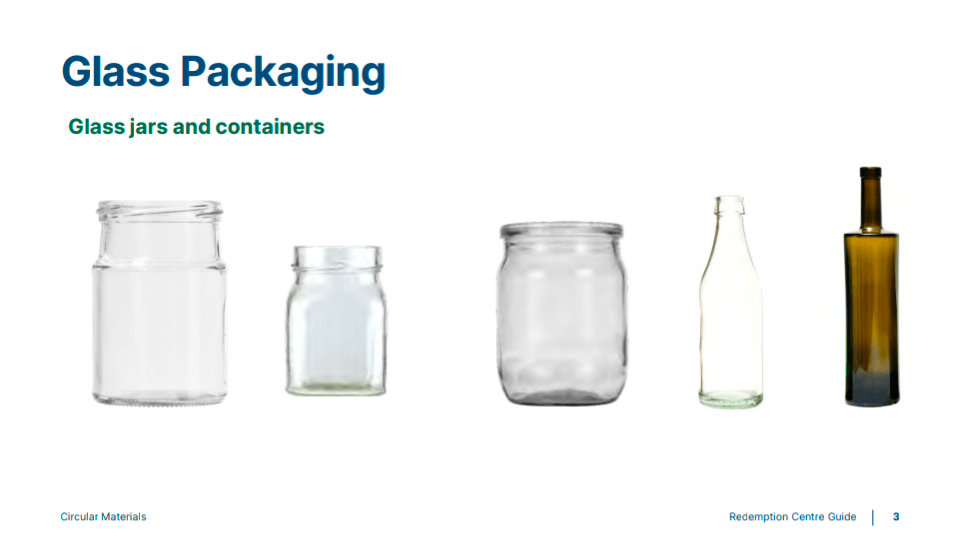

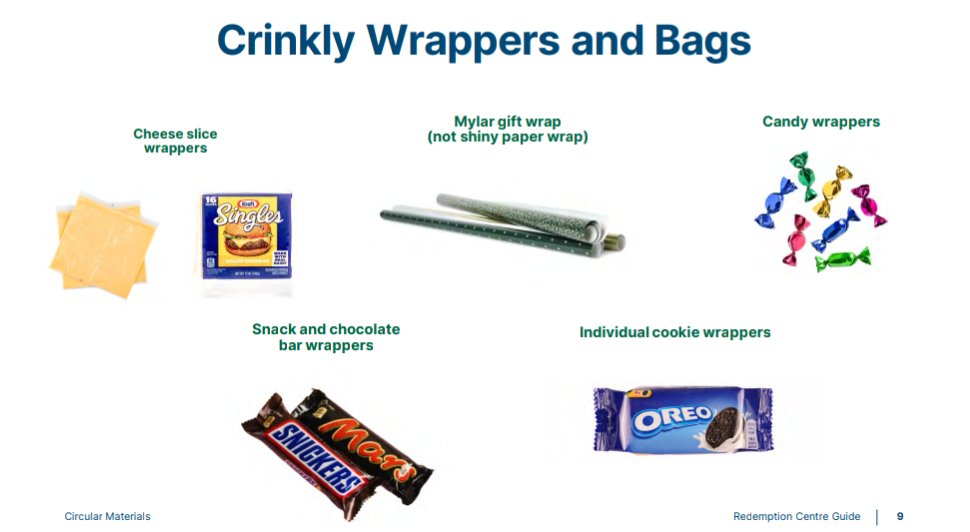
Two items caught my eye for our parish: crinkly wrappers and glass packaging. Being a sacristan, I knew that we used these—the former for altar bread, the latter for wine. The waste was simply being thrown out, because there was no way to recycle them.
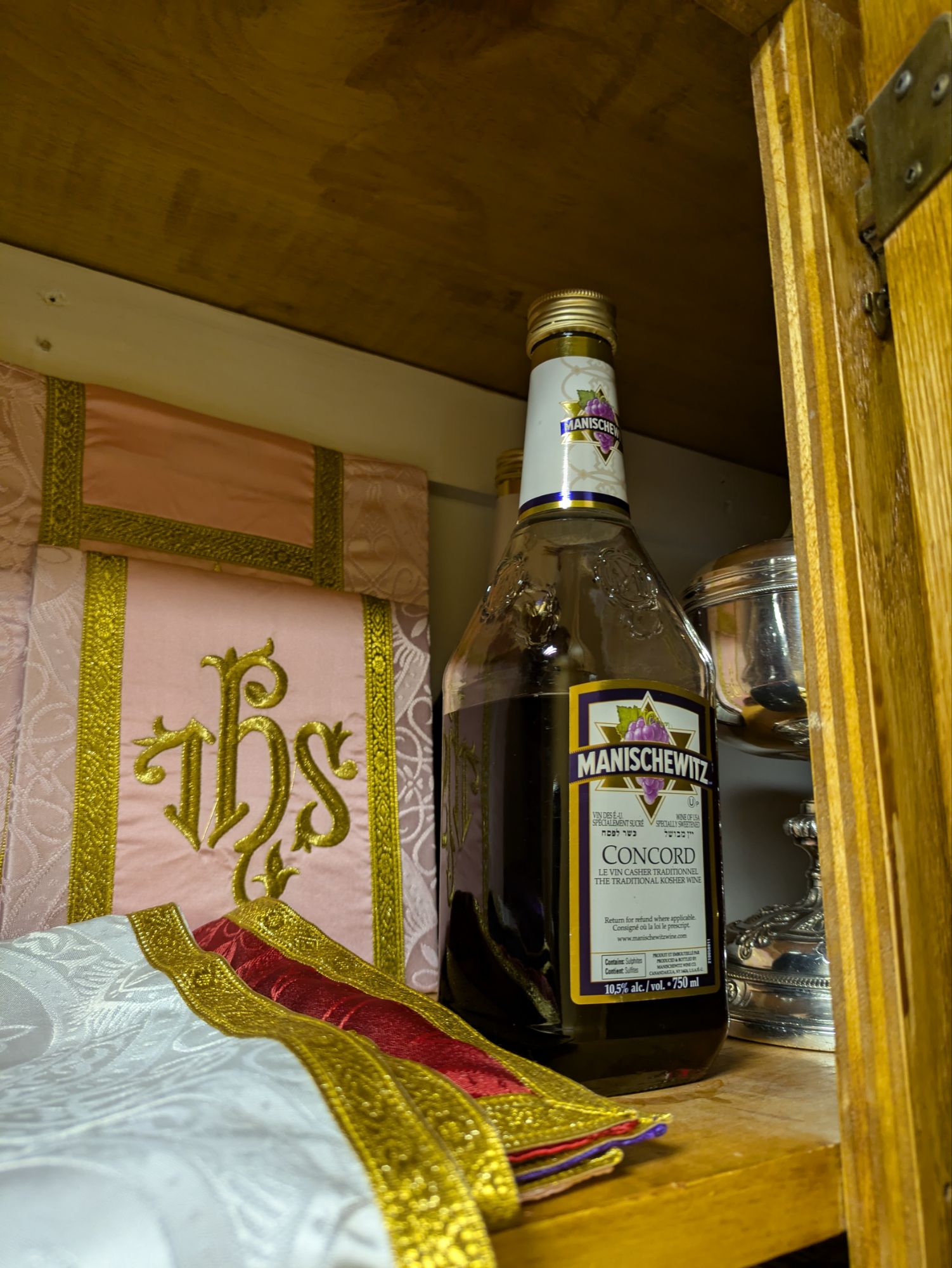

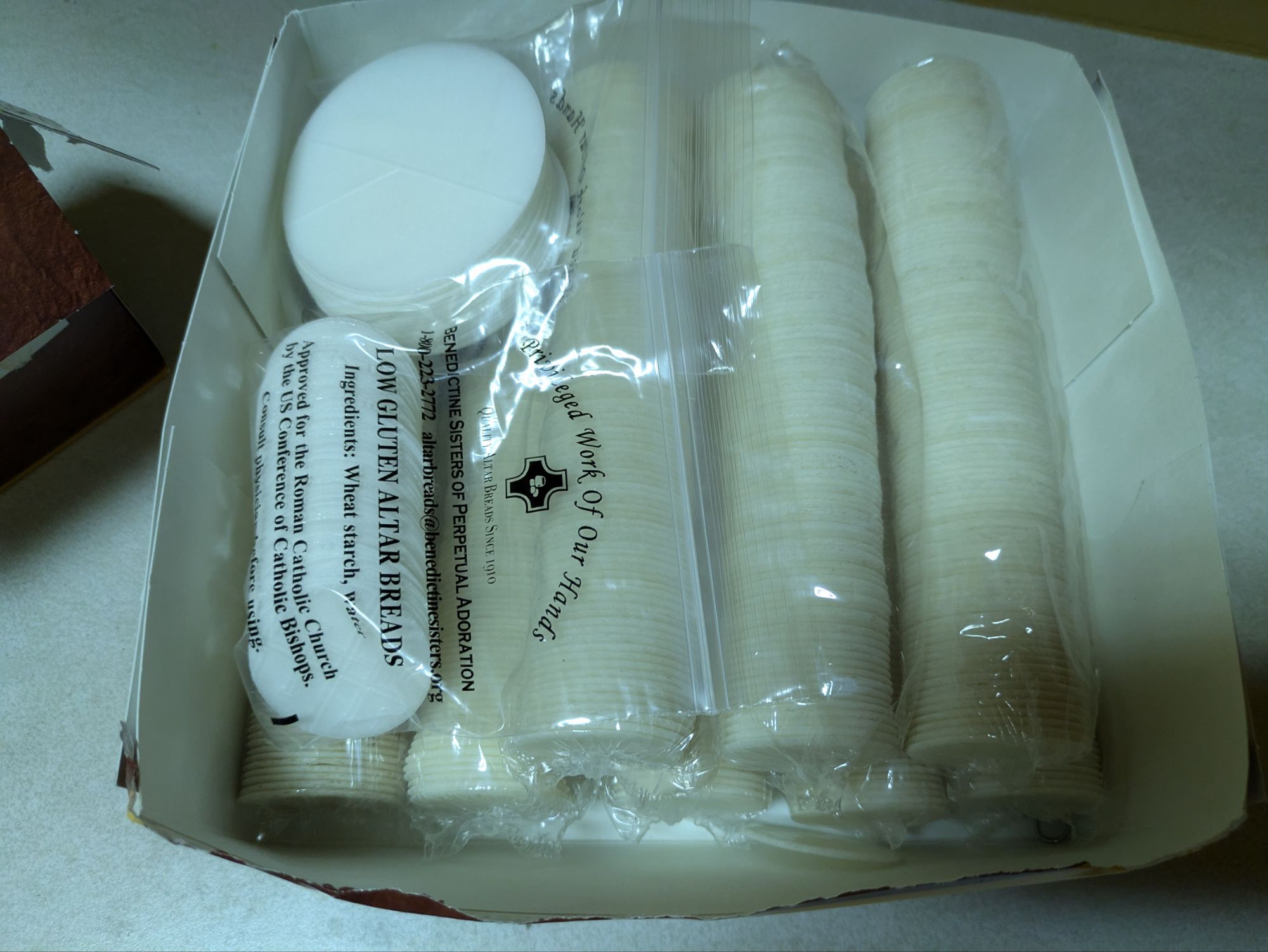
My idea formed: green the sacristy by recycling these materials.
So I found a recycling centre that would take the materials that, in my plan, we needed to recycle. I ran a trial, sorting home refuse to accommodate the new rules, and then I dropped it all off. Then I consulted with the other sacristans about implementing more recycling in the sacristy. We agreed that I could and would take the newly recyclable materials to the recycling depot, and I installed a little sign telling anyone absent that I can recycle the crinkly wrappers for the altar bread, if they would put it in the recycling bin rather than the trash can. (In truth, I can sort through the trash can just like I can sort through the recycling bin—but I’d rather sort through clean plastics than a variety of waste, for obvious reasons!)

We have greener, recycling-compliant sacristy program at our parish! Other existing materials, like cardboard boxes that the altar bread came in, were being recycled under the old program, of course. But the remainder of the waste from the sacristy now has its own system for recycling, too. I can gather crinkly plastics and glass bottles and take them to the recycling depot for the new program.
I found my LSA seed project to be more challenging than initially anticipated, but this was mostly because I was nervous about approaching my parish priest again about environmental matters, following some previous bad experiences. For months, I kept an eye out for what I could do, beyond prayer, conversion of heart, and showing interest in conversation with fellow parishioners. Finally, when the new province-wide recycling program started, I knew that this was a chance to make a small difference. Here was something I would be committed to for my own home, and I hoped that I would be able to make it work for my parish as well.
There is a nice integration of my spirituality and my action for our common home. It is since I am one of my parish’s sacristans that I can make the Mass itself greener. One practice feeds into another. In due time, if everything goes well, I can extend the collection of newly recyclable materials to other sections of the parish (e.g., kitchen, classrooms). For now, however, we’re one step closer to greening the parish—and in a place where it counts very much, for the Eucharist itself is where “all that has been created finds its greatest exaltation” (LS 236).
And I’m officially a Laudato Si’ Animator. Hope and act with creation.

 Contemplative in the Mud