
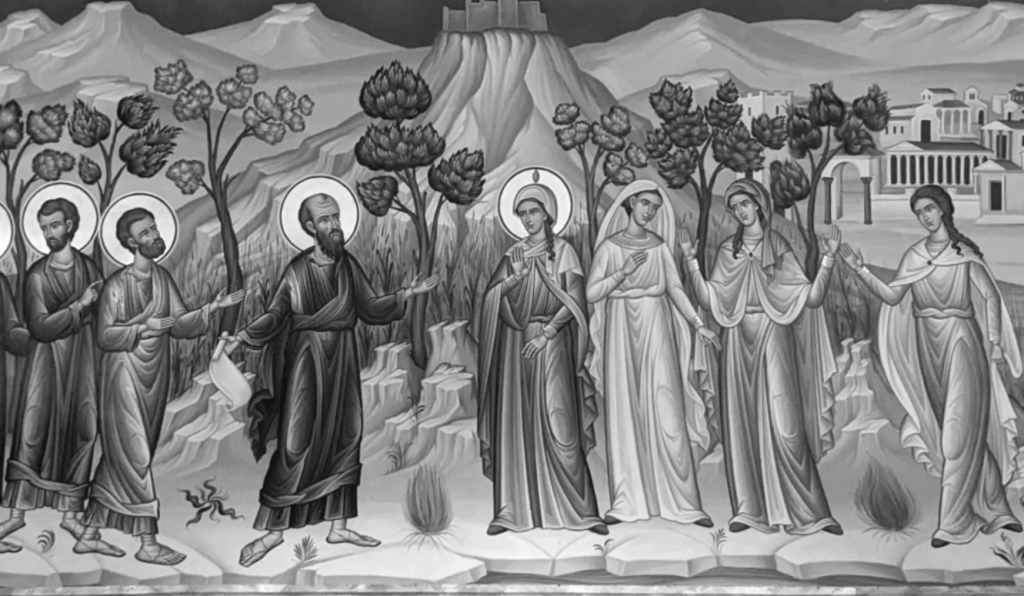
A memorial so optional that I would suggest few people have heard it celebrated in a liturgical setting, today the Latin Catholic Church offers before us the memory of Lydia of Thyatira (Eastern Christians and Anglicans honouring her on different dates). This laywoman, with her own intercontinental business, functions as a pivotal personality in the spread of Pauline Christianity. I have a personal devotion towards her, along with some other laypeople connected to the Apostle from Tarsus. Accordingly, when I recently took a little pilgrimage through Greece, Philippi was at the top of the list of places to visit.
Lydia in the Bible
In the Acts of the Apostles, Lydia’s story carries more than its proportional weight of interpretative difficulties. One popular translation goes as follows:
We therefore set sail from Troas and took a straight course to Samothrace, the following day to Neapolis, and from there to Philippi, which is a leading city of the district of Macedonia and a Roman colony. We remained in this city for some days. On the Sabbath day we went outside the gate by the river, where we supposed there was a place of prayer, and we sat down and spoke to the women who had gathered there. A certain woman named Lydia, a worshiper of God, was listening to us; she was from the city of Thyatira and a dealer in purple cloth. The Lord opened her heart to listen eagerly to what was said by Paul. When she and her household were baptized, she urged us, saying, “If you have judged me to be faithful to the Lord, come and stay at my home.” And she prevailed upon us. (Acts 16:11–15)
Later, after being released from prison, Paul and Silas go to Lydia’s home, visit and encourage the fellow children of the Father, and then leave (v. 40).
This all sounds pretty straightforward, but if you invest enough time in the narrative and personalities here, you’ll quickly discover some difficulties.
First, Lydia’s name sounds like it just designates her home region, Thyatira being a town in Lydia in Asia Minor (modern Türkiye). Potential reasons for this are multiple: the author might not know Lydia’s actual name; this could be a name given to a slave (and thus Lydia had worked her way out of slavery to become a freedwoman); or Lydia just had this name, for whatever reason.
Second, the place of prayer near the river is ambiguous: it doesn’t seem to be a synagogue in the sense of a physical building, but there lingers a greater question of whether Paul and friends expected to find fully converted Jews there or merely (or predominantly) adjacent, participating, Gentile “God-fearers.”
Third, Lydia seems to be in charge of her household, so we have a slew of questions about Augustan reforms to Roman marriage laws which would have allowed this to be possible in her context. The most likely hypothesis is that our convert had had a husband, who had died; but before her husband’s death, she bore enough children (at least three) who survived long enough for her to be granted a special status as householder, without further need for the control of a male guardian upon her husband’s death. It’s a pretty complicated network of causality to let Lydia become the person whom Paul finds and who can also offer her home in hospitality.
But that is precisely Lydia’s chief characteristic in the Acts of the Apostles: her hospitality. It is this feature of her person and action which prevails upon the entourage of the Apostle to the Gentiles. She exemplifies the reception that Jesus asks his disciples to look for when he sends them out in the Gospels of Matthew, Mark, and Luke, or the concern that the Elder shows for the rubrics of Christian hospitality in the Johannine letters.
There were all kinds of (largely unwritten) social codes about hospitality (philoxenia, love of the stranger) in the Greek and Roman universe in which Lydia was living. Exactly what was owed in return and whether there was established any unequal or equal relationship had a particular form that we might not recognize today. But the important thing is that her contribution to Paul’s Gospel, as it propagates into continental Europe, is one of reception, welcoming, accommodation, and support. Unlike Prisca and Aquila, there is no hint that she preaches or teaches. Unlike Phoebe of Cenchreae (whose memorial is exactly one month from today), there is no indication that she was a sort of Pauline emissary who read the incipient text of the New Testament to the People of God. Lydia’s story is focused on another node of evangelical life. She is just receptive of the Gospel and hospitable to those who proclaim it.
An account of pilgrimage
I find all this inspiring enough that I wanted to go to Philippi. Of course, many people who undertake this journey do so because of the site of “the first Baptism in Europe” (though non-Pauline Christianity seems incontestably to have reached the Italian peninsula well before Paul, given that the Apostle was welcomed by Christians outside Rome) or to see what remains of the “jailer’s house” in the centre of town.
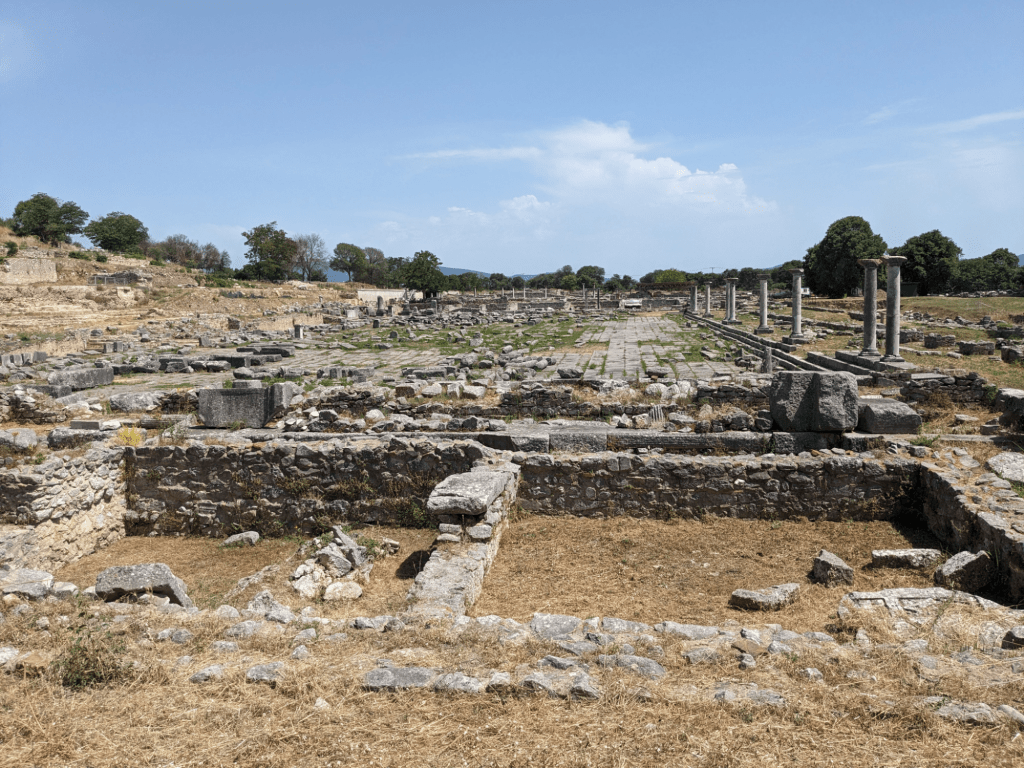
In Philippi, the marketplace (agora), located in the shadow of a steep mountain, which was lined with Roman administrative buildings and temples, is indeed impressive, despite its ruined state.



But Lydia drew me in and drew me on. Travelling a little past the modern museum and outside town, one comes to a site alongside the river. We don’t know that this is the place where Paul met the God-fearing women. But it is respected as such. The picturesque nature of the location and its proximity to the city give the hypothesis a good probability. Today, at a spot where the river’s flow becomes a gentle rush, a little auditorium with a baptismal site has been set apart. When I was there, a group of Protestant Korean pilgrims showed up and one of them was baptized.

And just a few metres from there, a more substantial construction, used for infant Baptisms by Orthodox Christians, who form the majority in Greece, has been erected. The chapel is dedicated to Saint Lydia, and gorgeous murals surrounding the central Baptistery font tell the story of Saint Paul in Philippi, not neglecting the contributions of his hospitable co-worker Lydia.

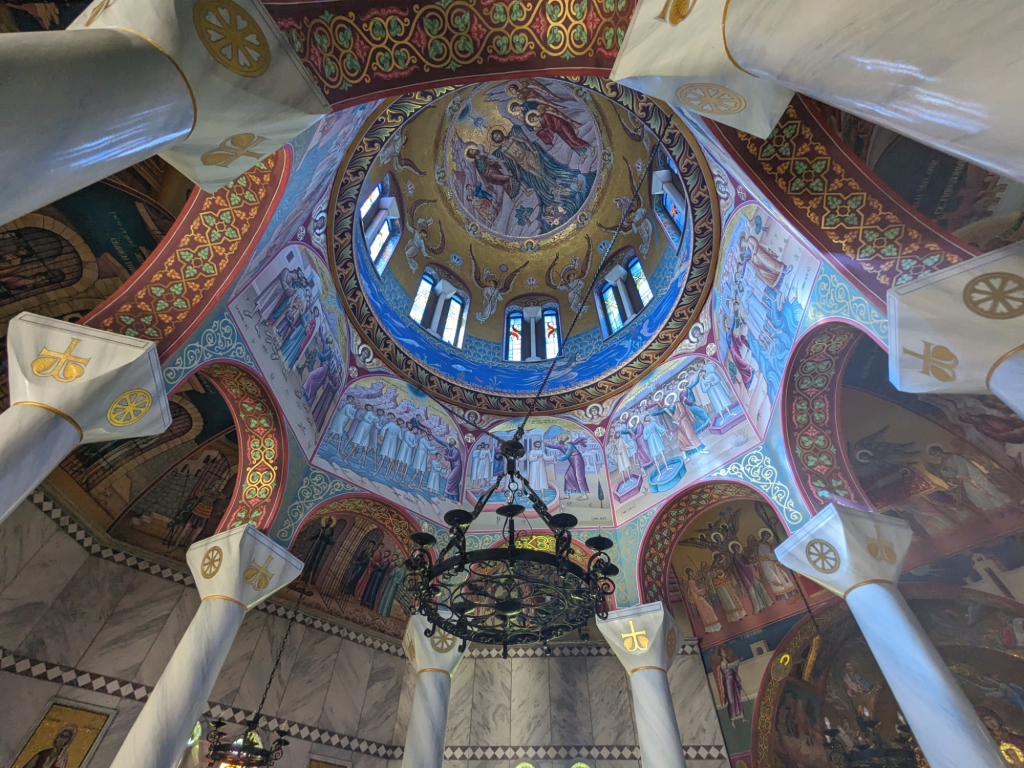


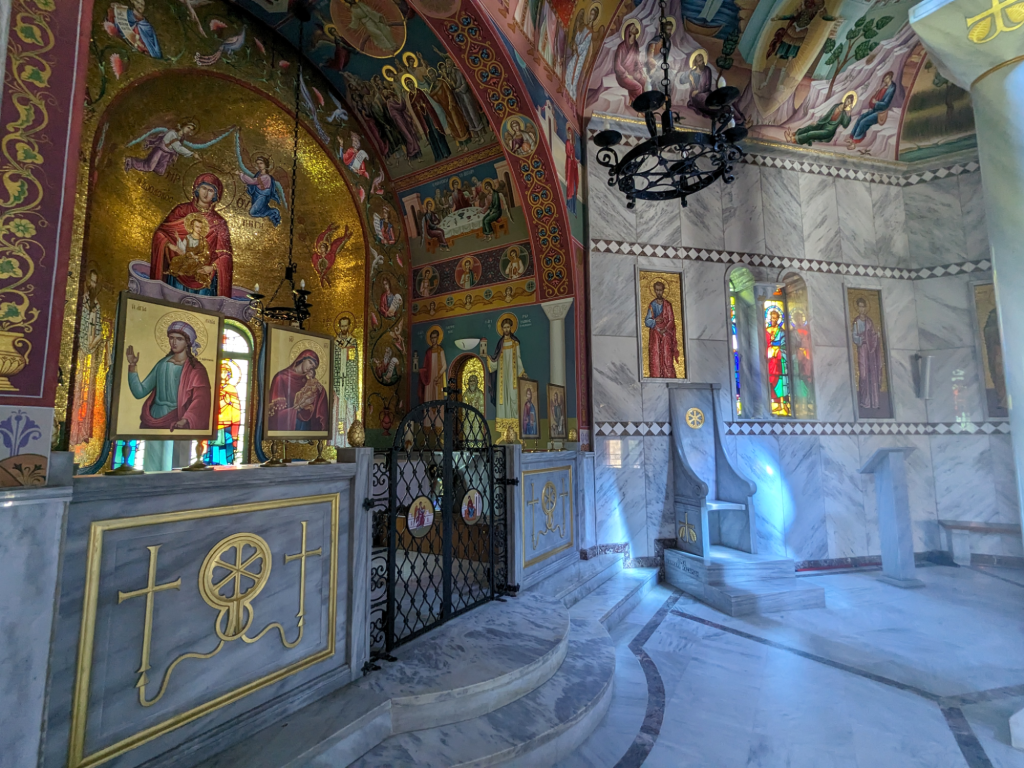
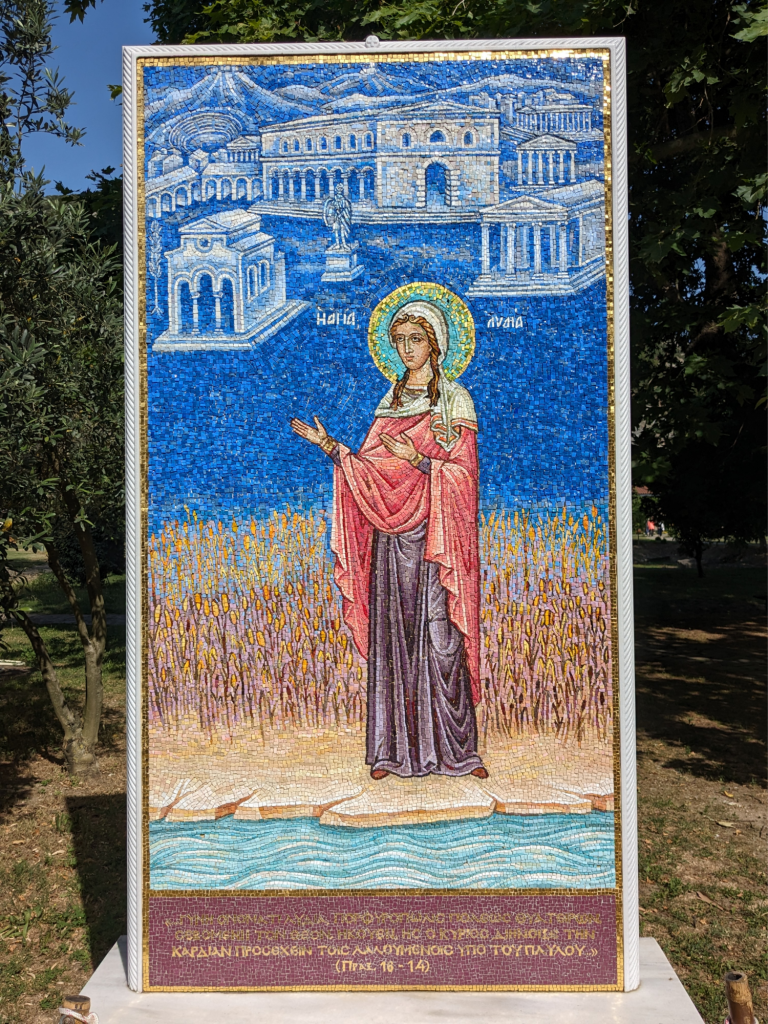
All around the site, too, one can find various iconographical representations of Lydia. Media vary: stained glass, mosaic tile, paint. Locations range: behind the main altar, as a simple iconostasis, in the portico of the chapel, outside the chapel, at the river site. All are—I imagine this comes as no surprise by now—dear to my heart.



One question remains and challenges us as laypeople, especially those with significant degree of a contemplative orientation: What is the role of receptivity of the Gospel, and of the Other, today? I ponder how much we are willing to put into this welcoming of and absorption in the integrity and support of the truths, and the persons, we receive. Lydia testifies to the pivotal role that such activity—if indeed we would dare to suggest that it is more active than contemplative—has had in the Church. May she continue to intercede for us to this end today.

 Contemplative in the Mud