
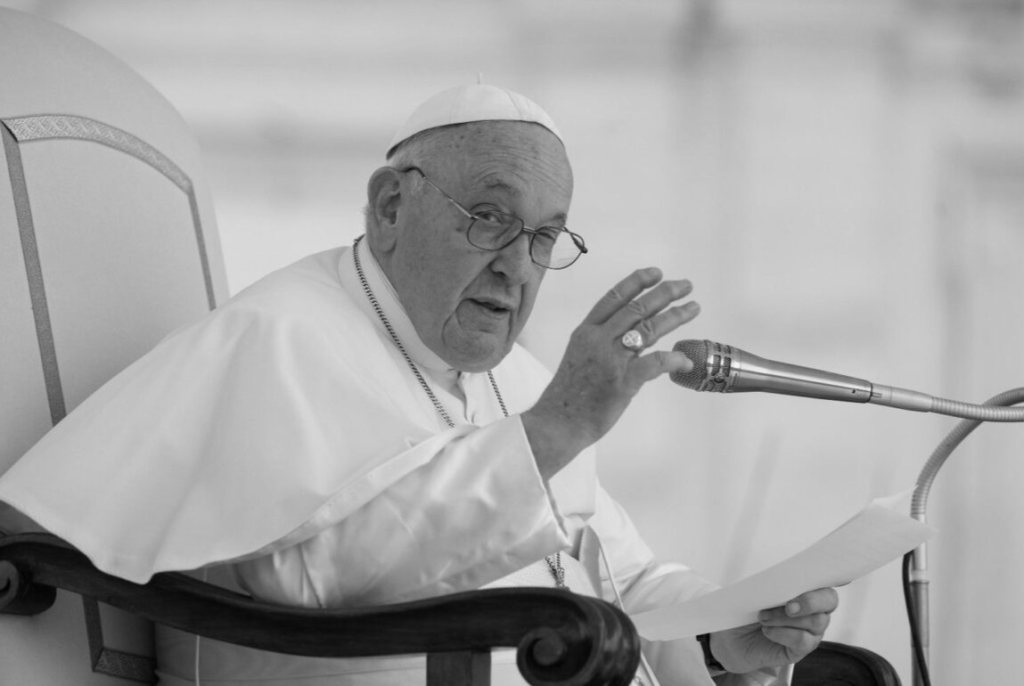
As is my habit—following an avenue which opened up quite unexpectedly to me after starting this blog a dozen years ago—I want to draw attention to some recent comments of the Pope that pertain directly to the main focus of this blog. A couple of weeks ago, Pope Francis was in Trieste. And although the media covered a fair bit of this, as one astute reader drew to my attention, there were some other remarks in a homily that are well worth pausing on.
The Holy Father, in the midst of the 50th Social Week of Italian Catholics, had this to say: “Why do we not contemplate misery, pain, the rejection of so many people in the city? We are afraid, we are afraid of finding Christ there…”
And this makes me think of Pope Francis’ constant call to see Christ in others, especially in the least of the children of the Father. In particular, the homily in Trieste is alluding here to a passage from Evangelii Gaudium:
We need to look at our cities with a contemplative gaze, a gaze of faith which sees God dwelling in their homes, in their streets and squares. God’s presence accompanies the sincere efforts of individuals and groups to find encouragement and meaning in their lives. He dwells among them, fostering solidarity, fraternity, and the desire for goodness, truth and justice. This presence must not be contrived but found, uncovered. God does not hide himself from those who seek him with a sincere heart, even though they do so tentatively, in a vague and haphazard manner. (EG 71)
In this fuller text, we get a good taste for Pope Francis’ teaching on Christian contemplation. It is, first of all, “found, uncovered,” not “contrived.” Contemplation is not manufactured or produced by our efforts. It is a gift. We accept the reality—here, the reality of the other, in their striving, in their tentative steps in this world. Behind it there is something, or Someone, that makes the whole effort—and each person—valuable to an incalculable degree.
But we also see why the teaching needs to be applied. This isn’t ethereal, wishy-washy stuff. The cities of Evangelii Gaudium are each individual places, filled with particular people in their various relationships. Thus, in Trieste—“Why do we not contemplate misery, pain, the rejection of so many people in the city? In his homily, Pope Francis adds:
God is hidden in the dark corners of the life of our city — have you thought about this? — in the dark corners of the life of our city. His presence reveals itself precisely in the faces hollowed out by suffering and where degradation seems to triumph. God’s infinity is concealed in human misery, the Lord stirs and makes himself present, and he becomes a friendly presence precisely in the wounded flesh of the least, the forgotten and the discarded. The Lord manifests himself there…
It’s challenging for all of us, for in many different areas—the economy, the Church, dialogue—there are those who are lesser, often those who are the least. But in our cities especially, there is this exigency of the Gospel, to find in the face of the other person, in their lives, in their streets, that which is evidence and matter for “a mystical fraternity, a contemplative fraternity” (EG 92).
This is so hard, so demanding, that the Holy Father likens the task to something scandalous:
We need the scandal of faith. We do not need a religiosity closed in on itself, that looks up to heaven without caring about what happens on earth and celebrates liturgies in the temple but forgets the dust blowing in our streets.
These grains of “dust blowing in our streets” are other people. Each has value. The fact that they are small grains of dust doesn’t change that. Indeed, the Holy Father’s beloved Little Flower, Thérèse, frequently returned to the motif of herself being a grain of sand (Ms C, 2v; LT 49, 74, 95, 103).[1] I don’t know if the choice is deliberate. But it is meaningful to me. All these actual or potential Thérèses blowing in our streets—can we, do we, see them?
I feel the demand, and I fall short. Maybe if we become as small as these grains it will be easier…
[1] Abbreviations as in Œuvres complètes (Paris: Cerf / Desclée de Brouwer, 2023).

 Contemplative in the Mud