
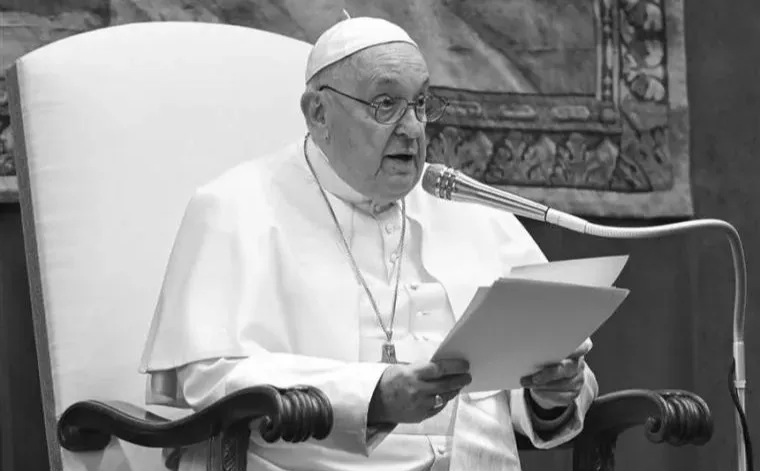
Last week, Pope Francis published the bull of indiction Spes Non Confundit, which lays out an ecclesial message and intention for the 2025 Jubilee Year. I would of course encourage reading the entire document, as it pertains to so much good and intentionality in the life of the Church. But there are a few passages that I want to draw out specifically, for my own reference and for that of anyone with a contemplative inclination reading this blog.
There are three passages that specifically talk about the role of Christian contemplation in the life of the Church for the Ordinary Jubilee.
Patience in today’s world
The first passage that I want to quote is a long one. It places the call to contemplation in contrast to a world of immediacy and impatience, and the antidote to the deficiencies of this contemporary culture is placed, not on contemplation of the Trinity, Christ, or the presence of these in one’s neighbours, but rather on contemplation of creation itself, the natural world:
Nor is there much place for patience in this age of the Internet, as space and time yield to an ever-present “now”. Were we still able to contemplate creation with a sense of awe, we might better understand the importance of patience. We could appreciate the changes of the seasons and their harvests, observe the life of animals and their cycles of growth, and enjoy the clarity of vision of Saint Francis. In his Canticle of the Creatures, written exactly eight hundred years ago, Francis saw all creation as a great family and could call the sun his “brother” and the moon his “sister”. (SNC 4)
In other words, we need to learn to take time to be with the world that God has made, for the one that we have placed atop it is too frenetic and too desirous of immediacy coupled to change. The pace of God’s world is a slower change. In these changes, we can find a balance that appeals to our inner sense of who we are as parts of God’s creation. Benefits abound, says the Holy Father:
A renewed appreciation of the value of patience could only prove beneficial for ourselves and for others. Saint Paul often speaks of patience in the context of our need for perseverance and confident trust in God’s promises. Yet, before all else, he testifies to God’s own patience, as “the God of all patience and encouragement” (Rom 15:5). Patience, one of the fruits of the Holy Spirit, sustains our hope and strengthens it as a virtue and a way of life. May we learn to pray frequently for the grace of patience, which is both the daughter of hope and at the same time its firm foundation. (SNC 4)
The place of contemplation in pilgrimage
The next occurrence of a vocabulary of Christian contemplation in Spes Non Confundit is in connection with acts of pilgrimage:
Journeying from one country to another as if borders no longer mattered, and passing from one city to another in contemplating the beauty of creation and masterpieces of art, we learn to treasure the richness of different experiences and cultures, and are inspired to lift up that beauty, in prayer, to God, in thanksgiving for his wondrous works. (SNC 5)
This passage likely connects to the previous one, insofar as “passing from” one place ot another requires time—and thus patience. But there is something else added to it. A further specification is included, insofar as the dimension of what is contemplated is given.
What we contemplate is beauty. This is a constant of the teaching of Pope Francis. And in particular, on a pilgrimage, the beauty made available to us is that of culture—“masterpieces of art”—but not just that. The Pope comes back around again to the contemplation of, not what we have made, but of the natural world that God has created. So we’ve circled back to the previous point about patience, but the patience and contemplation being considered has been contextualized for pilgrimage. This expands to include works of art that we can contemplate in vast ancient cathedrals and newer ecclesial buildings. But it also hearkens again to the natural world, whose pace and scale are—or ought to be—informative and influential for us as children of God.
Again time—but at its end
The final instance of contemplation vocabulary in Spes Non Confundit comes in discussing life after death. Contemplation leads us through time, but it also marks the end of our own time and our entrance into eternity:
What, then, will become of us after death? With Jesus, beyond this threshold we will find eternal life, consisting in full communion with God as we forever contemplate and share in his infinite love. All that we now experience in hope, we shall then see in reality. (SNC 21)
Here, contemplation is put in the context of love and communion. If we were to remain consistent in saying that what we contemplate is beauty, here the Beloved and the Lover contemplate their mutual beauty. That’s the goal. That’s the scale of eternity.
The glimpses of contemplation that we are accorded today—combatting impatience, attuning us to the temporal scale of God’s creation, leaving us in awe and wonder with human and divine creations—are just a foretaste. In hope, we aim for the end to which we are called, and hope does not disappoint, spes non confundit.

 Contemplative in the Mud