
Today is World Communications Day, so I wanted to take a few moments to reflect on what communication means from a contemplative point of view. You’d think that, having a blog about Christian contemplation, this is a topic that I would have given much thought to and regarding which I would have developed a conscious plan or strategy. In fact, over the past months, I realized that this was far from the case.
That’s not to say that I don’t have thoughts on the matter—or even patterns of behaviour. But I think they’ve remained more unconscious and lived than at the level of deliberation and articulation. There are contributing reasons to this.
Part of the reason is very personal. Actually, the earliest trauma that I know pertains to mass media and is particular to my generation (and a small subset of us at that). When I was just starting elementary school, the first Gulf War was taking place. This is the era when satellite television and the 24-hour news cycle took off, and in an effort to display and boast the sheer ability to provide live updates, scenes of war were exhibited without ethical limits.
My morning and afternoon children’s programming was repeatedly interrupted with live images of a war which, at my age, I could comprehend as violent and dangerous, but was unable to understand as regards its scale and distance from myself. In connection with other things that were happening in my little life, I was traumatized and developed some psychological problems. For about a year, I was quite messed up.
The aftermath is lifelong. It’s also a mixed bag. I have been gifted with an indefatigable skepticism and reticence about communications technologies, especially but not exclusively involving the audiovisual. If a form of media has the potential to intrude and pressurize, I am extremely hesitant, to say the least. This protects me from excessive consumption of media. You’ll rarely see me lack prudence in how much trust I put in technology. But the flip side is, if anything goes wrong as regards intrusion and pressurization in the technological sphere, I feel especially vulnerable as a result.
There is no denying that this trauma contributed to my less-active, more-contemplative bent.
But it also marks an irony, insofar as I was making websites as far back as the ’90s (and would have gotten a summer job doing it had the sponsorship money not run dry) and now am a blogger. I have obviously been acting on my own ideas about communication, both before my conversion (and in light of my trauma) and after my conversion (and in light of Christian contemplation). I clearly have a deeply felt need to try to redeem what I might have written off as irredeemable.
But most of these decisions are relatively unconscious.
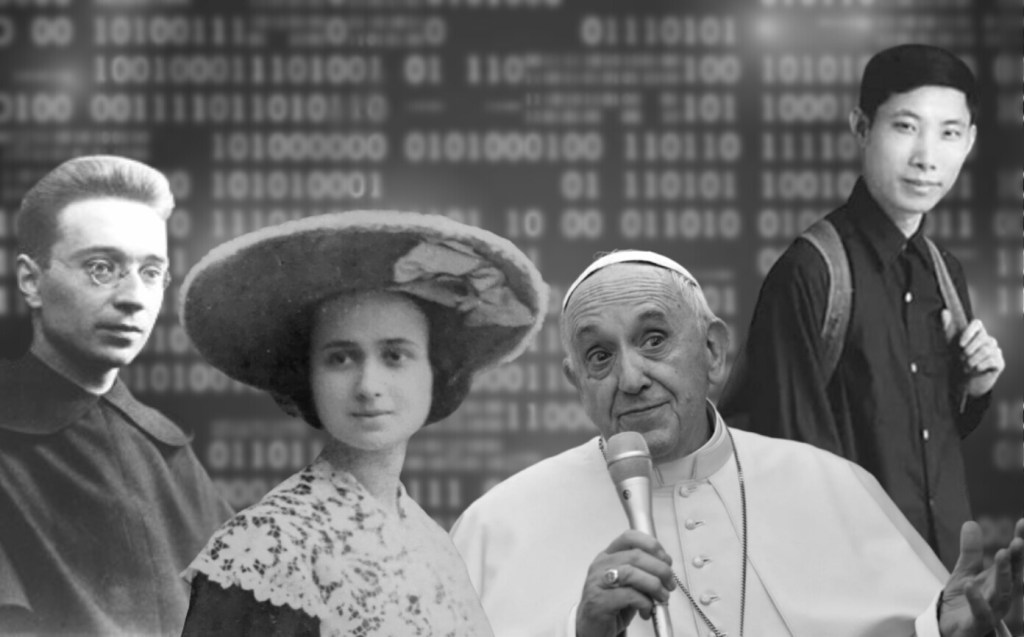
So, for the past few months, I have been trying to dredge the depths and figure out what I really think. I have been pondering what contemplative communication looks like. Scouring what must have influenced me, I’ve come up with four benchmarks which I think are of paramount importance. They come from four of my favourite contemplatives.
Raïssa Maritain: We only communicate through being
The earliest quote that has stuck with me about the very meaning of communication is one from the personal journals of Raïssa Maritain:
Men only really communicate with each other through being or one of its properties. If we touch the truth like Saint Thomas Aquinas, contact is made. If we touch on beauty like Beethoven, or Bloy, or Dostoyevsky, that does it. If we touch the Good and Love, like the saints, contact is made, and so souls communicate with each other. We expose ourselves to not being understood when we express ourselves without having first touched these depths; contact is then not made, because being is not reached.[1]
In other words, it is only the transcendentals—truth, good, love, beauty, etc.—that let us communicate. Everything else fails to rise to the challenge. You might think this word of Raïssa’s demands too much. Surely, you might object, we communicate without reaching these depths.
But do we? If our thoughts are just individual passions, can someone feel our emotion as we feel it? Surely, yes, there remain empathy and sympathy—but not bathed in love, even those amount to only a fleeting thing, do they not? Is there anything that truly communicates without first touching the depths of being?
I try to speak, write, and judge my gestures as if Raïssa is right. Maybe she is wrong. But if so, I don’t see what I stand to lose by bearing these demanding—but life-giving and inspiring—words in mind.
This is the first thought that I have held captive, and it is arguably the foundation of all the others.
Titus Brandsma: Choose to keep the positive in the forefront
Another early influence was that of Titus Brandsma, patron of journalists. Even though he was to face off against the Nazis over whether Catholic newspapers could print the truth, Titus tells us that, by preference, we must focus on the way of affirmation, not negation:
Too often we choose the negative way of defence and refutation, while it would be more noble and more useful to positively make the truth radiate in its own light. The light of truth has always been pleasant for the human spirit.[2]
This, you can imagine, is a big claim. But we should hesitate to jettison it today in the age of mass and social media. Sure, it was written by someone who knew primarily the printed word (alongside the radio, which he used to give talks). His technological ecosystem was different from ours. He didn’t know today’s threats.
True—but Titus’ main human enemy was the Nazi regime. We might think twice, thrice, four times, before finding an excuse to circumvent his rule or preference for the affirmative and the positive. The reasons we have and the exceptions we find should surely not number more than those Titus found for himself.
I’d also note that Titus’ practical rule goes well, I think, with Raïssa’s metaphysical observation.
Marcel Văn: Refuse all psychological manipulations
Marcel Văn wrote some comments on the media for his spiritual director. During the run-up to the surrender of Hanoi to the Communists, there was no lack of psychological warfare. The Redemptorists’ monastery participated as well. They would blare out songs over loudspeakers and project propaganda films on a wall, spilling the audiovisual noise into the streets. Marcel was not impressed.
Here are some of the biting paragraphs he produced:
To reform peoples’ lives, it is not necessary to show films, to make use of loudspeakers which ring out over part of the town; it is not necessary to play records nor to have recourse to the charming voices of young women… under the pretext of attracting people… And those people, who are they, if it is not solely those who take pleasure in admiring the smiles of artists and enjoy listening to their songs…
I ask a question: since one has opened this information office, since one has been projecting these films, since one has been broadcasting new records over loudspeakers under the care of a Father expert… in psychology, who dedicates all his strength, runs everywhere, the beard disarranged and with hollow cheeks… how many listeners has one been able to attract? But, alas! To speak more precisely, is there one among them who has been drawn to love God sincerely? (OWN7.8–9)[3]
His reasoning is as such:
As I see it, the holy apostles in their time were not familiar with psychology, as we know it today; also, I am certain that they gained a great number of souls for God… In speaking in this way, it is not my intention to pour scorn on the progress of modern life, nor to affirm that one must ignore it; however, it is necessary to show wisdom and not abuse with deceitful methods.
Usually, the devil does everything to put into the heads of psychologists his thoughts and tricks, so as to make use of them to do his work. The devil is also very good at psychology, he does not give way to anyone in this field. Consequently, let us not allow him to take advantage of our activities any longer. (OWN7.10)
He is sharp:
Formerly, I was proud to bear the name “Redemptorist brother,” that I would consider as an honour; but now, I feel ashamed each time I am designated as a “Redemptorist brother,” since the loudspeakers of the Redemptorist com-munities broadcast words which sound like those coming from advertising agencies… (OWN7.12)
Marcel suggests, then, that the loudspeakers and the projector be consigned to the shed, and that “it is necessary to whitewash the information office, to use the available space to put in the greatest number of beds possible, then to invite, each day, people make a retreat, to reform their personal lives, passions and sins” (OWN7.10–11). This, I think, is a strong indictment of all psychological manipulation and any communication whatsoever that does not speak to the deeper centre of the human person.
No less engaged than Titus Brandsma in a fight against a powerful and dangerous ideology, Marcel chooses simplicity of means and a concentration of spiritual power, rather than noise and confusion. He is focused. The superiors he criticizes are scatter-brained and in their quest for psychological effectiveness have lost the evangelical plot. Let it be a warning to us all, as means of technological manipulation increase.
Pope Francis: Communication is also silence and listening
This fourth insight comes from Pope Francis, and I am indebted to a reader, who drew my attention to some remarks given to a symposium on communication this past January. It is not a thought that I have had available to me for a long time. But it is one that, I think, summarizes well the preceding contributions of Raïssa, Titus, and Văn.
In his recent address, the Holy Father mentions “the importance of communicating with the heart, of listening with the heart, of seeing with the heart things that others do not see… to set out again from the heart.” We could view this as a little précis of Raïssa’s observation. If we do not go deep enough into the heart, we don’t get a substance to communicate. Only then, once we grasp something in the depths, can we set out again from our heart to another. This happens because we see something as yet unseen. It is only the depths of what exists, in all its mystery, that allows communication to be truly itself.
Reminding us of Saint Thérèse, a “witness of Gospel radicalism,” Pope Francis tells us: “Communicating for us is not overpowering with our voice that of others… it is also silence… sharing the good, the true and the beautiful.” Here again come Raïssa’s transcendental properties of being. Here again comes the concern of Titus and Văn to not overpower and manipulate, but rather to let radiate what is good, true, and beautiful.
The Pope also draws in a famous quote from another of my favourite saints, Francis de Sales:
How can we fail to remember the famous phrase of Saint Francis de Sales, patron of journalists and Catholic communicators: “Le bruit fait peu de bien, le bien fait peu de bruit” [Noise does little good, while the good makes little noise].
As my reader pointed out to me, this is also reminiscent of a phrase of Jacques and Raïssa Maritain:
Contemplation… is frequently the treasure of persons hidden in the world… souls who live by it in all simplicity, without visions, without miracles, but with such a flame of love for God and neighbour that good happens all around them without noise and without agitation.[4]
Is all this true—what Raïssa and Jacques assert, what Titus and Văn suggest, what Pope Francis teaches?
If it is not, it seems close to the truth to me—close to the good, the beautiful, and to contemplative love. And that, I think, is enough for me to meditate on what these five spiritual masters say and to, for my own part, try to live it.
[1] Journal de Raïssa, in Œuvres complètes de Jacques et Raïssa Maritain, t. XV (Paris: Éditions Saint-Paul, 1995), 199.
[2] Titus Brandsma, “The Idea of God” (1932), in Mysticism in Action, ed. Elisabeth Hense and Joseph Chalmers, Collected Works of Titus Brandsma 1 (Rome: Edizioni Carmelitane, 2021), 97.
[3] OW = Marcel Van, Other Writings, trans. Jack Keogan, Complete Works 4 (Versailles: Amis de Van Éditions, 2018).
[4] Jacques and Raïssa Maritain, Liturgy and Contemplation, trans. Joseph W. Evans (New York: P. J. Kenedy & Sons, 1960), 74 = Œuvres complètes de Jacques et Raïssa Maritain, t. XIV (Paris: Éditions Saint-Paul, 1993), 138.


 Contemplative in the Mud