
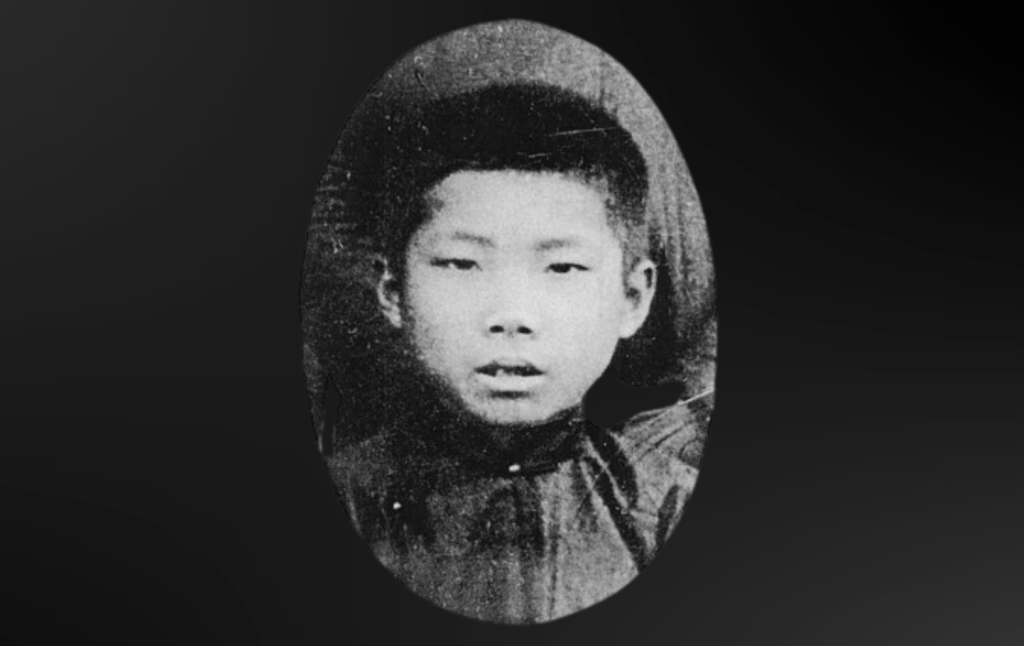
On this first day of Mary’s month, my heart throbs on thinking of those who have loved me as a mother loves her own child. — Văn to his aunt Khánh, 1 May 1947[1]
On this first day of Mary’s month, I would like to do the same, for one person who has loved me as a mother loves her child—Văn himself.
Not a few people are opposed to attributing “spiritual motherhood” to men (and are likewise opposed to attributing “spiritual fatherhood” to women). I don’t want to get into the reasons why this opposition exists. I have my own judgments and theories on the matter. But the fact of the matter is, this particular ideology of gender doesn’t find a place in the teaching of a variety of figures whose use expressions of spiritual motherhood, such as the prophets, Saint Paul, Saint Thérèse, and Marcel Văn.
Before Văn
Jewish writings, including the Old Testament, already speak this way about God. In a very demanding and illuminating book, scholar L. Juliana M. Claassens writes:
The pregnancy metaphor, the length of time when not much seems to be happening, may well explain why God seemed to be inactive for so long. At the same time, it powerfully asserts that God will bring new life into the world as well as provide the comfort and care necessary to sustain this new life.[2]
In Christian texts meanwhile, images of human beings mothering other people’s souls date back at least to Saint Paul—and indeed are found in what is likely his earliest letter. He tells us that he was “like a nurse tenderly caring for her own children” (1 Thess 2:7 NRSV). On another occasion, he uses a similar image: he “fed [the Corinthian Christians] with milk, not solid food” (1 Cor 3:2 NRSV). This is not the only maternal image that he applies to his relationship with the churches, however; he also stated that he was “again in the pain of childbirth until Christ is formed in [his Galatians Christians]” (Gal 4:19 NRSV). Evidently, some kind of spiritual motherhood is itself apostolic—among male apostles.
Similarly, Thérèse of Lisieux offers a frequent reflection on being a mother to souls (e.g., LT 129, 135, 182, 183, 185; Ms A, 81r; Ms B, 2v; PN 24.22–24; PN 45.6).[3] I’m not going to go into details for the moment; the references are too numerous and would derail the flow of my reflection. Suffice it to say that, for the Doctor of the Church, there is nothing intrinsically gendered to engendering souls as a mother. In fact, what it means is to suffer, make merit, and intercede for others, so that graces might be birthed in their souls and they might convert or otherwise profit from this sacrificial prayer. Men and women both have that capacity. It is a human capacity, not a gendered one.
So, when we come to Marcel Văn, that ardent mid-century Vietnamese disciple of Thérèse, it is no surprise to find him declaring himself a mother of souls.
Marcel denies that the act of mothering souls is gendered
Marcel follows his predecessors in viewing “spiritual motherhood” as a non-gendered reality. His “special mission” is to have the heart of a mother (OWN2.29).[4] “My soul is a mother,” he writes to his spiritual director (To Father Antonio Boucher, 22 Dec 1951). He’s not particularly bothered to have such a status. After all, he knows that Thérèse found in her father, after her mother’s death, “a truly maternal love” (Ms A, 13r) and that “the Good God is more tender than a Mother” (Ms A, 80v), and he has perhaps heard that, for his spiritual big sister, the heart of Jesus “is more than maternal” (PN 36.2). He has no gender ideology that restricts his abilities to show the love of Christ.
As Jesus tells Marcel when explaining that male religious are his spouses in the same essential way as female religious, “it is necessary to use the language of the world; but this language is weak in expressing spiritual things” (Conv. 539).[5] In reality, they are spouses; but in our language and custom, that sounds off. Similarly, being mother of souls is not dependent on biological sex, even though, in our language and customs, it sounds like it is.
Theoretically, Marcel could ground his belief, reflection, and mission in another of his beliefs. He holds that, in God, all relationships exist in one Love (Conv. 635–640; To Tế, 21 Apr 1951). God is the origin of fatherhood, motherhood, being a teacher, and so on and so forth. It all comes from him. Not just things come from him. But the relations originate in his infinity. Accordingly, Marcel might have grounded his belief in the non-gendered nature of spiritual motherhood in the non-gendered nature of God. We participate in God’s nature. Ergo, we can be “mothers” to souls as well.
But Marcel doesn’t take this route. He finds another.
Marcel insists that engendering souls is attained through suffering
What I think is the decisive text for interpreting Marcel is one where he is addressing his sister, who has gotten married. He writes: “If one marries, naturally it is to have children; who would dare to say that it is to have fun?” (To Lê, 25 Jan 1954)
What does this have to do with being a “mother of souls”? In the immediate context, nothing. But the implications are solid. Spiritual writers too numerous to count speak of a “spiritual marriage” of the soul with God. If Marcel is consistent, he will hold that such a marriage is nonsensical if it doesn’t bring forth spiritual children.
Saint Marie of the Incarnation famously said that God didn’t create us for a laugh. Well, he certainly doesn’t enter into a mystical marriage for the light pleasure of the beloved creature turned in upon itself either. He enters into such an arrangement with the intention to engender spiritual children. To be sure, the love for the beloved is intense. But so is the desire to multiply it. Realizing that should take away all the individualism and aestheticism in our desires to become more united to God. And Marcel has come to that realization.
We can find many texts where Marcel talks about the suffering that is required for him to give birth to souls or even to produce milk for them to drink and grow up with. Here is one:
I recall one thing which is that my soul is “mother”. Instead of tasting today great consolations and being filled with love, my soul, knowing that many of her distant children are immersed in sorrow, feels the need to show them more attention and tenderness. For that I must resign myself to suffer so that these souls may enjoy my portion of happiness. (To Father Antonio Boucher, 22 Dec 1951)
And another:
Further, since you are the mother of souls, you need spiritual milk to nourish your children. I am therefore suggesting to you a method which will allow you to produce much spiritual milk and to add to it some stimulating substances. This method consists in eating everything bitter that I offer to you. If you have the courage to impose this sacrifice on yourself, later, your children will be much stronger and robust. (Conv. 190)
It is in fact the suffering, the tears themselves, that become the spiritual liquid of nourishment for others: “I consider as precious these tears I gather to offer to Jesus, and to make of them a food for souls—since my soul is mother” (To Tế, 29 Nov 1951). This ability to produce spiritual nourishment for others is very grave. Marcel feels the weight. He writes in a letter to Jesus himself, as per the custom of the Redemptorists at the time: “I bear the responsibility of a mother… My suffering is nothing other than a food… for souls.” (OWJ 25 Apr 1952)
I would suggest that Marcel has read Thérèse carefully and assiduously. He knows that there is one side of Thérèse that associates being the spouse of Jesus, being a Carmelite, being united with Jesus, and being mother of souls (Ms B, 2v). On the other hand, for Thérèse, spiritual motherhood is not something for professed religious alone, let alone for female religious sisters alone. Thérèse teaches clearly: “I see that suffering alone [la souffrance seulement] can give birth to [peut enfanter] souls” (Ms A, 81r). She says the same to her sister Céline: giving birth to souls is done through tears (LT 185). And although she has a burst of feminism wherein she (quite accurately) sees the status of women as being despised in this world, but for that reason chosen by God for himself (Ms A, 66v), there is no reason to think that she finds the suffering that produces nourishment for souls to be exclusive to women, let alone religious sisters. The condition and status that allows Thérèse to suffer is one thing. The ability to birth souls is another. At least this is how Văn reads his big sister, and his reading is perfectly defensible.
Marcel regards others as mothers of souls
Of course, Marcel is well aware that it’s not just him and his spiritual big sister Thérèse who are mothers to souls. They have such a vocation in spades. But others have the calling, too. In fact, there is the Mother of the Church herself, Mary. Marcel calls her “Mary, Mother of souls” (Conv. 245). She is declared “Mother of saints, Mother of souls” (Conv. 321) and “Mother of all souls” (Conv. 480). Along with the reference to Thérèse calling Mary more Mother than Queen, this is probably one reason why Marcel wants to call her Mother more than Queen (Conv. 250, 326, 349, 432, 671–676, 692).
We might ask, then, quite simply: Who else can be a mother of souls? What is needed? Can it be me?
Marcel has not put any limitations here. All he suggests is that we have a willingness to produce the birth pangs and the spiritual milk. We can’t go out and seek it for ourselves, perhaps. We must only accept the suffering that comes to us, for suffering that comes to us is real suffering, whereas that which we select is minimal and hardly worth its salt compared to the real deal. But when suffering comes, when the tears arise—they can be the liquid base for the creation of new spiritual life and the nourishment of that which has already crossed the first threshold.
On this first day of Mary’s month, my heart throbs on thinking of those who have loved me as a mother loves her own child.
[1] To = Marcel Van, Correspondence, trans. Jack Keogan, Complete Works 3 (Versailles: Amis de Van Éditions, 2018).
[2] L. Juliana M. Claassens, Mourner, Mother, Midwife: Reimagining God’s Delivering Presence in the Old Testament (Louisville, KY: Westminster John Knox Press, 2012), 62.
[3] Thérèse of Lisieux, Œuvres complètes (Paris: Cerf / Desclée de Brouwer, 2023); translations my own.
[4] OW = Marcel Van, Other Writings, trans. Jack Keogan, Complete Works 4 (Versailles: Amis de Van Éditions, 2018).
[5] Conv. = Marcel Van, Conversations, trans. Jack Keogan, Complete Works 2 (Versailles: Amis de Van Éditions, 2017).

 Contemplative in the Mud