
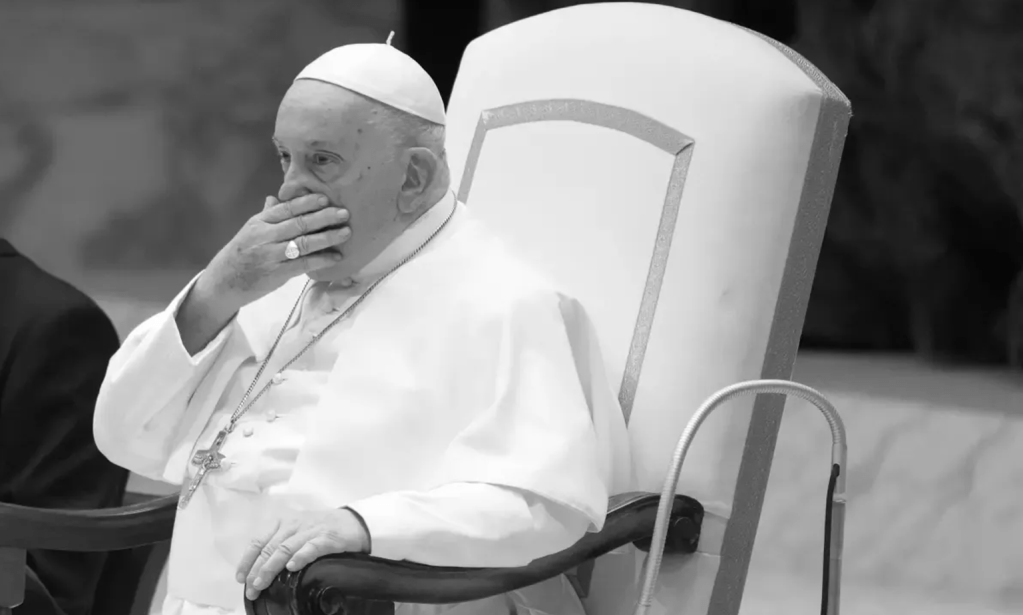
Although the message seems to have been prepared well in advance, this past week Pope Francis gave an address to the participants of the third Latin American Congress “Vulnerability and Abuse.” There are a few points that I want to draw attention to, for my personal reference as much as to post about it on the blog.
The Pope begins with the Sheep and the Goats, the eschatological parable of finding Jesus in those we encounter, particularly the needy and forgotten, and acting on that:
During my meeting last 25 September with a delegation from this Council, I highlighted the Church’s commitment to see the face of the suffering Jesus in each of the victims. However, at the same time, the need to place at His feet “the suffering we have received and caused”, praying to Him “for the unhappiest and most desperate sinners, for their conversion, so that they may see in others the eyes of Jesus who calls out to them”.
That previous meeting, Pope Francis had begun by saying, was providentially organized on the day of a martyred child. This is a fact, and it is striking for the Pope. It reminds him that
the tragedy of that child was associated with that of Jesus Himself, and in his representations, he appears dressed like the Lord, both while he walks to Calvary and while he suffers the Passion itself.
This fact, which may seem anecdotal, brought to my mind the Gospel account of the Final Judgement in which we hear the unsettling words of the great King: “Truly, I say to you, as you did it to one of the least of these my brethren, you did it to me” (Mt 25:40). How the world would change if we were to convince ourselves inwardly that every little one that we meet is a reflection of the face of God! If we were to see in the suffering of each child, each vulnerable person, a line impressed on the veil with which Veronica dried Christ’s face!
He continues later:
And, before the Redeemer, let us also contemplate in that affronted face the suffering we have received and caused, so that we do not feel distant from the people we welcome, but brothers, even in pain. Let us dialogue with Jesus, let us listen to that Word that forgives us, that heals us, that redeems us all. He did not take on the sin of the world to condemn it, but to save it, and He taught us that there is no greater love than that which gives life, that which leaves in it a trace of His Holy Face.
Here we have that great preoccupation of the Holy Father, as well as his inspiration Charles de Foucauld: see Jesus in everyone, particularly the least of these. We know from Gaudete et Exsultate 97 that Pope Francis has asked Christians to receive these words of the Lord “in a spirit of genuine openness, sine glossa [without a gloss]. In other words, without any ‘ifs or buts’ that could lessen their force.” Here he applies that desire. Victims and potential victims of abuse should be granted this status as a mirror of the Face of God. He prays, on that earlier occasion, specifically for the aid of Thérèse of the Child Jesus—and ahem, cough, the Holy Face—for the help needed as her feast day was approaching (this was back in late September).
From Charles de Foucauld’s declaration that no passage of the Gospel had made a greater impression on him, to Thérèse of Lisieux’s devotion to the Holy Face, we have the hallmarks of Pope Francis’ spirituality—directed at vulnerability and abuse.
This past week, he continued with a spirituality of the abuse crisis. What is called for is “a complete change of mindset with regard to our concept of relationships, privileging the least, the poor, the servant, and the ignorant, over the rich, the rich, the master, and the learned, on the basis of the ability to accept the grace given to us by God and to make ourselves a gift to others.” This means valuing littleness. It means a spirituality in which something of Thérèse’s inspirations come to the fore.
At the same time, Pope Francis is quick to highlight the fact that littleness is not an excuse for bad behaviour, weakness is not an excuse for being stuck in developmental problems that harm others, childlikeness is not an excuse for the childishness that denies our full dignity. We have to make distinctions:
Seeing one’s own weakness as an excuse for failing to be full persons and full Christians, unable to take control of their destiny, will create childish, resentful people, and in no way represents the smallness to which Jesus invites us. On the contrary, the strength of the one who, like Saint Paul, glories in his weaknesses and trusts in the grace of the Lord (cf. 2 Cor 12:8-10) is a gift that we must ask for in prayer, for ourselves and for others.
A few weeks ago, Pope Francis gave a catechesis on changing sadness into joy, and he noted a difference between sorrow that is godly and leads further, and sorrow that traps us in on ourselves (cf. 2 Cor 7:10). Here, the Holy Father makes a similar distinction. Littleness is a strength, not an excuse. It thrusts us upwards into Jesus’ hands, not weighs us down and makes us intractable. Pope Francis absolutely forbids the teaching of Thérèse and the Apostle Paul from being used to justify a stagnation in abuse culture and a personal lack of conversion.
As I think through all this, I can’t help but turn my thoughts to Marcel Văn, himself a victim of a lot of abuse in the Church. There is not a word here with which he would disagree. Spirituality of Thérèse, check. Seeing Jesus in the members of his Mystical Body, check. Heroic virtue, check. Abuse crisis treated as a crisis, check. I’m sent back, despite myself, to where I ended my series on Marcel Văn and the contemplation of beauty. Here are some words from a private notebook of Marcel:
People say I will have to go to Rome. I do not know if that is really the will of Jesus, or if they wish, quite simply, to tease me to make me forget a little the thought of heaven.
To tell the truth, Rome does not please me as much as heaven. Whatever may be, I do not think I will go to Rome, and if I ever go there, it will only be after my death. (OWN3.5–6)[1]
Go to Rome, little Văn. Go to Rome. 🙏
[1] OW = Marcel Van, Other Writings, trans. Jack Keogan (Complete Works 4; Versailles: Amis de Van Éditions, 2018).

 Contemplative in the Mud