
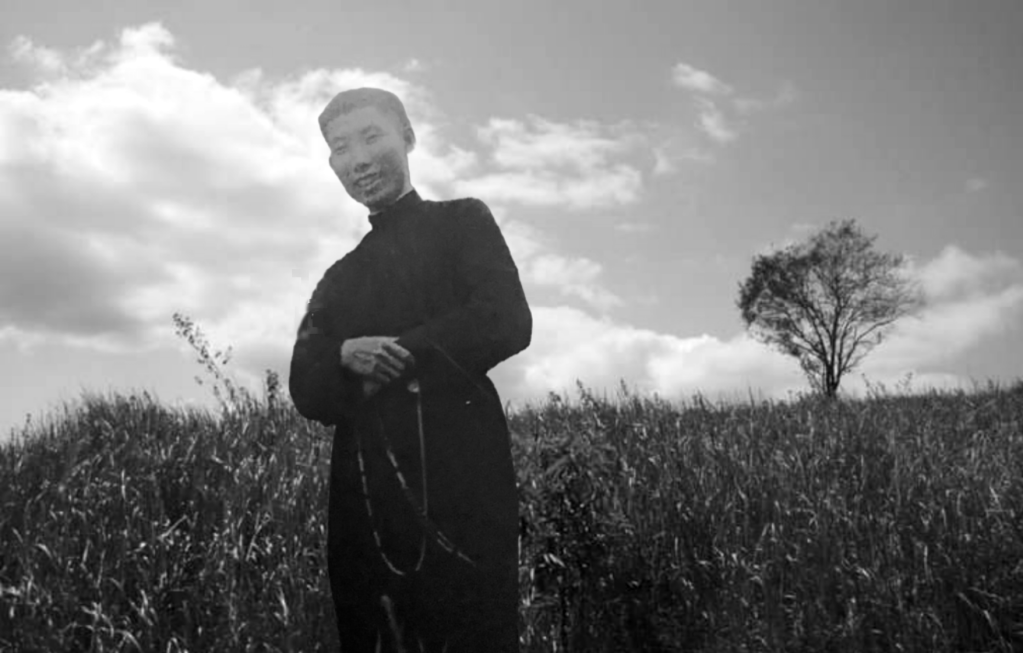
In the writings of Marcel Văn, that little Vietnamese Redemptorist brother from the middle of the last century, we find a lot of similarities to the teaching of Pope Francis about Chistian contemplation. He connects contemplation to an experience of the transcendentals. In particular, what we contemplate is beauty. That beauty can especially be that of a transfigured human face—smile and gaze. We contemplate Christ in his Divinity, in his Person, and in the members of his Body today.
One key component that Pope Francis and Marcel Văn have in common here is the connection between Christian contemplation and the natural world. The Holy Father has called grateful contemplation of our common home a work of mercy. For Văn, we contemplate the beauty of the natural world, in a spirit of grace, and we return by it in piety to the Father.
Precedents in Thérèse of Lisieux
Since Marcel saw himself as a prolongation of the Little Flower, exuding her same scent, we should usually start any discussion of his thought with a discussion of that of Thérèse of Lisieux. That’s the only realistic way to determine what are Marcel’s distinct thoughts and what is his original contribution.
In the works of Thérèse, the word “contemplate” is often used in the context of thoughtful and loving attention to creation (Ms A, 18r, 22r, 48r, 50r, 57v, 58r, 67r; Ms C, 5v; LT 105),[1] as also the word “meditate” (Ms A, 14v). To the best of my knowledge, only thrice does the word “beauty” occur in passages that talk of contemplation (Ms A, 57v, 58r, 67r).
So, while Văn could have picked up on this, he is far more careful, determined, and systematic about it. For him, we will see, contemplation is of beauty, and the beauty of the natural world is one locus of the activity of our aesthetic and contemplative sense.
Precedents in Văn’s own family
In recounting Marcel’s life, it is usually remarked what a dependence he had on his mother. She was a great woman. He considered her a saint. In contrast, Marcel’s father is someone he needs to work to redeem, to save from vices that ensnared him following his despair over the sudden blindness of Văn’s eldest brother, Liệt. In short, Marcel learns spiritual maternity from his mother, but he acts as a spiritual father to his father. This is partly true. But we shouldn’t neglect the major, positive role that his father had in his life, because it is here that the knack for finding God at work in his beautiful creation can be sourced.
While Văn’s mother and maternal grandmother seem to have been quite able to engage with religious education in the confines of the home, Văn’s father, during the period before his addiction problems, seems to have primarily, or only, transmitted the faith to Văn through contemplation of nature—though the young boy wasn’t quite ready for it at the time.
Here is the narration that Marcel gives in the final version of his autobiography:
The happiest evenings in those days were those of summer when my father took me walking in the fields. The green meadows did not yet give rise to any emotion in my soul. I loved the vastness of the flowering meadows and the yellow paddy fields. I loved to play in the grass, gather the flowers, chase the butterflies. I loved to sing and play in the evening breeze. Ah I loved, I loved a thousand things, but I loved these particularly because they were beautiful. Concerning spiritual joys such as the union of God in the green meadows, or the heart’s voice whispering with the flowers, I was as yet unaware. I did not yet experience any sensitive feelings in the presence of these noble pleasures. Because my soul was still small like a tender bud. the sun’s rays had not yet penetrated it. Its beauty still remained hidden in these natural surroundings.
But it was different for my father. After having deposited me on the ground, he would walk slowly in the fields, arms folded across his chest and, whilst walking, he gazed into the distance following the direction of the wind. Sometimes he stopped to contemplate the rays of the setting sun and the clouds wandering in the vault of the sky. Sometimes I seemed to hear him pray, and very often I had noticed that he seemed to be immersed in the immensity of creation. Sometimes he would recite lines of poetry or describe to me godly things in an enthralling manner. If at that moment I had been able to comprehend what my father understood so well, what sweetness I would have tasted in the heart of God. (A 21–22)[2]
The fact that his father would be “holding himself there alone in silence to contemplate nature, as well as watch us play” also makes it into an earlier redaction of the autobiography Marcel undertook (2A 35).[3] Note the use of the word contemplate in regards nature. The lengthy description in the final redaction is matched with a concise theological denomination in an earlier one.
Little Văn also acquired dispositions and habits in this regard while he lived away from home at his aunt’s:
At my aunt’s I enjoyed climbing the hills and boating in the rainy season. When the weather was fine my aunt, allowed me from time to time to amuse myself by following my cousins to the fields, and while they worked I climbed the hills alone.
I was a little afraid the first, time but later I got used to it, so much so that I preferred the highest peaks which extended my view, since these higher peaks seemed to me to be closer to heaven: I wanted to be able to say my rosary closer to the Blessed Virgin. In those days I did not know how to meditate by looking at the sky, but I was simply happy to look at it whilst saying the rosary. I always had the conviction in my mind that the Blessed Virgin was looking at me more closely than when I was at home. (A 70–71)
In this case, Marcel uses the word meditation. He is speaking of work we do ourselves. With the Redemptorists, he came to learn a bit about such methods of prayer, though he was never very good at it.
Not all of Văn’s prayer in nature could be called contemplative. Most memorably, and to the perplexity of a passerby, he prays the rosary and sings hymns to Mary while kneeling and standing on top of an ox while it grazes (A 448–449). As Marcel writes much later to his aunt, though: “When I took your ox to pasture, I knew how to contemplate the country landscape and raise my thoughts towards God” (To Aunt Khánh, 4 May 1947).[4]
Yet, when he tries to explain and condense his experience, he describes a shortcut to the God who makes himself know to us from within: “My soul, whilst enjoying the beauties of nature, was also tasting the sweetness of spiritual joys” (A 73). Văn was experiencing nature’s beauty, and interiorly, he was filled with spiritual joy. Since Marcel is (consciously or unconsciously) systematic about the fact that what we contemplate is beauty, he was already there. He didn’t even need meditation. He was already launched into a simple contemplative gaze.
Later formulations
Having picked up a theme and some practices from his familial environment and possibly from his familiarity with Thérèse, Marcel never dropped what he had attained. He only pushed it further. We cannot fail to be moved by this beautiful passage written of his time at the seminary at Lạng Sơn:
God had opened my soul fully to the wonders of nature, he had tightened the bonds of my love for him during these nights of intimacy and silence under the light of the moon, at the side of a spring or, again, in the peace that one tastes in the shade of a pine at the side of a mountain. At this point the memory of the days when we went camping camping! This fills me with happiness and brings back to my memory all the comes back to me. Ah, to go retreats. There, alone with God with Jesus my leader, the only view the trees, the mountains and all the marvels of nature were for me a stimulus to unite me more intimately to him. The more beautiful the flower, the more gentle the breeze, the more green the tree, the more roaring the waterfall, the more verdant the meadow: the more, also, was my heart uplifted as if by so many steps right up to the highest heavens, and there I loved God and he wrapped me in his tenderness. What intimacy there was between us during those moments of calm and close union! There, I went over in my mind my past life, and I did not see there an instant, not the smallest movement, nor the least action, which did not have its origin in divine grace. (A 533–534)
During his novitiate, when he became Jesus’ little secretary who wrote down prayer experiences, Marcel still was not entirely turned away from the natural world in favour of that of persons and grace. Rather, they went together. There was a time for each. He did not neglect going for walks in the garden, often as a way to take his mind off other matters (Conv. 15–16, 220, 349, 370, 550, 676).[5] Intimacy with God did not remove the path to him through his creation.
Examples are numerous. Of his first plane journey, he writes: “I would have loved, from time to time, to gaze on the landscape which was unfolding below, but I was too tired” (To Father Antonio Boucher, 12 Feb 1950). When his little sister moves halfway around the world to become a Redemptoristine nun, he speaks of his imagination for places real but never seen:
I am waiting for news of your journey and I am in a hurry to know if you are pleased to be in Canada. The landscape of Sainte Anne de Beaupré is certainly different from that of Dalat. I can see it in my imagination, I can already bring to mind many beautiful things, but it is nothing compared to what you can see with your own eyes. (To Tế, 26 Jul 1954)
Marcel knows how to include temporal observation. He has set about “contemplating the charming landscape of the new year”: “I have observed that during these recent days nature’s appearance has changed. A gentle breeze and drizzle are announcing the advent of spring.” (To his parents, 8 Feb 1948)
Yet, for all this, Văn knows that it is but a foretaste. When his older brother Liệt dies, he apostrophizes: “Today, you no longer look gropingly at the beauty of the spectacles of nature. You see, and you see things that we have never yet seen and that we will never be able to see in this world.” (To Tế, 12 Jun 1954) Particularly touching is that Liệt had been blind since early adolescence. Now he sees. Such must it be with all of us.
We can “see” even now. Contemplation of the beauty of nature can launch us into the Beauty from which it came and which tends to it. On the back of one image, he writes:
With a loving gaze, contemplate God under the rays of the summer sun and the gentle whiteness of the lunar disc. A gentle wind ripples the surface of the lake… (To Father Antonio Boucher, 30 Jun 1950)
When his little sister Tế moves to Québec, he writes:
Now is the time of love, the time when your friend Jesus wishes to take possession of all that belongs to you, your heart and your freedom, the people and things, the immense landscapes, the hills, the waterfalls; Jesus, your friend, has wanted that you leave all the space to him, to him alone and in future contemplate only he who is the beauty of Love. (To Tế, 1 Aug 1954)
When separated from the north of Vietnam, the land of his birth, he writes:
I am joyful not for finding myself in a new place to be able to contemplate the marvellous landscapes; the most marvellous landscape is out of sight… and which fascinates me the most; it is simply my heart, since it carries Jesus living in my soul… To look at Jesus is for me to contemplate an entire universe of perfect beauty, which encloses all the landscapes capable of delighting me, of seducing my heart. (To his mother, 18 May 1950)
He writes a poem that includes this movement from nature to the Person of Jesus:
A star flings its beams afar,
Beautiful as a pearl fixed in the firmament.
I ardently desire to fly close to you, Jesus,
For us to love each other… And contemplate the golden star.
One evening before going to bed, glancing through the window, I saw a beautiful star shining, and in my heart I thought feelingly of Jesus. (OWN10.4)[6]
And he offers a similar aside to Tế: “Little sister, with a loving gaze contemplate God under the rays of the summer sun and the gentle whiteness of the lunar disc. A gentle wind ripples the surface of the lake…” (To Father Antonio Boucher, 30 Jun 1950)
Neither the world of nature nor that of persons and grace is hermetically sealed. The boundaries are porous. There exist connections. Although most of these formulations are later, we can even read in the autobiography about how God’s closeness to us can be grasped in terms of what we learn from the natural world:
You see, Father, how many souls in their relations with God still fear him as someone very exalted and distant. Deep down, such people dare not allow themselves any intimacy with God because they do not yet understand the nature of Love. They are happy to regard God as a king above all kings, and possessing an incomparable authority, so that any intimacy with him appears as something totally impossible. As far as I’m concerned, each time that I have known how to throw myself at the heart of the Blessed Virgin, I have felt that this mother brought me closer to God. Yes, I felt that God was close to me just like the flower in the fields, the murmur of the wind in the pines. the magnificence of the break of day or the bird’s song ringing out everywhere in the air. No. God has never been a distant being for me. Without ever having seen him with my senses, nevertheless, all his creatures are like a voice, like a sign which is part of him and which impels me to admire him. The fields appear to me from day to day dressed in a great splendour, and make me reach closer into the heart of God. (A 449–450)
In this same passage, Văn dismisses “all the feelings which the beauty of nature gives rise to in me” as “only minute details” in the story of his soul (A 450), but we his readers are certainly allowed to think a bit differently. It seems, rather, that this was a big thing for him. At the end of the day, nature pales in comparison to grace. But Marcel seems more than capable of delving deeper into the world of persons, the world of grace, with the natural world as his starting point and conscious inspiration.
Connection to contemplation of Christ in our neighbour
From the beauty of created things in the natural world, we can end up, through piety and gratitude, in a contemplative gaze on the beauty of the Trinity from whom all things come. At the same time, the world of persons and grace is not limited to the Trinity. God throws his delights, his wonders, his supernatural gifts into the world of persons with unfathomable liberality. It is possible to contemplate the beauty of our neighbour. Accordingly, we might also move from the beauty of the natural world to that of the human person near or known to us. Marcel knows this form of Christian contemplative prayer, too.
Writing to a childhood friend the same age as him, Marcel points out how, in contemplating the natural world, his memory is triggered, and from there, he ends up in the presence of his friend, for whom he is grateful and for whom he offered intercession with God:
At times when I wander under the rays of the setting sun, I usually sit down to contemplate the mountain chain Mỏ Quạ, and I have the feeling that in a corner of the forest at the foot of these mountains there is a flower on the verge of dying. Rarely does a drop of refreshing dew penetrate as far as it, since there is no one to give to it the appropriate care. For this reason I can never forget you, and there is no favour that I do not ask for you. (To Sáu, 9 Jul 1947)
Indeed, these interconnections between the world of nature and that of persons and grace are not limited to the here-below. They extend, in the communion of saints, into the next world. Marcel’s devotion to saints enhances the feedback loop from nature to supernature:
On the Tuesday after Easter, I went to see the film Saint Bernadette Soubirous which moved me a lot… I did not stop crying!… And since then I feel even more a nostalgia for heaven… At the sight of a passing cloud or twinkling star it is impossible for me to hold back my tears … (To Father Antonio Boucher, 14 Apr 1950)
Here, the world of grace leads to the world of nature, which, given the reinforcement of the tears that grace inspired, leads back again to the world of grace. It really is a feedback loop for Marcel.
Having come this far and integrated all these thoughts, we can perhaps appreciate the complexity of one passage from Marcel’s pen with which I started my first, earlier post on contemplation and beauty according to Văn:
I was quite sad, and I did not know what to do to dissipate my sadness. I gazed into the distance, contemplating the country which unfolded before my eyes, but nothing could make me happy; there were everywhere collapsed houses, trees fallen down higgledy-piggledy, presenting me with a spectacle without any natural beauty. In passing and looking at the paddy fields, there were workers only occasionally and their demeanour betrayed their discouragement; there was nothing of that joy that one noticed in times of peace. There were also places where the rice was already beautiful, and where the breath of the wind raised the water of the paddy field up to the level of the stems. These places reminded one a little of harvest time, but the few workers did not have that hurried pace of the workers and planters of former times. (OWV 885)
Light and darkness make a piebald reality. Nature and persons both make an appearance, the walls between the two universes being permeable. Culture and history affect beauty, influence our contemplation here and now. The whole gamut of things held in God’s hand lies before the simplicity of a contemplative gaze.
Conclusion
What we contemplate is beauty: time and again this is Marcel’s declaration, either explicitly or implicitly, and in this he anticipates Pope Francis. Our aesthetic and contemplative sense is singular, and it responds to the world of nature as much as to that of persons and grace. In the friendship that we can have with God and in the communion of saints, we slide from one to the other.
This aesthetic and contemplative sense doesn’t, of course, meditate on things in the sense of rationally or imaginatively picking them apart to piece them back together again, to discourse with them in a way that has moments of prioritizing knowledge. It is fully attuned to knowledge and love simultaneously, and the object of those movements is valued in itself, not to use, to alter, or to manipulate, but as an end in itself. This is the common teaching of Pope Francis and Marcel Văn on Christian contemplation, and I daresay that we might have here one of the fulfilments of Marcel’s own prophecy:
People say I will have to go to Rome. I do not know if that is really the will of Jesus, or if they wish, quite simply, to tease me to make me forget a little the thought of heaven.
To tell the truth, Rome does not please me as much as heaven. Whatever may be, I do not think I will go to Rome, and if I ever go there, it will only be after my death. (OWN3.5–6)
Given that, as far as I know, nobody before Marcel Văn ever equated aesthetic and contemplative sense so insistently and consistently, let alone expanded it into all the realms that Pope Francis teaches about Christian contemplation today, I’d say our little brother has arrived.
[1] References to Thérèse of Lisieux according to the system in Œuvres complètes (Paris: Cerf / Desclée de Brouwer, 2023). Translations are my own.
[2] A = Marcel Van, Autobiography, trans. Jack Keogan (Complete Works 1; Versailles: Amis de Van Éditions, 2019).
[3] 2A = second redaction of the autobiography; here, Bulletin des Amis de Van 83 (Feb 2022), 5.
[4] To = Marcel Van, Correspondence, trans. Jack Keogan (Complete Works 3; Versailles: Amis de Van Éditions, 2018).
[5] Conv. = Marcel Van, Conversations, trans. Jack Keogan (Complete Works 2; Versailles: Amis de Van Éditions, 2017).
[6] OW = Marcel Van, Other Writings, trans. Jack Keogan (Complete Works 4; Versailles: Amis de Van Éditions, 2018).

 Contemplative in the Mud