
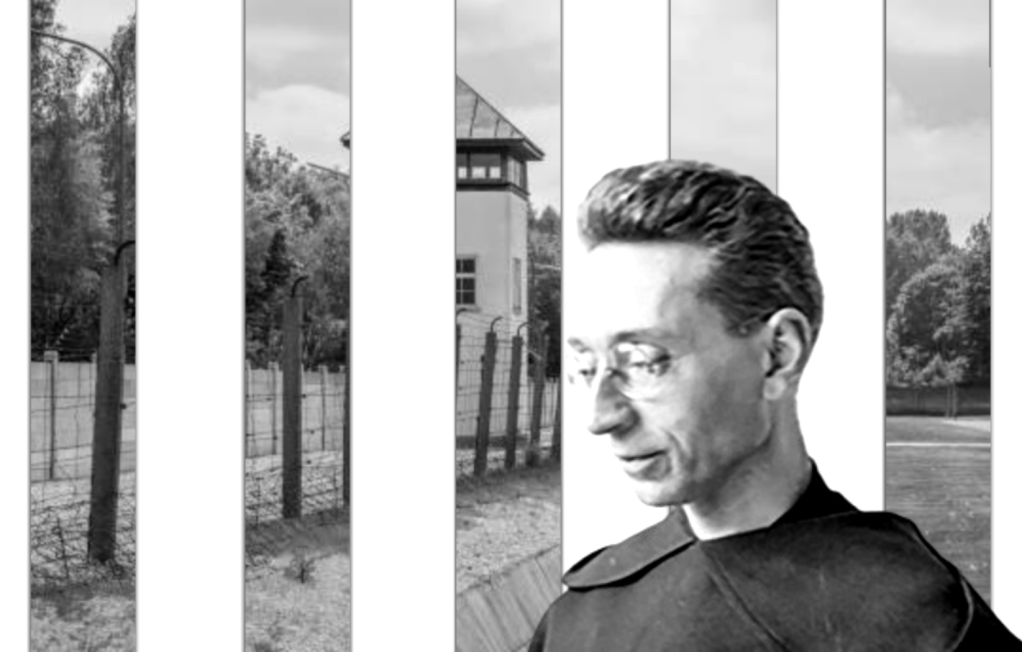
In the life story of Titus Brandsma, there is a remarkable example of what I, following Marie-Joseph Le Guillou and much of the tradition, call transfiguration in Christ.[1] Simply put, this theme means that charity affects the whole person. Le Guillou’s trademark phrase seems to be this one: “Charity has to pass all the way to our fingertips. If that doesn’t happen, something is awry!”[2] The whole teaching is in those short sentences.
This doesn’t just mean that we have to do actions with our body that manifest charity (although that is taken for granted). It also means that these actions, particularly ones that involve our face and our posture, will embed themselves over time into the lines of our face and the typical comportment of our bones. One’s eyes might transmit warmth, or maybe understanding, or perhaps a sense of being seen; one’s natural posture might indicate that another is respected and listened to, while the person themselves is approachable; one’s mouth might be marked by joy, or suffering that is taken joyfully. The possibilities are endless. Yet they are real. Charity is a thing to contemplate, not just in the invisible world, but sometimes in the visible.
As I was reading a book[3] on Titus Brandsma, a saint who has been so good to me, I came across a very compelling instance of this theme. For his opposition to the Nazis during World War II, Titus was arrested. First, he was placed in solitary confinement at Scheveningen. Then, he became Prisoner 30492 at the Dachau concentration camp. It is in this latter setting that testimonies of his transfiguration start to appear in the book that I was reading, and they are worthy of a post and of our reflection.
Titus was difficult to get to know. This had always been true. Apparently, it remained true in the concentration camp—and people didn’t quite know why they were affected by him in themselves and in being drawn towards him.
The nurse attending Titus at his deathbed in Dachau put it like this: “There was in him something that gave people confidence.”[4] She said is was something. It could be hard to say what. It was a je ne sais quoi that imparted confidence to, into, others.
Yet this wasn’t just a feature of his visible life as he approached death. It was more generally remarked about his earlier state in Dachau: “The others did not understand Titus but were still eager to meet him because, as they said, Titus radiates such warmth.”[5] There was something that drew them in. It was mysterious to the eyes of their face and the eyes of their soul. Yet it was unmistakably attractive. It radiated. Just like the confidence that was thrown into others, there was a movement from one to another—and quite deep within.
Various answers could be given to what this radiation and tangible extraversion of grace consisted in. “In her report the nurse [at his deathbed] says that people sought him out for his calm and friendliness.”[6] Perhaps that was it.
At the same time, the author of the biographical book itself (Constant Dölle) seems to try to draw out this characteristic of Titus, which was interior but also exterior, with a contrast of traits that is just so much more visible and tangible than the abstractions of “calm” and “friendliness.” In the same paragraph, we have a reflection on Titus’s smile—and the screaming of the Nazi officer:
Titus’s smile and the screaming of the Nazi officer: the contrast between the spiritual man and the [merely] physical man. The time of screaming is usually short. The time of physical violence does not last long. We cannot live with it.[7]
In contrast, of course, Titus is resilient, and his spiritual comportment, on the whole, carries on. It has etched itself into his muscles and tissue. It’s part of who he is. And that is true at a deeper level than anything we could say of the deformation of the visible person that is a screaming Nazi officer.
The author continues to try to understand this aspect of Titus Brandsma in Dachau:
The smile of the angel in the cathedral at Reims is the answer to the demonic figures so abundantly present in the Roman style. The smile overcomes the anxiety of the terrifying, the monstrous. The Nazi officer with the bull’s neck screamed; he always screamed. He drove people apart and beat them down. He sowed fear and panic all around him and was soon satisfied. He never had emotions which penetrated deeply into the core of his being, which were permanent, and could change him.
Titus’s smile was liberating. It was the smile of a purified person. He had found himself back. In other words: he received himself anew with a trust that was altogether pure. His smile in the barrack of Dachau and his tears in the cell at Kleve came from the same source: “Now I know again that You love me.”[8]
It seems to have been that smile. Surely, other things caught people’s attention. But this must have been the most prominent feature, at least to most eyes in most encounters. A Capuchin priest named Othmarus, who was also at Dachau, has remarked:
An eternal smile full of patience and inner serenity, a smile of mystical resignation in all the suffering he had to bear, marked Titus. He had been maltreated so badly that his teeth literally hung loose in his mouth. He repaid all that with the prayer of Christ: ‘Father, forgive them.’ Neither I nor anyone else ever heard him complain. He was a saint.[9]
Titus himself was likely drawing on his own contemplation of the suffering Christ as he went through this harrowing experience. In 1927, he had written:
Compared to this internal image, finally, that external image of wounds and stripes is something secondary; it is of value as the confirmation and deepening of that internal image.[10]
In other words, what is on the inside is a greater reality than what is on the outside. Christ suffered more interiorly, in some sense, than exteriorly. This is a theme dear to other contemporary spiritual writers, like Marcel Văn. But more importantly, I find it difficult to believe that something of Titus’s transfiguration wouldn’t shine through outside because the interior image had been arranged so well. Compared to the external image, the interior one is the greater. We get everything that these witnesses tell us of Titus’s transfiguration because—and he would know it—of the Christ-conforming image imprinted in the first place inside him.
Moving towards the conclusion of his book, Constant Dölle tells it like this:
The source from which his strength came was deeper. Titus lived on the strength of his conviction that humans are not abandoned to themselves, that they belong to God, and that God’s power works in them. The deepest level of a human life is only fulfilled in that relation to God.
This does not mean that he sealed himself off from the world outside of him and spun a cocoon for himself in a protected interior world of his own. He remained an open and receptive person but did not let himself be overpowered by the superior power of evil. He saw the relativity, the transient character, of violence. This world could not penetrate the core of his being where he kept the holy experience of God’s inviolable nearness. Accordingly, he did not ask himself: Why does especially this misfortune happen to me? He took the days as they came. Behind everything he assumed the existence of an order which he respected.
The characteristic trait of his life became more clearly evident toward the end. In these last days the splendor of his humility came out.[11]
This is a remarkable reflection on the power of God’s transfiguration of our nature. Yes, something is awry if charity is not manifest down to our fingertips. But time is God’s. “Time is greater than space,” as Pope Francis likes to say (Lumen Fidei 57; Evangelii Gaudium 222–225). Whatever needs to emerge will emerge. What needs to organize itself will organize itself. Whatever needs to come out will come out. Divine grace works itself out, especially as we abandon ourselves to the horrific, but gentle, providence that comes to us and then takes full advantage of all the connections and circumstances and the temporal order of events, whatever that may be in each individual case, to blossom and send forth an aroma of love, not just words and actions, but a whole new creation in Christ to be gazed on as a thing of beauty, inside and out, a proper focus of Christian contemplation. Titus Brandsma was transfigured in Dachau.
[1] Marie-Joseph Le Guillou, Des êtres sont transfigurés. Pourquoi pas nous? (Paris: Parole et Silence, 2001).
[2] Ibid., 17.
[3] Constant Dölle, Encountering God in the Abyss: Titus Brandsma’s Spiritual Journey, trans. John Vriend (Leuven: Peeters, 2002).
[4] Ibid., 187.
[5] Ibid., 169.
[6] Ibid., 187.
[7] Ibid., 179.
[8] Ibid.
[9] Ibid, 180.
[10] Ibid., 171.
[11] Ibid., 187.


 Contemplative in the Mud