
[ Marcel Văn and Clerical Abuse | Introduction | Part 1 | Part 2 | Part 3 | Part 4 | Part 5 | Part 6 | Part 7 | Part 8 | Part 9 | Part 10 ]
“If eyes are always kept blindfolded, one must fear that they may become blind.”
Marcel Văn (OWV 820-2)[1]
Should the abuse crisis need its Doctor—in the sense of a teacher of the universal Church, a Doctor Ecclesiae Universalis—I don’t know who else we are going to find but Marcel Văn (1928–1959). To the best of my knowledge, nobody else who has been put forward as a candidate for sainthood has written so much about clerical abuse in its various forms, its effects, and the evangelical responses and solutions.
Of course, you would hardly know that from reading the existing literature on Văn.
The way that the life of this Servant of God is usually told goes rather like this. Joachim Nguyễn tân Văn was born to poor parents in a village located on the roads between Hanoi and Hạ Long Bay. The third of five children and a sensitive one at that, Văn’s piety led him at a young age to move to a presbytery in a place called Hữu Bằng. There, things were exceedingly difficult for him. Some years later, in adolescence, he met Thérèse of Lisieux, first in the version of Story of a Soul that was available in Vietnamese at the time, then very shortly afterward in some mystical way. He learned about her “Little Way.” This confirmed his own deepest longings and even his suspicions about the spiritual life.
Some years after this, he joined the Congregation of the Most Holy Redeemer while still a teenager. During his novitiate with the Redemptorists, he had mystical experiences with Jesus, Mary, and Thérèse that his formator instructed him to write down (now called the Conversations). In these, Marcel—as his name was in religious life—emerges as incredibly weak and childish, struggling every day through the trials of the introduction to religious life. The whole atmosphere is one of spiritual childhood taken, as it were, to the extreme. These writings are the origin for some popular prayers for France, and they also display Marcel’s devotions to the souls in purgatory and for the benefit of children who die before the age of reason without baptism, as well as other children who have a rough life. Since it had been revealed to him that he would not become a priest, Marcel lived as a simple coadjutor brother. This period of his life lasted about a decade. During this time, Marcel wrote, at the request of his spiritual director, four different drafts of his Autobiography, many letters (collected as the Correspondence), and various Other Writings, including some notebooks and poems.
Marcel’s time in the various Redemptorist communities of Vietnam was put to a halt when he was arrested by the communists who had taken control of Hanoi. Eventually, after trials and moves from one place of incarceration to another, he died in the summer of his thirty-second year with a reputation for sanctity among those who knew him in the camps.
This received narrative leaves out words like abuse, trauma, and moral injury and hardly even hints at their centrality in Văn’s life. In contrast, the ten articles that I’ve published over the past month tell the story of the Vietnamese Servant of God in a way that takes the abuse as a focal point—a manner of reading Văn that has been woefully, if not disturbingly, ignored.
In Part 1, “The Clerical Abuse Marcel Văn Survived,” I give a lengthy summary of Văn’s experience of abuse at the hands of (in chronological order) a teacher in a Catholic school, catechists at a parish effectively functioning as a minor seminary, the priest stationed at that same parish, a Spanish mission priest at a second parish/juniorate, some women who were Dominican tertiaries, and a confessor and a superior in the Congregation of the Most Holy Redeemer that he joined. The experience encompasses sexual abuse, physical abuse, emotional abuse, psychological abuse, abuse of conscience, abuse of power, spiritual abuse, and the experience of a culture of disbelief, shaming, and coverup.
The next two articles discuss psychological needs that Marcel addresses in his writings. Part 2, “‘Changing Suffering into Joy’ as Spiritual Resilience in Surviving Abuse,” shows how Marcel’s signature message—that of “changing sadness into happiness”—is, in context, a response to abuse. There is an in-built need for psychological resilience, including in the realm where spirit intersects psyche. Especially after clerical abuse, the need for meaning and meaningful relationship must be found with God.
Psychological exigencies are not only internal, but also external. This is the topic of Part 3, “The Grace of Resistance after and through the Grace of Resilience.” Marcel teaches not only that we must change sadness into joy, but also that any abuse survivor has a need for either rebellion or resistance. Spiritual resilience converts rebellion into resistance, but this is a progressive transformation. It doesn’t happen all at once. To whatever degree the process of changing suffering into joy is incomplete—as Marcel narrates applies to himself, too—so too will be the process of changing rebellion into resistance. This is the challenge for survivors, but it is also the challenge for everyone else. We’ll get rebellion wherever we don’t get resistance. This is reality. It’s reality soaked in the Gospel, but it is reality still.
Part 4, “The Childish Environment of Marcel Văn’s Conversations and Grace after Abuse,” investigates why many of Marcel’s writings have such a childish environment. I come to two conclusions. First, Marcel, like his spiritual big sister Saint Thérèse of Lisieux, has a need to recover dispositions that he had before trauma grabbed hold of him. Second, Marcel offers the healing balm of Jesus’ childhood at Nazareth as a subject for meditation and contemplation, contributing to the means of trauma healing available to anyone and everyone.
The next two articles discuss moral injury. Part 5, “Moral Injury in the Life of Marcel Văn,” distinguishes trauma from moral injury. Proximity to moral events that challenge one’s trust generates wounds to moral agency, moral identity, moral relationship to others, and the specific relationships to God and institutions. Marcel knows all of these, and his writings give material for reflection on all the main categorizations of moral injury offered by modern psychologists.
Part 6, “The Death of Marcel Văn and Moral Injury,” moves the discussion along to include injury to and confusion in moral reasoning. This category impacts not only Văn’s life but also his death. Exactly what leads Marcel to make the heroic decisions that he makes in communist North Vietnam is tied to the moral confusion he suffered in the immediate wake of abuse. Marcel is proposed as a confessor of the faith by the postulators of the cause of beatification. The suffering he endures at the hands of the communists, though, has earlier roots in clerical abuse. If Marcel becomes a confessor of the faith, he will be so, I argue, not only because of suffering for the truth at the hands of the communists, but also for suffering for the same truth in the wake of clerical abuse.
Another set of two articles deals with Marcel’s intercessory prayer. Part 7, “The Intercession of Marcel Văn for Priests,” probes the Servant of God’s writings for how his experience of the abuse crisis contributes to his prayer for priests. There is a profound link. Marcel can never put what he suffered behind him, even though he is frequently admonished in his prayer to intercede for clerics. He prays, in effect, for the conversion of domination into service and love.
Part 8, “The Intercession of Marcel Văn for Abuse Victims and Survivors,” continues the discussion into territory that Marcel needs no encouragement in. He readily intercedes for abuse survivors. I offer three examples of this. The first comes from his correspondence and other writings. Friends are trapped in abusive situations at a presbytery, and he intercedes with authorities on earth and in heaven to find a better path for these friends. The next two examples come from stories told in our own day of Văn’s intercession from heaven. One is taken from a film about Văn, the other is personal to the author.
Having come this far, in Part 9, “The Little Way after Clerical Abuse,” I reassess how everything in the previous eight articles affects how we interpret Văn’s lived experience of Saint Thérèse’s spirituality. Văn lives the same Little Way as his spiritual big sister. Yet it is smaller still. Without understanding why, Marcel believes that he is a soul that is actually weaker than Thérèse. He makes little sacrifices, but he also offers necessary self-care when he’d rather not have to undertake it. He believes that love can do everything, and this applies to his prayer for others, which he offers united to the little work of Nazareth that he does every day. He knows that a spiritual friend can’t heal his heart—with all its trauma, moral injury, and whatever other aftereffects of abuse persist in his psyche and his spirit—but Jesus will do the work in time. Everything is in the Lord’s hands. He must be small enough to fit into them, too. For an abuse survivor, that’s very, very small.
Finally, Part 10, “The Future Movement Marcel Văn Prepared For,” gives an outlook for our times, rooted in Marcel’s own perception of the fact that he is not unique and that he is sowing seeds. Marcel wants little apostles of Love, who are given to littleness and contemplative love, found anywhere and everywhere. He also wants, I think, a ministry of presence to abuse survivors. I suggest ways to instantiate Marcel’s unfulfilled dreams today.
With over 50k words here, I’ve tried very hard to “write the book” on Marcel Văn and clerical abuse. There needs to be a lot more than a book. There needs to be a reality that Marcel would recognize as the healing movement he prepared for over a half-century ago. But this, I pray, is a start.
Please share far and wide. If I can offer the resources of Văn to the abuse crisis, I will have given him back at least something of the great grace that he has given to me.
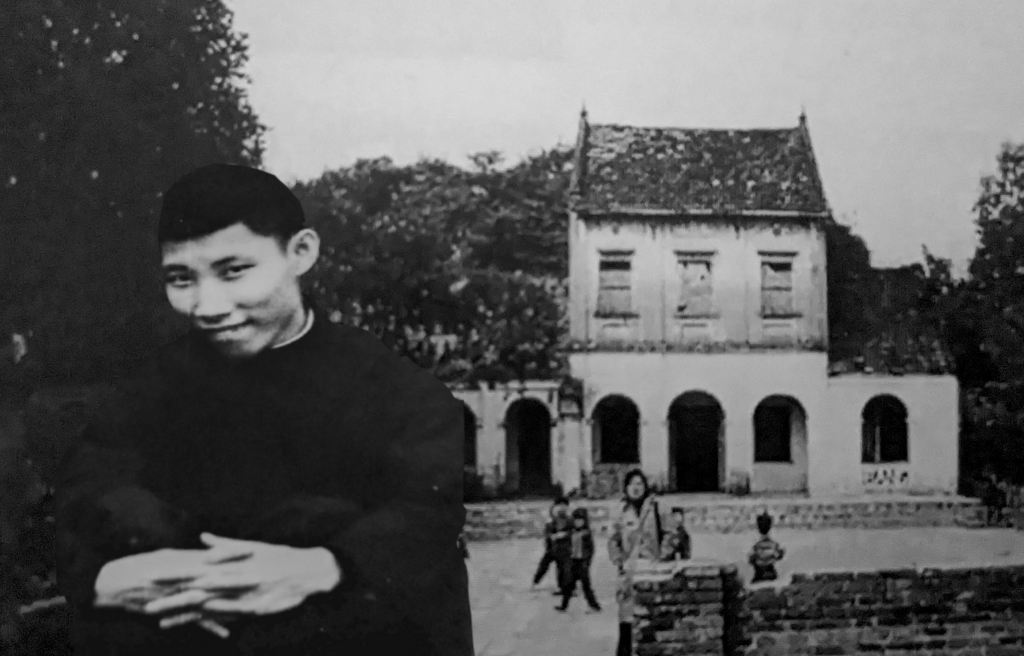
Images in header: Marcel Văn at around 20 years of age, presbytery of Hữu Bằng
[1] OW = Marcel Van, Other Writings, trans. Jack Keogan (Complete Works 4; Versailles: Amis de Van Éditions, 2018). Additional system for abbreviations explained on page 14, e.g., OWN = notebooks; OWV = various writings.

 Contemplative in the Mud