
[ Marcel Văn and Clerical Abuse | Introduction | Part 1 | Part 2 | Part 3 | Part 4 | Part 5 | Part 6 | Part 7 | Part 8 | Part 9 | Part 10 ]
There are two special areas of intercession which pertain to Marcel Văn’s experience of clerical abuse. First, what comes out most clearly in Marcel’s writings is a requirement to intercede for priests—the abusers and potential abusers. Second, there is the intercession that Marcel undertakes for survivors themselves. In this article, I will talk about the former. In the next article, I’ll broaden discussion to include the latter.
A few initial comments are in order. In the first place, when reading this present article, please do not think that Văn’s spirituality neglects the victims. Nothing could be further from the truth. I’ve only broken down discussion into two separate posts, because there’s a lot of ground to cover. In the second place, I’m going to be quoting a lot from Văn directly. This could seem tiresome. But the reason for this is precisely to show how Marcel himself experiences this exigency to pray for priests. His own words as a survivor matter a lot here. It is far too easy to make him sound prescriptive and to set out his ideas in a way that might be dismissive of pain. Hopefully, by relying on Marcel’s words as much as possible, this highly undesirable extreme can be avoided.
The horror
The urgency of prayer for priests comes part and parcel with Thérèse of Lisieux (e.g., Ms A, 50r, 56r, 69v; LT 135),[1] so Văn, being a Petal of the Little Flower (cf. A 8),[2] is certainly familiar with it. But it would be really confused to think that Marcel merely reproduces his spiritual big sister when it comes to intercession for priests. How could he? He knows clerical abuse intimately. It would be absurd to expect that this doesn’t affect his lived experience of praying for priests.
While acknowledging a difference between Flower and Petal, it would also be entirely unsatisfactory to say of Văn, as a biographer who is himself a canonically disciplined abuser has written, “More than Thérèse, he saw the fragility of priests.”[3] No. He did not just see fragility. That is a word he reserves for his own condition (OWN2.30).[4] It is all wrong to describe victim and abuser with the same terms. Moral evil isn’t the fragility of a delicate child. It’s a horrific chasm in the fabric of being, something deformed and “covered in purulent scabs” (OWN9.18). And directed along the structures of authority and power in the Church, it’s an abomination. What Văn saw is not just human fragility in priests, but the horror of the priestly state perverted and the indifference of coverup.
The strongest evidence for the horror being stuck into him like a knife, while he knows that he must pray for priests, comes towards the middle of his novitiate year:
While sweeping the corridor, thinking of the sufferings that I had to endure at the presbytery during my childhood, I said to myself: “If Jesus had not pulled me from that presbytery [at Hữu Bằng], perhaps I would never have known the tenderness of his heart for souls.” I then heard a voice speaking to Vietnamese priests in these words: “Unfortunate priests, because you have used human malice to hide the tenderness of my heart towards souls, know that it is not certain that you will benefit from this tenderness.” And, as I finished sweeping the corridor, I heard a still more threatening voice which said: “Put a stone round their necks and throw them to the bottom of hell, to put an end to them.”
My Father [i.e., his director of conscience, Father Antonio Boucher], these words disturbed me very much because I have never heard such threats.
[Comment of Father Boucher:] After his work, Brother Marcel came to tell me his concern and his doubt concerning the subject of the author of these words: “I doubt strongly that these are the words of Jesus because I have never heard him make such threats. Moreover, Sister Benigna Consolata said: ‘It is only the devil who scolds sinners.’” (Conv. 161)[5]
Starting immediately after he wrote this, Marcel experienced wave after wave of interior suffering, horrific visions, and physical illness, essentially inexplicable, for a month; during this time he could barely write (cf. Conv. 161–170). Was it a psychosomatic manifestation of bringing the memory of Hữu Bằng too close to the surface? Did God use that psychosomatic substructure to give a supernatural meaning? It is hard to say. But it can hardly be coincidental that the one time in the Conversations that Marcel writes of his own experience of clerical abuse, what follows is an extreme, prolonged intensity of suffering, taking in both the psyche and the body. Elsewhere he experiences long bouts of dryness (cf., e.g., Conv. 286, 350), but the interior and physical turmoil never compares. Later, when he remembers the suffering his own family caused him, it hurts him so much that he asks to forget it all (Conv. 694). It would simply be remarkable if, given Marcel’s temperament, he did not have any reaction at all to discussing the clerical abuse he suffered. In point of fact, the great trial of body and soul only ends with some extraordinary visions on Christmas night (Conv. 172–183).
To Marcel, Jesus reiterates that the threat is not on his side: “I myself act towards these souls just as I do towards you” (Conv. 224). However, whatever is received is received according to the mode of the receiver: “In fact, it is simply because they compare my love to that of earthly creatures that they fear in that way. If, on the contrary, they used the glance of love to probe the depths of my love, their fear would disappear” (Conv. 225). Thus, Jesus can say the things Marcel reports—and the Gospel too (Mt 18:6, Mk 9:42; Lk 17:2). His words have that meaning only for those who will not have loving confidence in him. But those Vietnamese priests that Marcel knew, that abused him and so many others—it is not unreasonable that they should have Jesus’ terrifying words addressed to them.
This is a theme that recurs in the Conversations. It’s almost as if Marcel can’t let it go. Not because he wants these kinds of threats for priests, but because he suffers or struggles with the fact that they even exist. Bearing in mind that, I think, “children” means both actual young people and abuse survivors:
Why, in the Gospel, do you make such terrible threats against those who scandalize children? If I remember correctly, it is perhaps the only place in the Gospel where you allow such threats to be heard. (Conv. 433)
I utter such serious threats against the scandalous who insult the Blessed Trinity in a manner which could not be more outrageous. (Conv. 434)
These statements, and other like the, are all the more disturbing since the Conversations acknowledge priests as Jesus’ “other selves” (Conv. 478) and what kind of a simplicity and confidence one ought to have with them (Conv. 497, 614). No wonder Marcel is fixated on them. They don’t immediately jive with his reliance of the infinite mercy or God. Yet they are evangelical.
This, I think, lies constantly in the background of Văn’s intercession for priests. He knows how utterly horrific clerical abuse is. He struggles to grasp how entrenched it is. Yet he does come to terms. He often eschews dealing with his own experience head-on, perhaps because too much of that or an uncontrolled reflection on it can cause psychosomatic attacks. Nonetheless, he knows and he prays. We are a long way from Thérèse who was surprised priests weren’t “purer than crystal” (Ms A, 56r). We’re seeing what intercession looks like from within a very distinct kind of mud.
The mission
Marcel is given intercession for priests as a mission. It’s not something he comes up with himself. He doesn’t sit down and say to himself, I’ve been abused a lot by priests and in clericalized settings; I can do something about this by intercessory prayer. No, Jesus confides this to him as a mission. The necessary task comes to him in mystical conversations—or, let’s just say, in times of prayer themselves.
The mission is given very early in the Conversations. Here Jesus, or some representation of Jesus filtered through the psychological possibilities that Marcel carries within him, is speaking:
I am now going to speak to you about priests. Remember what I am going to say to you. Shame on the directors of conscience who, seeing in the souls of their charges a bond of friendship being forged with me, far from tightening this knot, cause it to be loosened to the extent that these souls end up by distancing themselves from me… My child, pray a lot for these unfortunate spiritual directors; if many souls do not know how to love me, they alone must carry the responsibility…
Happy are you not to be a priest… Many priests acting in my name allow a great number of souls to be lost… I tell these priests: “I thirst for souls, nevertheless, they do not take care to give them to me. Imitating the torturers, they give me vinegar to drink, and not daring to come close to me they give me this drink by means of a reed… Oh!… How I suffer from such behaviour…” Pray for these unhappy priests… I love them still and I wait for them but, for their part, they only know how to receive my love without loving me in return. They abuse the time I give to them in order to insult me. My child! Love me in place of this kind of priest. (Conv. 9–10)
The role of Marcel is to be intercessory (“pray a lot for” this kind of priest) and substitutionary (“love me in place of this kind of priest”). It is by love that the prayer can be effective and worthwhile. It is by making up for what is lacking elsewhere that Marcel can contribute to building the Body of Christ.
In fact, the substitutionary character is tied to the suffering of Christ. Jesus tells Marcel that he will have to suffer a lot for being misunderstood and for keeping his special intimacy with Jesus private, i.e., for his contemplative vocation or vocation to Nazareth; “this type of suffering will serve to expiate the sins of priests who do not cease to repulse me” (Conv. 49). Aridity and times of waiting serve the same goal (Conv. 50, 63). In these moments, when he prays for priests, or perhaps even if he forgets but has had the general intention in his heart long before, he will be especially heard.
Marcel carries this conviction about the connection of his love and suffering bearing fruit for priests well beyond the novitiate year of the Conversations. He writes to his director of conscience:
Jesus has often reminded me of this: “If you are sick, it is solely because I wish to ask you to make up for the sins of priests who loosen the rein on concupiscence of the flesh.”
In truth, the heart is the living strength that one abuses, and what is not the sorrow of Jesus when he sees his representatives give themselves over to such a cruelty! So, he cannot prevent himself from feeling the sorrow of his heart in the hearts of spouses who live close to him.
I, therefore, a victim of holocaust offered to the fire of love, I regret nothing, my sole wish is to so make of it that love may be entirely satisfied. (To Father Antonio Boucher, Apr 1951)[6]
Similarly, he says to a friend: “it is because of this thirst [for the salvation of souls] that I oblige myself to be ‘the Heart’ of priests, using the warmth of love and the source of the redeeming Blood to beat and give life to priests” (To Lãng, 22 Apr 1951). God knows that this beating heart is wounded and pumping only with great difficulty.
Various reminders
One would think that the mission given to Văn, while incredibly hard and painful to put into effect, is pretty straightforward to understand. Priests abuse. Not all of them, but many. There needs to be intercession to prevent this. Intercession is accompanied by love and sacrifice.
Yet, amazingly, Marcel is still not completely following the message. He keeps a certain naivety about priests. After all he suffered at the hands of priests, he is still able to ask:
Jesus, today I heard the novice master ask for prayers for priests, saying that certain priests seem to have lost the faith… How can a priest lose the faith? Since without faith it is impossible to love you and also impossible to save souls. That must make you so sad, Jesus. What can I do to comfort you and what means can I use so that priests can become more helpful to the Church? It is truly strange. Why does such a disorder exist among the clergy at this time?
Jesus: My child, little apostle of my love and my little friend, do you love me? What you understand on the subject of priests is very little. If I let you see the pain that priests cause me every day by their conduct, would you perhaps ask me to chastise these unhappy priests here and now… Apostle of my love, try to pray and to practise little sacrifices to console my loving Heart. Pray also that the time I give to these priests, in the hope that they will come back to me, will be lengthened a little more so that they may profit from it and be converted. My little child, if priests are in revolt against me, to whom will my love go to seek a little comfort? Pray that priests may be full of zeal for me; ask that, each day, they will come closer to me, to comfort my love and to protect me from the injuries that bad priests inflict upon me. My little apostle, I need priests who are full of zeal for me; it is only thanks to them that I will be snatched from the hands of these priests, and that these latter will be led back to my love. My child, pray therefore, pray as if you, yourself, had to submit to my unhappy lot. My little friend, all I ask of you is to do me a favour, and this favour, whatever it may be, offering or word, if it is done with the intention of comforting me, I will accept it gladly… (Conv. 25–26)
Jesus continues after Marcel takes a rest:
Little apostle of my love, it is now dark but since you have a lamp. I am asking you to make an effort to write again what follows: to escape the darts which sinners throw at me, I shall take refuge among priests. I am among imploring their help then, making known to them my unhappy fate. I am begging them to console my abandoned love. Alas there are those them who treat me without respect and show me the door, thus showing that it is not convenient that I show my love to them and that my words of love are too much. By such behaviour it happens that the souls who are entrusted to them lose confidence in me. Little apostle of my love, nothing wounds heart so much as to see someone lose confidence in me.
Faced with such a situation I have to withdraw to the little souls and, once installed in them. I recognize them as my spouses. I take them into my service and confer on them the dignity of mother of souls that I want to save. I give them marks of affection, I even make known to them my unhappy fate… My little friend, I also find in these souls in diverse ways many consolations.
Little apostle of my love, make known to your director how I suffer because of the conduct of priests and ask him to comfort me in my love for all priests. Ask him to help you in the work I am confiding to you and I myself will join with you in pressing your request… I am asking him also to pray that other directors understand clearly the love I have for the souls confided to their care. (Conv. 27–28)
In sum, the abusive and/or scandalous behaviour of priests harms the flock. The little souls lose confidence. Thus, Marcel needs to pray for priests. It’s not for the sake of clericalism that he focuses on them. It’s because priests can really harm people, because clericalism is a cancer, because evil lodged in a certain part of the Body spreads faster and corrupts more than elsewhere.
Again, Jesus delivers the same core message:
There is something which is even more deplorable, there are priests who use the following procedure. Placing me on one side and the world on the other, they hold souls in their hands. If the world asks for some of them, they give them readily and are even ready to help these souls… But if I, on my part, ask for some of them, they answer me: “Who will be the master of these souls?’ And I must resign myself to gaze after them in spite of my ardent wish to possess them. And if, sometimes, they offer me one, they only place it at my side, leaving it to its own devices in that which concerns its conduct towards me. Too bad for me if I wish to use this soul in some way. That is why a great number of souls abandon me to follow the way of the world.
My little apostle, if I have invested priests with my authority, it is with the sole intention that they use this authority to lead souls to me in such a way that they can unite themselves intimately with me. But the reality is that these priests dare to use my name to lose souls. Little friend of my love, since I am but one with you, you must suffer just like me the treatment that I am subject to. To comfort my love and expiate the sins that priests do not cease to commit against me, accept cheerfully the sufferings that I send you at the time when I should send you joys and sweetness. (Conv. 29)
Here, the theme of suffering and sacrifice rejoins that of prayer, stressed as necessary because of abuses and the corruption of the only meaning of authority—service—that Jesus wants to exist in his Church.
Often Jesus redirects Marcel’s attention to intercession for priests. His mind is elsewhere. Jesus says to come back to this assigned task. On the Feast of Christ the King, Marcel suggests that he will pray that Jesus reigns in the hearts of everyone. To this, Jesus replies by giving him this prayer: “Jesus, King of love, may the reign of your love be deeply rooted in the hearts of priests” (Conv. 30). When Jesus asks Marcel to pray for France, he asks him to “above all” or especially pray for the priests of France (Conv. 76, 111, 159, 188, 202, 231). Once he internalizes the approach, the saintly little brother asks Mary to “have pity on the priests of France and Vietnam” (Conv. 247).
When Marcel asks Jesus for a way to remember to pray for all the various intentions he has to be concerned with, Jesus gives him one intention for each day of the week; Fridays are “that priests may overflow with zeal for my love” (Conv. 103), including “those priests who have strayed far from Love and who walk barefooted in the sludge of sin” (Conv. 477). Lest we think there is no deeper meaning behind this being the petition for Friday specifically, Marcel is designated to pray on Good Friday itself: “O Jesus, I love you for the priests who do not love you. Make your Love penetrate freely to the innermost hearts of priests. Make it so that fervent priests may be full of zeal for your Love.” And he is told the harrowing fact that “the voice in the world that rejected my Love came first from priests”; Marcel must always remember this and it is why he must pray (Conv. 477–478).
When Jesus tells Marcel about the need to entrust the task of bringing souls to him to people on earth, Marcel blurts out: “Little Jesus, entrust these functions to priests, to the priests of France.” And Jesus responds: “But is it possible, Marcel?” Despite what he has experienced, Văn still thinks the holiness of priests is possible. Jesus challenges him, and finishes off with throwing the ball back into Marcel’s court: “Will they accept these responsibilities? Pray a lot.” It is back to intercession; he can’t get rid of the task. Nor, for that matter, will the goodness of priests be seen as anything other than an arduous good to attain. The words are a bit haunting: “But is it possible, Marcel?” (Conv. 210).
Another aspect of Marcel’s thought that is worth pausing on is the implantation of his vocation of intercessory prayer within his vocation to be a member of the Congregation of the Most Holy Redeemer. He is “numbered among the Redemptorists, another Redeemer” (Conv. 716). That is one way for him to understand prayer united to the Cross. Yet he also knows that obedience is the only way to prove his love to his superiors, and he must love them as he loves Jesus (Conv. 717). He writes, “I place my joy in pleasing my superiors” (To Father Alphonsus Tremblay, 26 Jul 1948). This could become an unimaginable nightmare if the superiors were as twisted as the parish priests he met. At this stage, Marcel does not seem to have grappled with this potential contradiction at a conscious level. But as we know, his two years in Saigon will become a nightmare, with abuse coming from both his confessor and the superior. Perhaps, though Marcel doesn’t say this, there emerged great intercession, by means of great love and suffering, at that time.
Visions
To give an idea of what Văn feels in a deep way about the failures of priests, consider two visions that he has. Now, I don’t intend to adjudicate on the authenticity of these visons (though I also don’t see anything objectionable in them). What matters to me is that they illustrate the world that is found in Marcel’s imagination. What image bank does he draw from? How does he think of this is a way that involves the whole thinking and imagining person?
Take this vision first:
[Jesus:] “My child, see how people pursue and strike me; be happy to suffer for me.” I was about to cry and Jesus confided me to Thérèse. I then saw a great number of priests armed with sticks who advanced towards the place where Jesus stood. That lasted about a minute and then everything disappeared. (Conv. 155)
In this vision, priests—not all of them surely, but many—are armed with sticks and surrounding Jesus to beat him. It’s a simple image. That’s it. Nothing else. But as a point of reference for prayer, it is very powerful. Truly, if victims of abuse are members of the Body of Christ, the vision is accurate. To have this shocking vision in mind when praying can go a long way. It doesn’t soften any of the edges of abuse. It’s theologically sound. It demands intercession.
A second vision lasts quite a bit longer and is described at greater length:
On the morning of Good Friday, during meditation, I saw little Jesus in the tabernacle and I saw him clearly; he was bigger than at other times and could have been thirteen or fourteen years old. He did not smile at me: his face was tinged with sadness. He kept his eyes closed and he was complaining about priests. It was solely by the movements of his hands and the position of his eyes that he expressed his sadness. He spoke a lot about priests, but after having spoken a few sentences, he rested a moment. I cannot remember in detail what he said to me; I remember only that he called priests to come to the foot of the cross to console his Love, to spread the reign of his Love in the world and act so that all men may come to know his Love.
This vision lasted a fairly long time; then suddenly, little Jesus faded away bit by bit, until he disappeared completely. (Conv. 488–489)
For my part, I’m glad that Marcel doesn’t tell us what Jesus said exactly about priests, other than where he wants them to come and how he wants them to be. We don’t necessarily need more. It’s enough to know how Jesus shows his sadness: hands, eyes, simple gestures, human gestures. It’s enough to know that Jesus is hurt. It’s enough to know that this is the same Jesus who is in the tabernacle. Again, it’s the Body of Christ.
Repairing the corruption of domination
There is, I think, another way to find out more about what Marcel thinks about the abuse crisis. A key theme of his thought is the broken relationship of domination and how the relation needs to be repaired. This is obviously true about his understanding of the clerical state lording it over laypeople. Domination, though, also stands out in Marcel’s understanding of the political situation of French colonialism in Southeast Asia. Consider for a moment what we can learn about domination in the case of clericalism, by looking at domination in the case of colonialism.
Start with the French and their colonialism. One of the remarkable facts of the Autobiography and the Conversations is that Văn does not like the French (e.g., A 614–630; Conv. 634–635; OWN3.55–56). Although he respected French missionaries, he struggled to love anyone else from France,[7] particularly those who were actively the colonialists in his country. At one time during the mystical discussions of the novitiate, Jesus declared this to be a “natural feeling” in Marcel; after all, Marcel had often “seen them make many Vietnamese suffer a lot” (Conv. 507).
The point that stands out to me, here, is this. Marcel has seen no less from priests and other clerical personalities. We could just as easily say that he has “seen them make many Vietnamese [laypeople] suffer a lot.” He himself is one of the sufferers—one of the most extreme cases. He says that “the French make my country suffer cruelly and I know that they consider the Vietnamese as servants” (Conv. 634); Văn also says that he himself was treated as the “boy” of the parish priest (A 167, 456, 537; SH 9).[8] It’s the same thing. It’s the same corruption.
So why doesn’t he struggle to love priests, catechists, tertiaries, and religious teachers in the same way that he struggles to love the French? Maybe he does—subconsciously. Perhaps he does—in depths of a psyche that he cannot face. Given his shy, scrupulous, sensitive character (A 4, 9–10; Conv. 441, 523), it would be a wonder if he had no such subterranean feelings. It’s already a miracle that they aren’t at the surface. Even his little Jesus would call it a “natural feeling,” were it to be there. It would of course be a natural feeling to overcome by intercessory prayer. But it would be natural, nonetheless.
At any rate, we can see why Văn’s need to pray for priests is completely free of clericalism. The reason is, his prayer for France is free from colonialism. Consider what Jesus says to him: “I regard the French as Vietnamese, having as their mission the protection of my Love in this country of Vietnam… So, in praying for France, you are praying as well for Vietnam” (Conv. 509). And the prayer Thérèse gives him: “Little Jesus, so arrange things that France acts towards Vietnam in a spirit of brotherhood, as you yourself, in your Love, graciously act towards France” (Conv. 532-1). In Marcel’s world, the French must be servants and brothers, not lords. They must spread the love by somehow using their status for uplifting, not take land, people, and colony. Prayer for them contributes to this goal, the good of the Vietnamese.
Marcel tells us in a similar vein: “All Jesus wants is the union of France and Vietnam, with the aim of spreading the reign of his Love, and not to re-establish the domination of France over Vietnam as before” (Conv. 729), thus Marcel is to ask Jesus to “make all the French and Vietnamese understand that they must form but a single heart so that the two countries may together enjoy a true peace founded on your Love” (Conv. 761). This preaches the end of colonialism, but it emphatically does not preach kicking the French out. That, I think, is remarkable. Marcel does not like the French, remember. Yet he thinks that the answer to colonialism is to take domination out of it, not to take the colonialists out of Vietnam. I don’t know how much we are inclined to agree with him today, but if we take this as a model for clericalism, the clerical state, and the lay state, it is undeniably useful—and challenging—for us.
Analogously, we have to assume that priests are regarded as Christian, with a mission of service, brotherhood, and protection for the laity. Clericalism is denied from the outset. A great interest in or need for praying for priests connotes nothing high and mighty in their regard, but rather something humble and lowly. And it is also, indirectly, prayer for laypeople, particularly those who have been hurt or may otherwise be hurt in the future by unrepentant priests. Like France towards Vietnam, the role of the priest toward the layperson is one of service, brotherhood, and protection. Violating that relationship of service just breeds “natural feelings” that, yes, prayer can overcome at an individual level, but which make matters spiral further out of control in global terms.
We could expand our reading to find words of Marcel on domination, and the conversion of domination into service, throughout his writings. On the political situation, Jesus says: “I wish it so to teach you that you are not the only one suffering” (Conv. 678). In other words, you have suffered a lot. That suffering is, in large part, clerical abuse. So if we talk about the political situation, you will see domination equally at work in colonialism. Indeed, the notion of domination manifests itself in other contexts, too. Marcel writes to his father of a time he “saw [him]self like a servant in the family” (To his father, 6 Oct 1946). This is domination at work in family dynamics.
We have here a constant of Văn’s thought patterns. Whenever something goes wrong in a relationship which should have a certain hierarchy to it, but nonetheless be entirely governed and subjected to the higher constraints of love, and thus the reversal of service, Văn applies the same model. Parents–child, clerics–laity, even (and bizarrely to us today) France–Vietnam get the same treatment. Of course, some concrete points differ, making it more an analogy than an identity. But the symbolic, interpretive universe of Văn remains a constant. Domination should go out, but the relationship should remain. Love should convert authority to service. No wonder Văn is called to a vocation of intercession. This is a tall order. But it is a necessary one. Without it, we can only tear people apart, not save them all.
Marcel is, in the end, remarkably consistent. He has a mission of changing suffering into joy. He must convert rebellion into resistance. All this would be an even more perpetual struggle with yet more bodies scattered on the battlefield if there were not also a call to change domination into service. Since Marcel himself is always on the other side of those relationships, and thus can’t effect the movement from domination to service himself, his role must be to pray.
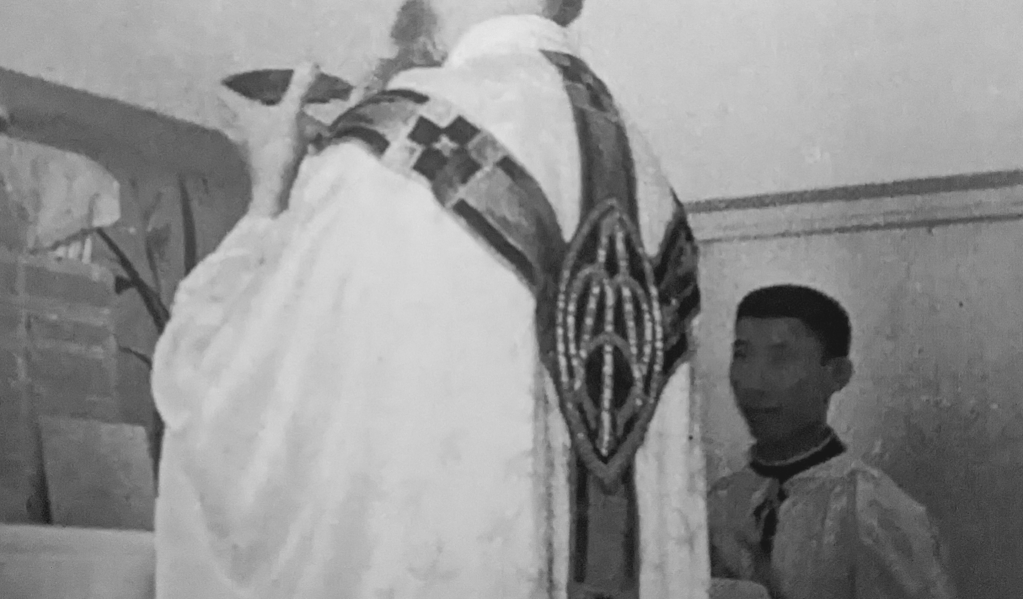
Image in header: Marcel serving Mass with Father Antonio Boucher as celebrant
[1] All references to Saint Thérèse of Lisieux using the system in Œuvres complètes (Paris: Cerf / Desclée de Brouwer, 2023), with translations my own.
[2] A = Marcel Van, Autobiography, trans. Jack Keogan (Complete Works 1; Versailles: Amis de Van Éditions, 2019).
[3] Marie-Michel [Hostalier], L’amour ne peut mourir. Vie de Marcel Van (Paris: Fayard, 1990), 94.
[4] OW = Marcel Van, Other Writings, trans. Jack Keogan (Complete Works 4; Versailles: Amis de Van Éditions, 2018). Additional system for abbreviations explained on page 14, e.g., OWN = notebooks; OWV = various writings.
[5] Conv. = Marcel Van, Conversations, trans. Jack Keogan (Complete Works 2; Versailles: Amis de Van Éditions, 2017).
[6] To = Marcel Van, Correspondence, trans. Jack Keogan (Complete Works 3; Versailles: Amis de Van Éditions, 2018).
[7] Note that the Redemptorists were from Québec, not France.
[8] SH = Father Antonio Boucher, Short History of Van (Versailles: Amis de Van Éditions, 2017). References to section number, not page number.

 Contemplative in the Mud