

At the beginning of this month, Pope Francis travelled to Mongolia, a large country by physical size but a small country by population, the number of Catholics in which is hardly much more than that in my parish. I want to pull out some highlights from the August 31 – September 4 trip, which may have been overlooked, but which are focal points for this blog. There are, to be sure, many more areas we could rest our gaze, but these are just the ones I propose.
Understanding silence with the senses
On the flight to Ulaanbaatar, Pope Francis made his way, as is his custom, to the part of the plane with the journalists who would be covering the trip. There he conversed with them. One of his unscripted remarks struck home with me:
Mongolia seems to have no end, and its inhabitants are few, a people few in number of a great culture. I think it will do us good to understand this silence. It will help us understand what it means: not intellectually but with the senses. Mongolia is to be understood with the senses.[1]
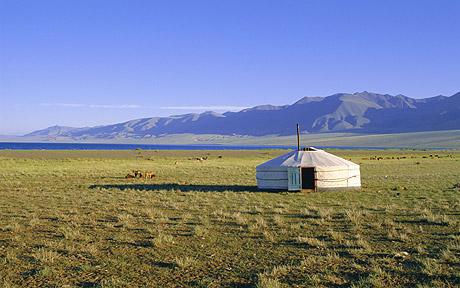
As the Season of Creation was kicking off, Pope Francis used the natural landscape of the place that he would be visiting as a point of reference for theological understanding—indeed, understanding about silence, prayer, lived spirituality. Since Mongolia is such a vast land, with so few inhabitants, there is something about the land itself that speaks of silence.
In other words, Pope Francis is here applying some general principles of Christian contemplation of the created world to the natural environment of the specific country that he will be visiting. And the lesson drawn, or message read in nature, too, is about contemplative life.
It’s important that the pope specifies that silence isn’t an intellectual thing. It’s lived. It’s experienced. It’s encountered with our senses. We find in a particular natural place—as Pope Francis says elsewhere of the Amazon region—“a theological locus, a space where God himself reveals himself and summons his sons and daughters” (Querida Amazonia 57). That’s how we learn in Christian contemplation of the created world. We know and we love. The only way that’s possible with nature begins with our senses.
We could really apply here, in a double sense, the words of Laudato Si’: “This contemplation of creation allows us to discover in each thing a teaching which God wishes to hand on to us, since ‘for the believer, to contemplate creation is to hear a message, to listen to a paradoxical and silent voice’” (LS 85).[2] In this case, not only is the voice we listen to a silent one, i.e., nature doesn’t talk. The message itself is about silence. We really and specifically learn to listen to the silent voice itself as the theological locus. It’s that silence that is speaking of a characteristic of God. In other words, we only gain this knowledge of the spiritual life through encounter with silence that is localized on a place that tells us that this is God’s doing.
This message is tied to the Mongolian plains. It could be tied to many other natural ecosystems, too. But it is now tied, especially to anyone who has been there and anyone who remembers the pope’s words, to the Mongolian plains.
Accordance with vs. standing against beauty, and thus contemplation
Pope Francis also used the opportunity of a trip to Asia to highlight some values about harmony and beauty. At an ecumenical and interreligious meeting in Ulaanbaatar, he said:
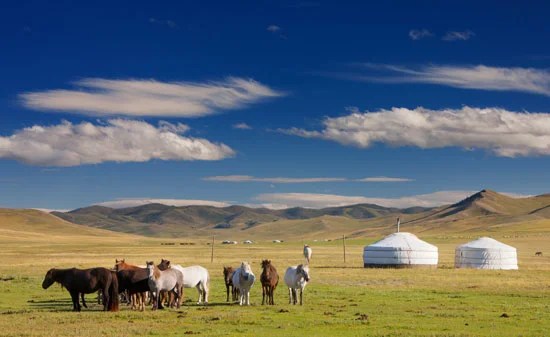
Harmony. I would like to stress this word, in its typically Asian accents. Harmony is that special relationship born of the creative interplay of differing realties, without imposition or amalgamation, but with complete respect for their differences, in view of a serene life in common… Harmony may well be the best synonym of beauty. Whereas narrowness, unilateral imposition, fundamentalism and ideological constraint destroy fraternity, fuel tensions and compromise peace.[3]
This is a lot like the pope’s favourite image of the polyhedron (Evangelii Gaudium 236; Fratelli Tutti 145, 190, 215). The sides all fit together. Each face is unique, but they together form a whole, a unity. We could say they are in harmony. This isn’t uniformity. It’s not a sphere, where every position is no different from its neighbour. In musical terms, we don’t have a single note hit by everyone all together. There are many notes, and they work together to make a chord.
The interesting point, however, is the connection to beauty: “Harmony may well be the best synonym of beauty.” For Pope Francis, beauty is what we contemplate. It is knowledge plus love for the same object. We contemplate the beauty of God, of Jesus, of a leaf, of an ecosystem, of a family, of a poor person reflecting the priorities of the Lord. This happens by knowing and loving, not by closing our eyes, minds, and hearts.
So, what the Holy Father is saying here, I think, is this. We can contemplate the beauty that is harmony. And this happens through fraternity and peace. The enemies here are “narrowness, unilateral imposition, fundamentalism, and ideological constraint.” These are not harmonious. They pull apart. They put things into the kind of tension that isn’t unitive, but rather destructive. Thus, they are not beautiful. Consequently, we could say, they need to be removed from ourselves if we are to enter into contemplation. And where they are present, we can only contemplate the beauty that surrounds them, pained and hammered to the Cross with these enemies themselves.
I would also point out a comment made during the in-flight press conference that made quite a splash. My reason for bringing this up is because it relates to the question of harmony:
I don’t know if I’ve already said this before: a few months ago, I telephoned a Carmelite, and said to the Prioress: “How are the nuns doing, Mother Superior?” She was a non-Italian Carmelite, and she finally replied: “Your Holiness, we are concerned about the Synod.” I said jokingly, “Now what’s going on? Do you want to send a sister to the Synod?” “No, we are afraid you are going to change doctrine.” And this is what she was saying, she had this idea… But if you go to the basis of these ideas, you will find ideologies. In the Church, whenever people want to attack the path of communion, it is always an ideological attack. And they accuse the Church of this or that, but they never make a true accusation: that it is made up of sinners. They never speak of sinners. They defend a “doctrine”, a doctrine like distilled water that has no taste and is not the true Catholic doctrine, which is in the Creed. And very often, true Catholic doctrine scandalizes people. How scandalous is the idea that God became flesh, that God became Man, that Our Lady kept her virginity? This scandalizes. Catholic doctrine sometimes scandalizes. Ideologies are all distillations, they never scandalize.[4]
Many others have commented on this text. Some have disputed it.
The one indisputable thing is this: The nun expressed a concern that the Synod on Synodality would change doctrine, and the pope doesn’t even give this worry the time of day. Why? Because it’s not worth it. That’s an ungrounded “fear.” So Pope Francis, as the spiritual master that he is, goes to the heart of the matter: What leads to this bad discernment?
In light of what the pope said in Mongolia about harmony and beauty, I would suggest the following reading. It may supplement some of the others that have been offered.
Harmony will always have many voices. A synod is not for that a problem. (On the contrary, it’s an opportunity!) If you are worried about a synod as such, what are you worried about except these voices? Now, sure, they could be cacophonous—but that’s not a problem with speaking together. It’s a problem with knowing how to respect each other and respond to each other. So, the focus should be more on how to be a plurality, without becoming a noisy mess. That happens through fraternity. It happens through getting to know one another under the inspiration of the Spirit. It happens, then, by having a fraternal conversation about fraternity… or having a synod on synodality.
More to the point: If what you are worried about is a plurality of voices in itself, are you really saying you want one single voice? If what you want is one single voice, do you really want beauty? Because if you don’t want harmony, can you have beauty? This is Pope Francis’ key intuition. Is there beauty without harmony? And since this is a contemplative nun, one might also ask: If you don’t want beauty, can you truly want contemplation? The other major insight of the Holy Father here is the idea of “our God-given aesthetic and contemplative sense” (QA 56). It doesn’t seem like you can have Christian contemplation without an experience of beauty. Do you want to try? Beware of contemplation itself being co-opted by an ideology! If you start to question the multitude of voices, the dominoes might fall all the way down.
May we not abandon any of these difficult demands. May we want all three of harmony, beauty, and contemplation—and thus fraternity, talking together on the same road, synodality, and peace, too.
[1] “Among the small flock in the land of the eternal blue sky,” L’Osservatore Romano (September 8, 2023), which can be read here.
[2] Quoting Pope John Paul II, “Catechesis” (January 26, 2000), 5, which can be read here.
[3] Ecumenical and interreligious meeting, apostolic journey to Mongolia (September 4, 2023), which can be read here.
[4] In-flight Press Conference, apostolic journey to Mongolia (September 4, 2023), which can be read here.

 Contemplative in the Mud