
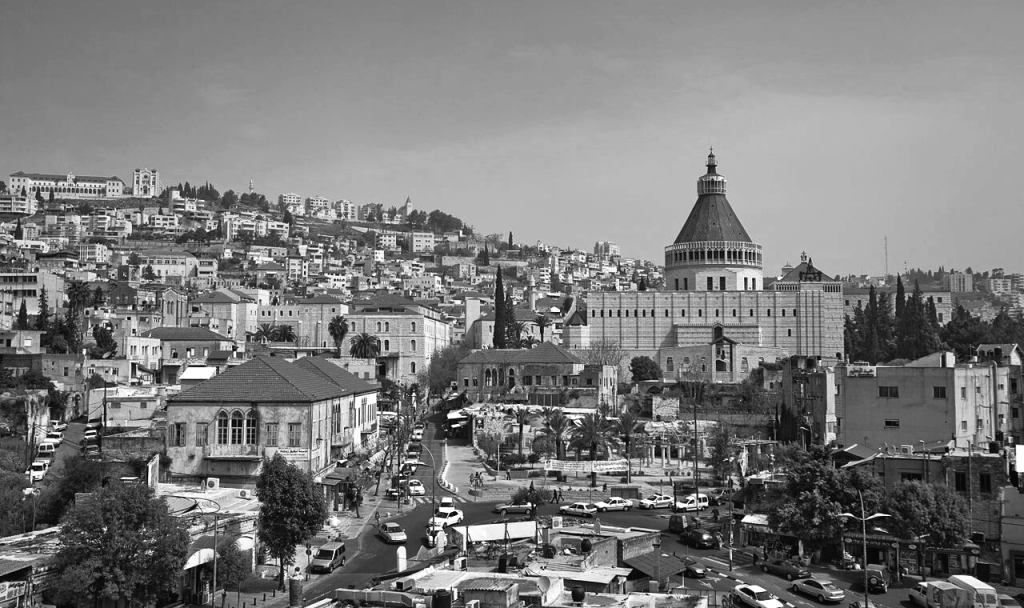
In Latin-Rite Catholicism (and others), today is the feast day of Saint Bartholomew, or Nathanael, the disciple and apostle. The Gospel reading at Mass starts quite simply like this:
Philip found Nathanael and said to him, “We have found him about whom Moses in the Law and also the Prophets wrote, Jesus son of Joseph from Nazareth.” Nathanael said to him, “Can anything good come out of Nazareth?” Philip said to him, “Come and see.” (Jn 1:45–46 NRSV)
The question is one that is often pondered by friends of Saint Charles de Foucauld: “Can anything good come out of Nazareth?”
Nazareth is, of course, Jesus’ hometown. It’s where he lived for thirty-ish years a life in the family, with relatives, with neighbours, and in work. This was before his Paschal suffering and redemptive work. It was prior to any life of preaching and healing. It was even earlier than his desert combat with temptation and the devil. Yet these moments were chosen by God and lived by him, as one day, hour, minute, flowed into the next. They were sanctified. It’s not just the wondrous birth, the Paschal mystery, the mysteries of preaching and healing, and the depths of prayer alone with the Father, and in temptation by the devil, that manifest to us the mystery of Jesus. It’s also the daily humdrum of Nazareth, whatever that may be.
When Nathanael asks, reflecting either a seriousness or a sense of humour about stereotypes pertaining to this little Galilean town, “Can anything good come out of Nazareth?” the answer can’t just be, “Jesus can come out of there,” in the sense that he can emerge from there and leave it behind as something that was, indeed, necessary but better not to think about. The answer has to take into account the good that can come out of living in Nazareth, not just escaping from it.
Comments of Pope Francis
When he set out to open the Synod on the Family, Pope Francis offered a pretty long meditation on the mystery of Nazareth, as well as the place of Charles de Foucauld in its (re)discovery:
Charles de Foucauld, perhaps like few others, grasped the import of the spirituality which radiates from Nazareth. This great explorer hastily abandoned his military career, attracted by the mystery of the Holy Family, the mystery of Jesus’ daily relationship with his parents and neighbours, his quiet labour, his humble prayer. Contemplating the Family of Nazareth, Brother Charles realized how empty the desire for wealth and power really is. Through his apostolate of charity, he became everything to everyone. Attracted by the life of a hermit, he came to understand that we do not grow in the love of God by avoiding the entanglement of human relations. For in loving others, we learn to love God, in stooping down to help our neighbour, we are lifted up to God. Through his fraternal closeness and his solidarity with the poor and the abandoned, he came to understand that it is they who evangelize us, they who help us to grow in humanity.
To understand the family today, we too need to enter – like Charles de Foucauld – into the mystery of the family of Nazareth, into its quiet daily life, not unlike that of most families, with their problems and their simple joys, a life marked by serene patience amid adversity, respect for others, a humility which is freeing and which flowers in service, a life of fraternity rooted in the sense that we are all members of one body.[1]
After the synod had ended, Pope Francis issued his unduly maligned apostolic exhortation Amoris Laetitia, where he returned at one point to the same theme:
The incarnation of the Word in a human family, in Nazareth, by its very newness changed the history of the world. We need to enter into the mystery of Jesus’ birth… We then need to peer into those thirty long years when Jesus earned his keep by the work of his hands, reciting the traditional prayers and expressions of his people’s faith and coming to know that ancestral faith until he made it bear fruit in the mystery of the Kingdom. This is the mystery of Christmas and the secret of Nazareth, exuding the beauty of family life! It was this that so fascinated Francis of Assisi, Theresa of the Child Jesus and Charles de Foucauld, and continues to fill Christian families with hope and joy. (AL 65)
This is one of those places where it is really unfortunate that one of the Holy Father’s teaching and pastoral documents was subjected to media hysteria that tore focus away from the depth of his teaching, its consistency with what the People of God have been thinking and living for ages, and its integration of new Christian insights into old, old truths.
Analysis and themes
Pope Francis designates Nazareth as a mystery or a secret. It would be pointless to think we could exhaust all its meaning, then—either in one blog post or a thousand. A mystery, in the Christian sense, is something that can only be entered into, slowly, more gradually, until we embrace it from the inside, live in it, and are lived in by the Holy Spirit through it. We don’t deplete its meaning, because we can’t encompass the infinity of God.
But what is always fruitful is to try—to give themes a listen, to open little doors here and there, where, by the porosity that characterizes our hearts, we can be permeated by some divine water.
The first theme that I’d point to is that of humility and simplicity. Pope Francis in both passages points out that Nazareth is a school of littleness. The Scriptural language is perhaps kenosis: God “emptied himself” to become one of us, to live a human life, to be there in Nazareth (Phil 2:7). Grandeur, wealth, riches, greatness: in Nazareth, you find them not. After all, if such things were to be found there, what kind of seriousness or humour could lie behind the question: “Can anything good come out of that place?” People believe goodness lies in the homes of the rich, or, as the Gospel puts it, “Look, those who wear soft robes are in royal palaces” (Mt 11:8 NRSV). In Nazareth, while things were not the absolutely poorest and lowest of the poor that Charles de Foucauld, a nobleman who lived through his contemporaries’ extreme devaluation of labour, might have taken them to be, nonetheless they were simple.
A second emphasis of the pope is quiet maturation of the values of the Kingdom. Things take time. As the Holy Father likes to say, time is greater than space (Lumen Fidei 57; Evangelium Gaudii 222–225; cf. Laudato Si’ 178; AL 3, 261; Christus Vivit 297). It is not by imposing a great mental structure on reality that the Kingdom arrives. Its coming is only incremental. Jesus grew in wisdom (Lk 2:52). Even in Someone who is all grace, only one step at a time are the values reaching maturation. How much more slowly for the rest of us! We can let God do his work in us, but time is of the essence—in the exact opposite sense that the phrase is normally used. It’s not essential to rush. It’s essential to wait in patience.
Within the same emphasis, there is, I’d say a second dimension. It’s not just a maturation that takes place. A particular kind of maturation occurs. It’s quiet. There’s nothing boisterous here. We know that for sure because, once Jesus does set out to teach, everyone is surprised. Where’d he get this wisdom? Isn’t he Joseph’s son (cf. Mt 14:54–56; Mk 6:2–3)? What is this? We can quietly live out the Kingdom values without preaching. That’s not to say we must be quiet when the time is right to speak out. Each kairos must be accepted for what it is. Sometimes that means not silence, but speaking. Every age of Jesus’ life can be lived by us, and must to some extent be lived by us, today. Nothing is off the table. But Nazareth itself signals a value of quietness, the gentleness, the deep, divine silence of the Kingdom.
Next there’s the obvious: work. Jesus at Nazareth was a worker. There is sanctification of the act of labouring. Pope Francis has returned to this theme elsewhere: “the Christian spiritual tradition has also developed a rich and balanced understanding of the meaning of work, as, for example, in the life of Blessed Charles de Foucauld and his followers” (LS 125; quoted in CV 269). The origin of course, is contemplation of the mystery of Nazareth. It’s not just by thinking. We also love the appeal of the life of God-made-Man, working.
Alongside work is family. It’s not just Jesus who lives at Nazareth. So do Mary and Joseph. They are a family. Although Charles de Foucauld himself seems to have tried to incarnate the life of Nazareth in ways that, at times, appear rather isolated, alone, or hermetical, in truth Nazareth was a familial reality of some kind. This, then, is where the insight of a Saint Thérèse or a Marcel Văn can be helpful. It’s the whole Holy Family that leads this life, and while we can think about what Jesus did, it’s just as important to attach that to what the family, the community, the larger group did.
Next, there is something that might initially appear odd, but which I’ve been trying to show is part of Pope Francis’ understanding of Christian spirituality: beauty. For the pope, contemplation is united to the taking in of beauty. Both finds human roots in “our God-given aesthetic and contemplative sense” (Querida Amazonia 56). In writing about Nazareth, Francis says we need to be attracted, we need to peer, we need to contemplate, we need to appreciate the beauty in the Holy Family at Nazareth. This is not abstract appreciation of an idea. It’s the reality of those people that catches our heart and mind. We’re drawn in to rest with such a beautiful mystery. Not just doing. Contemplating too. And the object of that contemplation is the beauty of a life lived in a particular, holy way.
Finally—though there is much more in the mystery of Nazareth and, I’m sure, even in the two brief reflections of the pope on Nazareth—one theme that stands out, and which brings a lot to Francis’ papacy, is the question of who evangelizes whom. Charles de Foucauld started by wanting to bring things to people. He had the values. He had the means. He would bring them. But in the end, he learned that in living in Nazareth, it is often we who are evangelized. We’re the ones who learn to be vulnerable, little, poor in spirit, by living alongside those whose spiritual life, even if visibly and institutionally lacking Christ, is richer than ours. Charles learned this when he was sick and nursed back to health. His life changed. He learned better to see Christ in our neighbours, not just as people we can do something to for Jesus’ sake, but as agents of Christ for us. Pope Francis issues the same invitation: “Through his fraternal closeness and his solidarity with the poor and the abandoned, he came to understand that it is they who evangelize us, they who help us to grow in humanity.”
Partial explanation
All this is, of course, a partial explanation of the mystery of Nazareth. The question that Nathanael asks is never exhausted. We never completely say what good can come out of Nazareth, a stage of life which, like all those mysteries of the life of Jesus, is imprinted on us in baptism and the first moment of our faith, but realized now here, now there, under the inspiration of the Spirit who moves where he wills.
Still, it is perhaps presumptuous of us to think that we should be living the other life-mysteries of Jesus most of the time. The Nativity, the Desert, the Public Life, and the Paschal Mystery are big events. But they take a short amount of time. Most of Jesus’ life was just that of Nazareth. Charles de Foucauld is probably right to call Nazareth “the place where most people live their lives.”
So I just end where we started: “Can anything good come out of Nazareth?” Or rather, What other good things can come out of Nazareth today?
[1] Pope Francis, “Prayer Vigil in Preparation for the XIV Ordinary General Assembly of the Synod of Bishops” (October 3, 2015), which can be read here.

 Contemplative in the Mud