
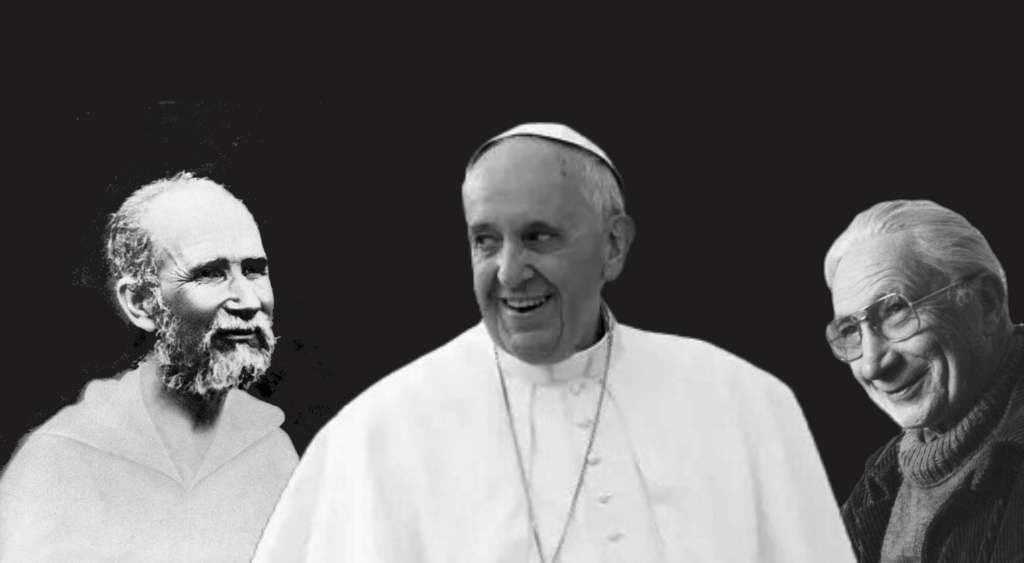
Pope Francis is a great simplifier. When something could be complicated, his usual modus operandi is to see straight to what is essential, without losing the depths.
This is exactly what I think he has done in the case of Christian contemplation, too. Starting from two disparate ideas, both of which are very simple, he comes up with an even simpler idea about Christian prayer.
The first component idea is the one dear to Hans Urs von Balthasar (not to mention Alberto Methol Ferré and numerous others): Beauty goes with truth and goodness. One appeals to the intellect (truth), another to the will (goodness). Beauty is like what is there when you’ve got both together, inseparable. So it’s kind of like what we reach out to and get hooked on when both our mind and our choosing are both active. Truth leads to God, goodness leads to God, beauty leads to God.
The synthesis or conclusion that Pope Francis draws is that contemplation, be it of ecological nature created by God, of Christ in others, or of the Trinitarian persons, relies, on the human or psychological level, on “our God-given aesthetic and contemplative sense that so often we let languish” (Querida Amazonia 56). This truly is a simple, wonderful, Christian view of things.
As someone who has studied so many saints, mystics, and spiritual writers, I am honestly floored by the capacity of the pope to push things so gently towards the essential. This definition is so fruitful, but so dense, yet within the grasp of almost anyone to put into practice (so long as the word “aesthetic” is explained in a non-elitist way, as Pope Francis always takes pain to do—it just means “taking in and appreciating beauty,” wherever it may be found).
What, though, is the missing premise that lets the Holy Father go from the truth–goodness–beauty trio to this astounding and fecund conclusion? The idea of counting beauty as a transcendental and never doing without it is dynamic and compelling. But it is well known. (Von Balthasar may be a prominent proponent of the view, but he is hardly its inventor.) And it certainly lacks the power of associating—or rather, uniting—“contemplative sense” with “aesthetic sense.”
The missing premise comes from Charles de Foucauld
I think the best, but perhaps not the only, candidate for a missing premise comes from Saint Charles de Foucauld, whom we know Pope Francis is strongly devoted to, via René Voillaume, whom we know Pope Francis “read constantly” when studying theology.
The book of Father Voillaume’s that, to my eyes, looks like it has most impressed itself on the Holy Father’s ways of thinking and doing is the one called Retraite au Vatican (“Retreat at the Vatican”), which was translated into English as Christian Vocation.[1] And it is, in fact, in this book (as well as at least one other, later book) that the premise that I’m looking for can be found.
At one point, René Voillaume is trying to explain in as simple a way as possible what Christian prayer is. Now, here both Father Voillaume and his source, Father de Foucauld, aren’t thinking of every possible meaning of prayer. They are focusing on what makes something, as we might say, “mental prayer” or “contemplative prayer.” The definitions or ideas aren’t supposed to draw out all the important features of liturgical prayer, communal devotions, petitionary prayer, or ways of vocalizing prayer. These can go along with the kind of prayer that Fathers Voillaume and Foucauld mean. They’re not absolutely separate things. But the essential nugget that both of them are trying to open up to us is about contemplation.
René Voillaume says of Charles de Foucauld: “to pray, he says, is to think of God and at the same time to love him.”[2]—And here we have it.
On this view, something isn’t prayer if it’s just thinking. Doing theology isn’t prayer. It might become prayer when, in a moment of doing theology, we will to go this goodness, we love it. Then, added to thinking is loving.
An activity isn’t prayer just because it’s loving, either. We might do our daily duties out of love of God, but we aren’t thinking of him at those moments. Calling this “diffuse prayer” or the like is very misleading. It’s actually just love, charity, until some moment strikes us and, as we carry out our tasks for Christian love, we think of God or turn our thoughts towards him. Then, with mindfulness of God added to love, we have prayer.
This is a very deep idea about contemplation. It makes things very simple.[3] As I said before, we would have to nuance this view if we want to capture elements of prayer that are vocal, communal, supplicatory, or liturgical. But as far as the prayer life as it pushes into “mental prayer” or the realms of contemplation, this is pretty robust stuff. It might even account for a distinction between meditative mental prayer—where thoughts are more piecemeal and discursive, moving from one thought to another, more restless—and contemplative mental prayer—where thoughts tend to disappear as conscious objects to be moved around, and the absorption, for however long or short it lasts, is just with the one to be loved. The simpler, even if obscurer, the act of “loving knowledge” or “knowing love,” the more contemplative it is, rather than discursive.
But the fruitfulness of this idea in itself isn’t where I want to draw attention.
Putting the pieces together
Now we have two big, important premises. We have the truth–goodness–beauty trio (e.g., Hans Urs von Balthasar). We also have Charles de Foucauld’s idea of (contemplative) prayer as thinking and loving. I think it is the unique genius of Pope Francis to have combined these two simple ideas into one even simpler idea.
Of course, the simplicity is not without its own details. The simpler idea has what I’ve called a “surface” and a “foundation.” Talk of beauty functions at the surface level of communication; there’s ideas about aesthetic experience. Pope Francis mentions “aesthetic” first, before “contemplative” in his phrase “our God-given aesthetic and contemplative sense.” He talks about the beauty of this and that. Deeper down, mentioned second, is a foundation in what we mean by “contemplation.”
Expressed logically and linearly, the thought process could go something like this:
- Beauty goes together with truth and goodness.
- Truth is what we seek with our intellect.
- Goodness is what we seek with our will.
- So, if you’ve got both truth and goodness being sought, you’re captured by beauty.
- Now, contemplative prayer is knowing God and loving him at the same time.
- So, contemplative prayer is attraction to God as truth and as goodness, at the same time.
- Well, then, contemplation is an appreciation of beauty.
All this just flows from the two main premises: the truth–goodness–beauty trio and the knowing–loving duality of contemplation. I haven’t added anything new here. Just take the two thoughts side-by-side, concentrate hard enough, deduce logically, and you get all this.
To make it more manageable as an idea, Pope Francis condenses and redefines. He looks at things from an anthropological angle. He says, there’s something in us that remains constant from appreciation of beauty (i.e., aesthetic experience) to contemplation (i.e., contemplative experience). The constant must be the same “sense.” It’s “our God-given aesthetic and contemplative sense.” Great. Simplified. No longer complex and complicated, but still very, very profound.
In reality, this “sense” is actually twofold. We have this “sense” when we work two interior “senses” together: knowing and loving, or thinking and loving, or intellect and will, or mind and choosing, or brain and heart—whatever we want to call it. It’s actually the duality that matters. But Pope Francis simplifies. He always simplifies. He just calls it one “sense.”
Utter genius.
A new way forward
I’m someone who has, over the years, tried on a lot of hats in the story of Christian contemplation and spirituality. As such, I think I’m in a fairly good, but certainly not perfect, place to give an evaluation here. My view is this: Pope Francis’ idea is a new way forward. It’s a great lens to try to read the saints and spiritual writers. We could move into original, profitable readings for today.
Pope Francis’ idea can also deal robustly, I think, with ideological deviations from Christian contemplation. Obviously, it is well positioned to respond to notions that would minimize either knowing or loving. Gnosticism (human pursuit of knowledge as salvation) and Pelagianism (human willed, self-realized activity as salvation) are both sent packing. The Holy Father’s framing can also tackle, albeit indirectly, the deviations of anyone who might place (e.g., smells-and-bells) “aestheticism” or “aesthetic relativism” above contemplation of Christ in the people of God. All these errors—and probably many more—are easily and simply debunked with Pope Francis’ view.
But most importantly, we have been given a great tool for focusing our own spiritual life. Know and love. Find beauty—ecological nature (seen with Christ’s eyes), Christ in our neighbours, the Trinitarian persons. Rest with it. Be changed by the experience of beauty. Respond in actions that are consonant with that change.
Praise be to God for everyone who speaks of beauty, for Saint Charles de Foucauld, and for Pope Francis.
[1] René Voillaume, Christian Vocation, with an afterword by Pope Paul VI, trans. Elizabeth Hamilton (London: Darton, Longman & Todd, 1973); Retraite au Vatican, with a preface by Virgilio Levi (Paris: Fayard, 1969).
[2] Christian Vocation, 19; Retraite au Vatican, 73.
[3] Note, for the sake of completeness, that a similar doubling of knowledge and love can be extracted from the Catechism of the Catholic Church: prayer is “a response of faith” and “a response of love” (CCC 2561).

 Contemplative in the Mud