
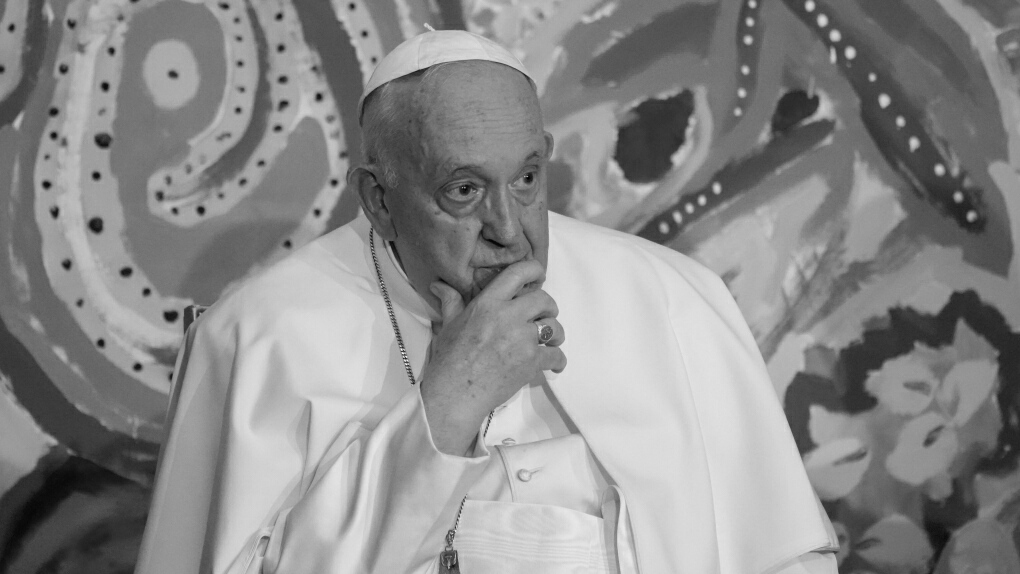
Although I have recently sidetracked to establish the links that Pope Francis has with Charles de Foucauld via René Voillaume, my primary purpose has been a larger exploration of the place of contemplation of Christ in others in the Church’s magisterium. There is a movement in this direction that passes from John Paul II through to Pope Francis, with much greater insistence in the latter.
Ultimately, I want to look at each of the many times Pope Francis has exhorted us to see God at work in the other children of the Father. They are all, I am convinced, fruitful passages, especially for this blog. In order to get there, though, it helps to till up the soil and plant something, or dig deep enough to set a foundation. For instance, what does Pope Francis even mean by the word “contemplation”?
An unlikely source
To my mind, the most illuminating passage comes, not from any text devoted to prayer, or from anything that has been called Pope Francis’ program for his pontificate, or in a document on the call to holiness in today’s world… but in one on social ecology. And even then, it’s not in the better-known encyclical letter Laudato Si’ where we’ll find the useful passage, but in the later post-synodal apostolic exhortation Querida Amazonia (“Beloved Amazonia”).
If one has been sidetracked by ideologues on the left to be disappointed about the issue of viri probati or by ideologues on the right by nonsense about pagan worship, one will have to put aside pre-conceived ideas about the synod on the Amazonian region in order to approach Querida Amazonia gently and fruitfully. But there was always a lot of good stuff in that document. Indeed, some of it is, I think, the most beautiful and helpful in any papal document on any topic.
The passage I have in mind is the following:
Let us awaken our God-given aesthetic and contemplative sense that so often we let languish. Let us remember that “if someone has not learned to stop and admire something beautiful, we should not be surprised if he or she treats everything as an object to be used and abused without scruple” [quoting LS 215]. (QA 56)
For Pope Francis, there is a link between aesthetics and contemplation. Another way to say this is that there is a link between beauty and contemplation; aesthetics is just the appreciation or taking-in of beauty.
In fact, aesthetic appreciation and contemplation seem to be rooted in the same “sense” or faculty within us. The grammar is deliberately singular. Just as the English translation has a singular “aesthetic and contemplative sense,” in what is perhaps the original Spanish we have el sentido estético y contemplativo, and in Portuguese (equally important in the context of Amazonia), there is o sentido estético e contemplativo. The words are put beside each other, and then sourced in the same God-given gift.
Learning contemplation in the context of our common home
Now, obviously, warning lights might go off at the mention of beauty and aesthetics. It needs to be made clear that Pope Francis doesn’t mean an “aestheticism” where snobbish elites indulge in particular, specific, narrowed-down objects of interest. But he does mean a real appreciation of or sitting-down-with something beautiful. This is what he links somehow to contemplation.
We don’t need to infer this for ourselves. The text tells us. The way that Pope Francis connects aesthetics and contemplation makes it, in fact, very clear that any separatist, elitist notions of beauty and appreciation are proscribed. By way of explanation, the Holy Father says:
From the original peoples, we can learn to contemplate the Amazon region and not simply analyze it, and thus appreciate this precious mystery that transcends us. We can love it, not simply use it, with the result that love can awaken a deep and sincere interest. Even more, we can feel intimately a part of it and not only defend it; then the Amazon region will once more become like a mother to us. For “we do not look at the world from without but from within, conscious of the bonds with which the Father has linked us to all beings” [quoting LS 220]. (QA 55)
In other words, if you think that this aesthetic or contemplative engagement of ourselves is going to be something special just for you and the people good enough to be like you: think again! We should be or could be learning it from indigenous peoples, some of the most neglected, marginalized peoples on the planet. This isn’t elitist. It’s the exact opposite. It forces almost everyone to appreciate the gifts of those who live on the peripheries.
Throughout 2020, Pope Francis continued to come back to the notion of “our God-given aesthetic and contemplative sense,” and his way of expressing himself stayed quite constant. On the occasion of the World Day of Prayer for the Care of Creation, he said:
The earth from which we were made is thus a place of prayer and meditation. “Let us awaken our God-given aesthetic and contemplative sense” (Querida Amazonia, 56). The capacity to wonder and to contemplate is something that we can learn especially from our indigenous brothers and sisters, who live in harmony with the land and its multiple forms of life.[1]
Similarly, at a general audience immediately subsequent to the initial pandemic lockdown:
Dear brothers and sisters, “let us awaken our God-given aesthetic and contemplative sense” (Post-Synodal Apostolic Exhortation Querida Amazonia, 56). The prophetic gift of contemplation is something that we can learn especially from indigenous peoples.[2]
In each of these cases, Pope Francis ties this aesthetic and contemplative sense to the indigenous peoples of the world, as he already had tied it to the indigenous peoples of the Amazon in Querida Amazonia. Variants are added. The gift of contemplation is linked now to “wonder” and a manner of “liv[ing] in harmony,” then called “prophetic,” just as it had originally been connected to “love” and “feeling a intimately a part of” a reality.
These are all different notes that are hit. But they seem to make the same chord. In every case, the core of the insight remains the beauty–contemplation link, supported by the fact that our human teachers here can be indigenous peoples, with their ways of living-together-with. They point to some sort of connection between “intimate knowing of beauty” and “loving contemplation.”
Taking things in a more general sense
Pope Francis does not think that the aesthetic–contemplative sense is only doubled up or united in the case of creation, the earth, our common home. He thinks of connecting beauty and contemplation more generally, too.[3]
This can be quickly shown by taking a journey to that other of the highly politicized, ideologically maligned documents of the Holy Father, the post-synodal apostolic exhortation Amoris Laetitia. In fact, Pope Francis says there, the linked aesthetic–contemplative sense applies just as much to contemplation of Christ in others!
Check this out:
The love of friendship is called “charity” when it perceives and esteems the “great worth” of another person [Thomas Aquinas, Summa theologiae I-II, q. 26, a. 3]. Beauty – that “great worth” which is other than physical or psychological appeal – enables us to appreciate the sacredness of a person, without feeling the need to possess it… Loving another person involves the joy of contemplating and appreciating their innate beauty and sacredness, which is greater than my needs. (AL 127, emphasis added)
And this:
The aesthetic experience of love is expressed in that “gaze” which contemplates other persons as ends in themselves… (AL 129, emphasis added)
These are two extracts from a long passage (AL 127–129). The longer passage is, actually, the most detailed, in-depth, and illustrative of the texts of Pope Francis on contemplation of Christ in others. I will come back to it in a later post, for sure. But for the moment, note that in this long passage, the pope does the same doubling. Aesthetics is parked beside contemplation. Beauty is intertwined with contemplation. They go together. They are not—at least not easily—separable.
But why?
Why do aesthetics/beauty and contemplation go together? What idea does Pope Francis have of contemplation such that there is one “God-given aesthetic and contemplative sense”? What developments in his thought led to this manner of conceiving things?
I could be wrong, but I think the answer has two parts. At the surface, and in Pope Francis’ more recent reading and thinking, there are the Uruguayan philosopher Alberto Methol Ferré and the Swiss theologian Hans Urs von Balthasar, especially (at least consciously) the latter. But deeper down, at a layer of personality, spirituality, and thought that Jorge Mario Bergoglio acquired much earlier in life, there is a specific perception of prayer given in writing by Saint Charles de Foucauld, and mediated for the future pope by René Voillaume.
The next post will be about Methol Ferré and von Balthasar on the surface; the one after that about Foucauld and Voillaume in the depths.
[1] Pope Francis, “Message of the Holy Father for the World Day of Prayer for the Care of Creation” (September 1, 2020), 2, which can be read here.
[2] Pope Francis, “General Audience” (April 22, 2020), which can be read here.
[3] We could note that Pope Francis comes back to this theme throughout his book A Gift of Joy and Love (New York: Worthy, 2022). For example, the chapter titled “The Dream of Beauty” mentions “the wisdom of contemplation” in its first sentence. Instead of focusing on this book here, I will content myself to explore the theme in official Vatican documents.

 Contemplative in the Mud