
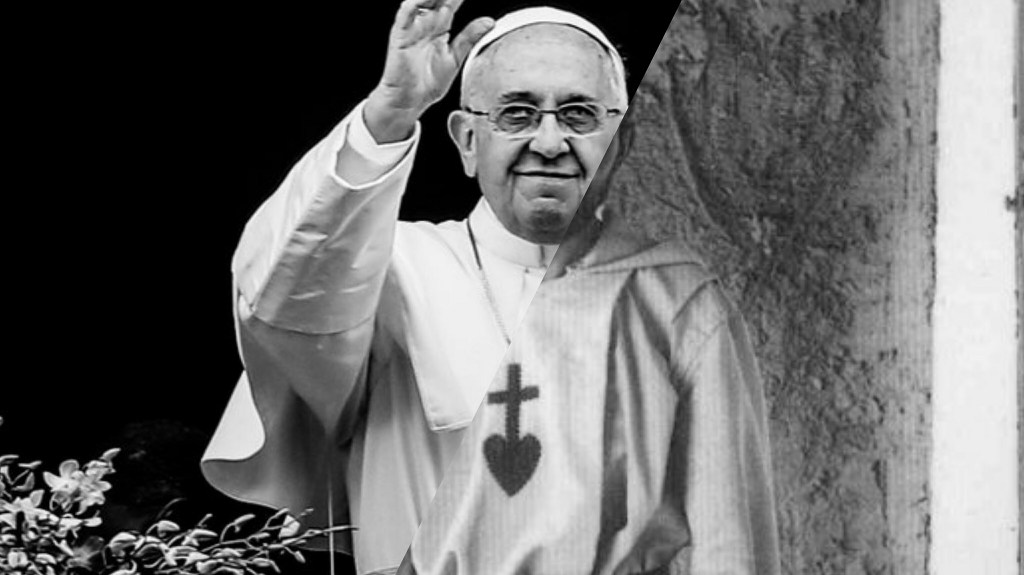
In my last post, I promised an exploration of how Pope Francis teaches about and encourages Catholics to engage in contemplation of Christ in others. There have been 21 discussions of this topic in seven of the pope’s encyclicals and apostolic exhortations—which is to say, an awful lot. I plan to unpack this step by step, over many different blog posts; each of Pope Francis’s references is unique, and most of them flesh out aspects that deserve consideration on their own. There’s a lot of fruit to harvest.
First, though, there’s some digging up of the soil to do. Or, to shift metaphors—there’s a foundation to lay. I think it is vitally important to understand that finding contemplation of Christ in others in Pope Francis’ teaching is unsurprising. Charles de Foucauld has had a considerable influence on the Holy Father’s thought and spirituality.
That Pope Francis has an obvious reverence for Charles de Foucauld and his spirituality seems to have escaped the better intellectual biographies, such as those of Austen Ivereigh and Massimo Borghesi.1 You won’t find a single reference to the saint in those works.
Nonetheless, the influence is very real. I daresay we neglect it to our peril.
Mentions of Charles de Foucauld in official papal documents
The place to start is with the encyclicals and apostolic exhortations themselves. Even when Pope Francis isn’t talking about contemplation of Christ in others, he still often enough ends up mentioning Saint Charles.
The earliest explicit mention is in Laudato Si’, where it is stated that “the Christian spiritual tradition has also developed a rich and balanced understanding of the meaning of work, as, for example, in the life of Blessed Charles de Foucauld and his followers” (LS 125; quoted in the apostolic exhortation addressed to young people, Christus Vivit 269). This is perhaps not so much a question of thinking about Charles himself. I wouldn’t exactly hold up Charles by himself as an example of positive and fruitful interpretation of the place of work in Christian spirituality. His idiosyncrasies can be a bit too much to swallow.
The allusion seems to me more to “his followers,” particularly the Little Brothers of Jesus, Little Sisters of Jesus, Little Sisters of the Gospel, and Little Brothers of the Gospel.2 It is there that whatever Charles intuited about work was first developed in a way that applied to anyone other than himself. This first mention of Charles de Foucauld in Pope Francis’ teaching documents, then, tells us one thing: Charles’ life has to be interpreted, and Pope Francis has certain “followers” in mind that help with interpretation.
The next mention of Charles de Foucauld is much more straightforward. Pope Francis says that he, along with Francis of Assisi and Thérèse of Lisieux, is an example of someone fascinated by the life of the Holy Family at Nazareth (Amoris Laetitia 65). There is a lot that is said in that short sentence, but I don’t want to get into it for now. I have previously discussed similar, but longer, comments from Pope Francis on Charles and the mystery of Nazareth.3
Next comes a direct quotation of Charles. It is about his conversion experience: “As soon as I believed that there was a God, I understood that I could do nothing other than to live for him.”4 The point the pope is making is: “If we realize that God exists, we cannot help but worship him” (Gaudete et Exsultate 155). It seems to me that there are any number of ways to make a point like this one. Including Charles is almost gratuitous. Evidently, the pope wanted to mention him because he wanted to mention him.
The last reference to Charles (up until now!) is the now-well-known conclusion to the encyclical letter Fratelli Tutti. This should be read (or re-read) in full, if one is to truly appreciate the commitment that Pope Francis has to the saint and his spiritual influence:
I would like to conclude by mentioning another person of deep faith who, drawing upon his intense experience of God, made a journey of transformation towards feeling a brother to all. I am speaking of Blessed Charles de Foucauld.
Blessed Charles directed his ideal of total surrender to God towards an identification with the poor, abandoned in the depths of the African desert. In that setting, he expressed his desire to feel himself a brother to every human being, and asked a friend to “pray to God that I truly be the brother of all”. He wanted to be, in the end, “the universal brother”. Yet only by identifying with the least did he come at last to be the brother of all. May God inspire that dream in each one of us. Amen. (FT 286–287)
As Pope Francis points out in a footnote, this is not the first occurrence of Charles’ commitment to being a “universal brother” in a papal document. All the way back in 1967, Pope Saint Paul VI spoke of this, too (Populorum Progressio 263). But he seems to have got the message muffled a little bit; instead of saying that Charles aspired to this state, Paul VI said he earned the title from his contemporaries. Pope Francis is more accurate and thus presents Charles in the magisterium in a sharper light.
We might also add that Pope Saint John Paul II exhorted all missionaries to “universal brotherhood” (Redemptoris Missio 43). But John Paul II doesn’t mention Charles by name here. It’s an obvious allusion for anyone familiar with Charles’ story. But it is left implicit. Again, then, where a predecessor was using what basically amounts to a torch, Pope Francis directs a proper spotlight onto the experience, life, and intuitions of Charles de Foucauld. This speaks, I think, volumes.
Pope Francis is very much at home with Saint Charles de Foucauld. He is comfortable with direct quotation from the saint’s writings, with interpretations of his life events, with selecting from among a history or tradition of interpreters, with diplomatically correcting his predecessors’ slight misrepresentations of the saint’s life, and with drawing attention to Charles’ place in the accumulation of intuitions and expressions in the magisterium itself—not to mention ending an entire encyclical letter with a meditation on the saint’s example. This is truly a person at home with Charles de Foucauld.
The parable of the sheep and the goats
Another thing that shouldn’t be overlooked is the fact that Pope Francis talks about the Parable of the Sheep and the Goats (a.k.a. the Scene of the Last Judgment; Mt 25:31–46) with a style and content that are highly reminiscent of Charles de Foucauld. This part of Matthew’s Gospel is the location of the famous phrase: “Whatever you did to the least of these, you did also to me” (Mt 25:40).
The question on which Pope Francis and Saint Charles sound nearly identical is that of interpreting those key words “the least of these.” In the eyes of dedicated scholars, there may be various ways to interpret just exactly who, in a particular historical context, Jesus or Matthew had in mind as “the least of these.”5
Pope Francis, for his part, is sharp, decisive, and holds nothing back:
Given these uncompromising demands of Jesus, it is my duty to ask Christians to acknowledge and accept them in a spirit of genuine openness, sine glossa [without a gloss].6 In other words, without any ‘ifs or buts’ that could lessen their force. (GE 97)
In fact, the Holy Father has returned to this imperative, saying Christians are “compelled” by these words of the Master (FT 85) and “cannot fail” to take them seriously (Patris Corde 5). He wants our reading to be abrupt and arresting, spurring us to act rightly.
Compare the pope’s meaning, and even his phraseology, to Charles de Foucauld: “What a weighty saying [is Mt 25:40, 45]. It is not there for us to make up commentaries about but to believe.”7 Again—no commentaries, no glosses, just the words of the Master. I think it’s a safe bet that Pope Francis’ idea of “sine glossa” is a direct descendent of Charles’ refusal of “commentaries.” If you compare the way Francis tackles the text to the way his predecessor Benedict XVI did (e.g., Deus Caritas Est 15), it’s evident that Francis has moved in a very “Foucauldian” direction.
A personal account of the influence
Finally, having noted all these references to Charles de Foucuald in Pope Francis’ encyclical letters and apostolic exhortations, I want to get to the heart of the matter. The pope has actually given his own account of the influence of Charles on his life:
And I would also like to thank Saint Charles de Foucauld because his spirituality did me so much good when I was studying theology, a time of maturation and also of crisis. It came to me through Fr Paoli and through the books of Voillaume which I read constantly. It helped me so much to overcome crises and to find a way of Christian life that was simpler, less Pelagian, closer to the Lord. I thank the Saint and bear witness to this, because it did me so much good.8
From this, I think it is essential to draw out a few things: (1) Charles’ spirituality shaped the pope’s thought from an early time. (2) It preserved him from Pelagianism, which Francis identifies as one of the great spiritual temptations of our age (Evangelii Gaudium 57–59; Desiderio Desideravi 17–20, 28); this is no minor addition to his thought. (3) Charles’ life and example came to him filtered or interpreted, as it does for all of us, and those filters or interpreters were Little Brothers Arturo Paoli (whom I don’t have much familiarity with, sadly)9 and René Voillaume (whose writings I know quite well). It would seem that Jorge Mario Bergoglio had personal contact with Arturo Paoli in Buenos Aires, particularly since his books appeared after the future pope finished his years of studying theology in 1969.
Interpreted through René Voillaume
I would stress that Pope Francis speaks of “the books of Voillaume which I read constantly.” He didn’t read Charles’ own writings—at least not assiduously. Books by his contact Arturo Paoli hadn’t yet appeared—so he wasn’t reading those either. He didn’t imagine on his own how to apply the experience, life, and intuitions of the saint—at least not as the primary method of understanding. The legacy of Charles came mediated. If we take the emphasis that Pope Francis places on his repeated reading seriously, the mediator of greatest importance was seemingly René Voillaume (though this should not be taken as exclusive of any existential, lived contacts with the Little Brothers in Argentina).
This is a key point. First, it lines up with the pope’s statements in the encyclicals and apostolic exhortations; as we saw (cf. LS 125; CV 269), Pope Francis is interpreting through the LSJ/LBJ and LSG/LBG lenses—which are lenses that were largely constructed by or with the support of René Voillaume. What a coincidence!
Second, and most importantly, this is a very productive piece of knowledge to have. It lets us understand better—indeed, very well—where the pope is coming from and what his spiritual heritage is. When one knows well the writings of both René Voillaume and Pope Francis, the golden threads start to appear and the reliefs pop sharply into focus. That’s where I intend to go with the next blog post or two.
- Austen Ivereigh, The Great Reformer: Francis and the Making of a Radical Pope (New York: Henry Holt, 2014); Massimo Borghesi, The Mind of Pope Francis: Jorge Mario Bergoglio’s Intellectual Journey, trans. Barry Hudock (Collegeville, MN: Liturgical Press, 2018). ↩︎
- Note in this context that Pope Francis made the unusual move of appointing a Little Brother of Jesus to be rector of Rome’s diocesan seminary. ↩︎
- Pope Francis, “Prayer Vigil in Preparation for the XIV Ordinary General Assembly of the Synod of Bishops” (St. Peter’s Square, October 3, 2015), which can be read here. ↩︎
- Letter to Henry de Castries (August 14, 1901). ↩︎
- See, e.g., Brendan Byrne, Lifting the Burden: Reading Matthew’s Gospel in the Church Today (Collegeville, MN: Liturgical Press, 2004), 194–197; “Matthew,” in José Enrique Aguilar Chiu, Richard J. Clifford, Carol J. Dempsey, Eileen M. Schuller, Thomas D. Stegman, and Ronald D. Witherup (eds.), The Paulist Biblical Commentary (New York: Paulist Press, 2018), 970–971, here 961–962. ↩︎
- Pope Francis, I think, tends to bring out Latin (and/or Thomas Aquinas) when he wants to make a point with, let’s say, a particular crowd. He does it quite effectively. ↩︎
- Charles de Foucauld, Aux plus petits de mes frères. Méditations de 1897-98 sur les passages des Évangiles relatifs à 15 vertus axées sur la Charité (Paris; Nouvelle Cité, 1974), 92, trans. Little Sister Annie of Jesus, Charles de Foucauld: In the Footsteps of Jesus Nazareth (London: New City, 2004), 85. ↩︎
- Pope Francis, “Address of His Holiness Pope Francis to the Members of the Charles de Foucauld Spiritual Family Association” (May 18, 2022), which can be read here. ↩︎
- [A previous version of this article said that I’m not familiar with Fr. Paoli. Thanks to the generous help of reader, I now am. The text has been emended slightly to reflect this. — B. August 9, 2023] ↩︎

 Contemplative in the Mud